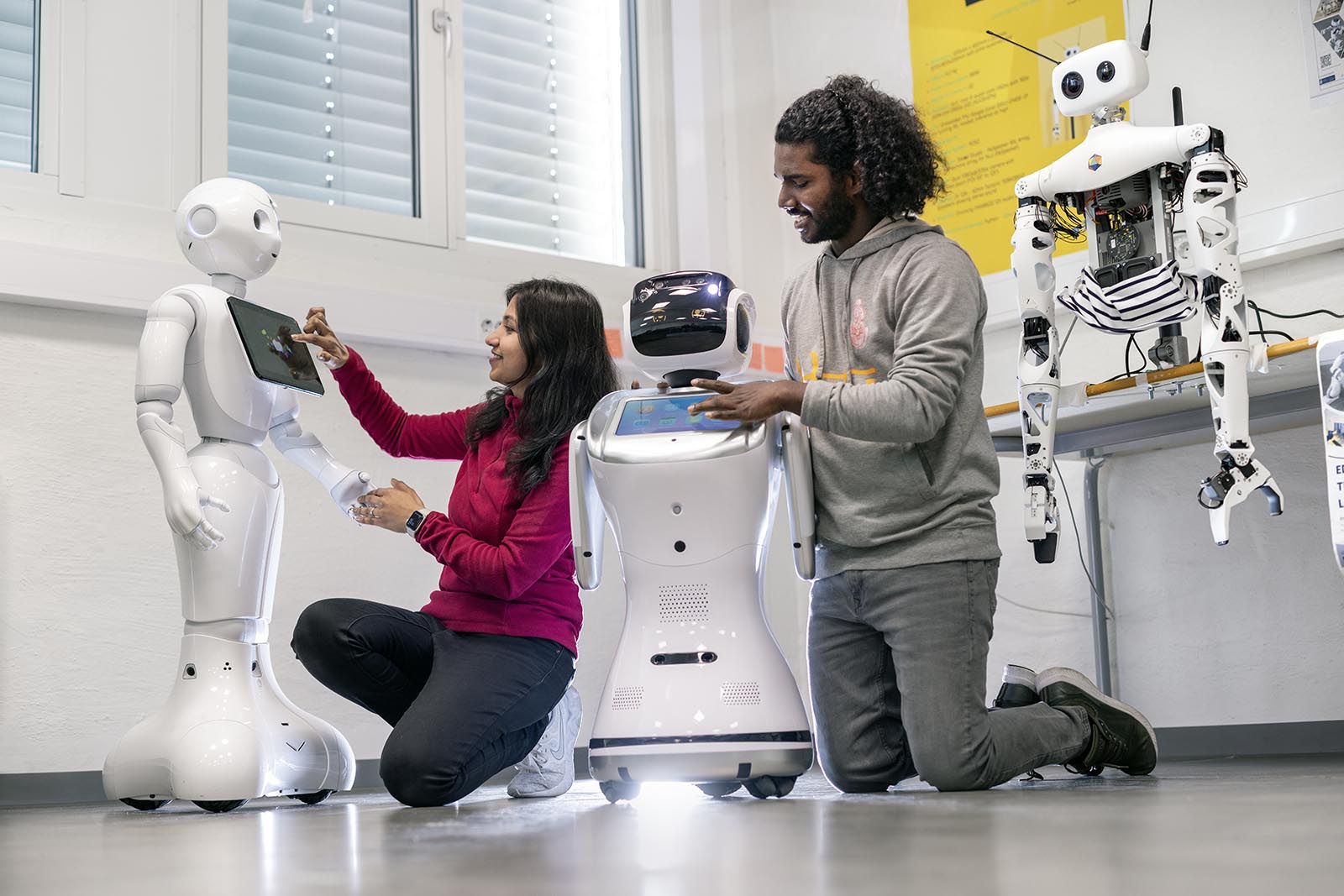
Robots improved student motivation and helped them perform better
When Pepper the social robot was given the chance to try its hand as a teaching assistant, it showed that it can be even better than a human teacher at motivating pupils and helping them learn.
The short version:
- Social robots can in some contexts work even better than a human teacher at motivating students.
- In a new pilot experiment at NTNU, the robot Pepper demonstrated that it can motivate people while they work and inspire them to make an extra effort while trying to solve a difficult task.
- The researchers believe this confirms that social robots can also be used to engage people of various ages in training or games — which in turn can help keep the brain active and healthy.
- Pepper is a humanoid robot designed to interact with humans. It has many movable joints and is full of sensors that allow it to perceive its surroundings and, for example, interact with students in a classroom.
- The research at NTNU is conducted by the Laboratory for Learning Technology in Gjøvik, which explores the possibilities that advanced assistive technology can offer in education and health.
It has a friendly voice and is about as tall as an average 6- or 7-year-old. It moves naturally, and its body and head are full of sensors such as microphones and cameras.
Pepper has now become a household name in the field of humanoid robot research and is currently playing a leading role in a new pilot trial. Preliminary results indicate that robots can effectively help reduce the workload of teachers in schools. They can motivate pupils while they work and inspire them to go the extra mile when struggling with a difficult task. The study shows that in some cases, the robot can even function as a better motivator than a flesh-and-blood teacher.
An inspirer and companion

Professor Deepti Mishra, NTNU.
“Social robots can also be used as a motivator in other contexts. For example, we have observed that they can engage people of all ages in physical and mental exercises. By doing things in a fun and entertaining way, the robot can encourage others to pay attention and take part. It can play games and inspire others to play, which in turn can help keep the brain active and healthy,” said Professor Deepti Mishra.
She led the study, along with Associate Professor Akshara Pande. Both are researchers at NTNU’s Educational Technology Laboratory in Gjøvik. The goal is to explore the opportunities that arise when advanced assistive technology is implemented in education and healthcare. The pilot trial with Pepper was conducted at NTNU, while the data were analyzed by colleagues at Banaras Hindu University in India.
Support for physical and mental training
Challenges can arise in the classroom that pupils need help dealing with – such as academic performance, self-regulation, difficult emotions and motivation.
“When these situations occur, it can be difficult to find a supportive companion at the right time who can help pupils overcome the challenges they face. In this context, it may be useful to explore the use of social robots such as Pepper,” the researchers explained.
- You might also like: Can Pepper the robot be a good playmate?
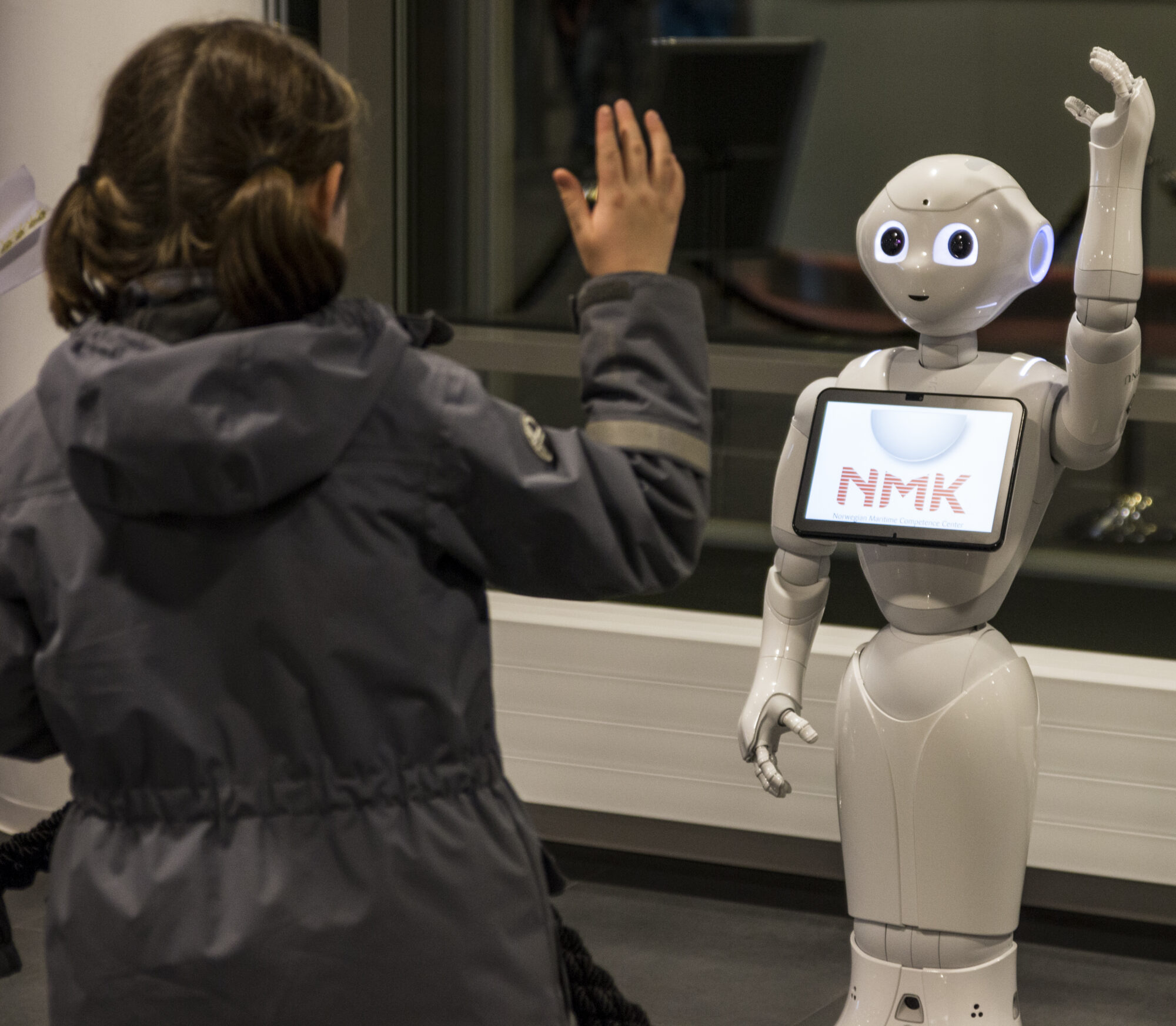
Pepper is about the same height as a 6–7-year-old and designed to interact with humans. Here, human and machine find each other during an event at NTNU in Ålesund. Photo: Sissel Basso.
Designed to interact with people
Pepper was developed by SoftBank Robotics in Paris in 2014. The robot is designed to serve as a personal assistant that interacts with people. It has three wheels that ensure smooth movement, and its 17 body joints make it look both elegant and lifelike. The sensors help it perceive its surroundings, enabling it to interact with pupils in a classroom, as NTNU researchers have now demonstrated.
Tracked eye movements
A total of 15 people aged between 16 and 40 participated in the pilot trial. The task was to find various objects in a series of images, where each image was shown for 10 seconds. The participants had to find objects such as a basket in a forest, a blue car or a flag with specific colours. The participants wore special glasses equipped with eye-tracking technology that ‘detects’ when their eyes pause to focus, move or blink. The technology can also measure the dilation of the pupils and the reactions within them.
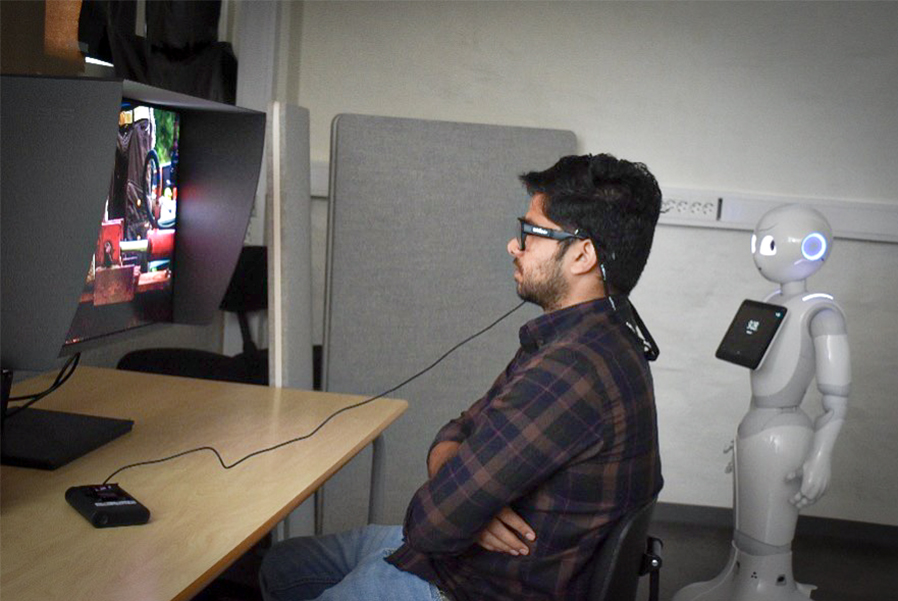
A total of 15 people aged 16 to 40 participated in the pilot study. The task was to find various objects in a series of images. The participants wore special glasses with eye-tracking technology, and the social robot Pepper was present to give them feedback. Photo: Bhanu Shrestha
All of these basic signals form a data stream that can provide insight into subconscious behaviours, such as decision-making, stress, fatigue, attention, memory and other factors. In addition, the signals may indicate whether the participant reacts differently depending on whether the feedback comes from a machine or a human.
A helpful companion
While the participants were trying to spot baskets, flags or blue cars, they received constant feedback from Pepper or a human assistant. To determine how effective the two different assistants were at motivating people, the researchers had to investigate several factors:
Does it make a difference who provides the feedback? What is the outcome if the feedback is negative, neutral or positive? Does the order in which the feedback is given make a difference? And how does all this affect attention and performance?
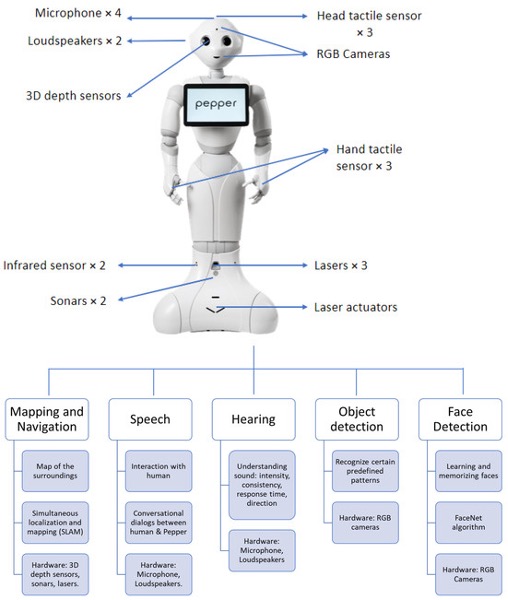
The social robot Pepper can perceive its surroundings through various sensors such as microphones and cameras. These sensors make it possible to assist humans. The five functions covered in this study are: mapping and navigation, speech, hearing, object recognition, and facial recognition.
The robot improves performance

Associate Professor Akshara Pande, NTNU. Photo: NTNU.
“The results suggest that responses from social robots have a greater impact on visual attention than responses from humans. This means it is possible to use them in settings where there is a need to inspire individuals to work more efficiently,” said Associate Professor Akshara Pande.
The study also suggests that, on average, participants performed somewhat better when the feedback came from the robot. However, this was not the case when negative feedback was provided at the end of the task. The results therefore indicate that the order in which the feedback is given is also significant.
- You might also like: Believing that practice makes perfect is most important for success at school
Surprised by the findings
“We had expected human feedback to have a greater impact because people tend to trust humans more than machines,” added Deepti Mishra.
You have shown that constant encouragement from a companion is important for learning, engagement and performance. Could we become overly dependent on technology to perform well?
“Yes, there is a potential disadvantage of becoming too dependent on technology to perform well. It can be compared to situations in which pupils expect teachers or teaching assistants to ‘hold their hands’. We want our pupils to be self-motivated, independent learners who are capable of managing their own learning process. Social robots are not there to replace people. They are tools that can be used in certain contexts for specific tasks. Everything must be monitored and evaluated by humans.”
Can lighten the load – in certain situations
The study ‘Do Social Robots Motivate Students Like Humans?’ highlights that participants may sometimes feel more comfortable receiving feedback and sharing information with a robot than with a human. The researchers believe that social robots can help reduce the workload of teachers. According to Akshara Pande, they may be particularly well-suited for one-to-one learning situations and adapted education.
“But social robots are not there to replace people. They are tools that can be used in certain contexts for specific tasks. Everything must be monitored and evaluated by humans,” emphasized Deepti Mishra.
Human ethics and judgement
Social robots are an emerging field, and considerable research is being conducted into the reliability and responsibility of their behaviour. Deepti Mishra, who has been named one of Norway’s 50 leading women in tech, refers to the ‘Human-in-the-Loop’ principle. This is an approach in which humans are involved in the training, development, evaluation, use and decision-making related to artificial intelligence systems.
The Learning Laboratory at NTNU in Gjøvik — key objectives:
- Seamless collaboration between humans and assistive technology such as social robots and wearable devices in the education and health sectors
- Using artificial intelligence to make human-robot interaction more accessible, engaging, and tailored to the individual user
- Implementing AI and assistive technology, particularly social robots, in the education and health sectors in ways that create positive and engaging experiences
- Developing new technology that enables increased participation and engagement in various contexts
Requires further research
“Human ethics and judgement are essential in ensuring user safety and system accuracy,” Mishra said.
The pilot project included only a few participants, and researchers at NTNU’s Educational Technology Laboratory in Gjøvik view it as a prototype for future, larger-scale studies with more participants and greater diversity among those involved. They recommend conducting a study in which participants can be followed over a longer period of time.
Reference:
Pande, A., Gosala, B., Gupta, M., Mishra, D. (2026). Do Social Robots Motivate Students like Humans?. In: Staffa, M., et al. Social Robotics + AI. ICSR+AI 2025. Lecture Notes in Computer Science(), vol 16131. Springer, Singapore. https://doi.org/10.1007/978-981-95-2379-5_8