The Brain’s Searchlight
Grid cells were supposed to tell the brain only where it was. Now it turns out they also point towards where it wants to go.
For twenty years the grid cell was the closest thing neuroscience had to a fixed point. May-Britt Moser and Edvard Moser found them in the rat brain in 2005, work that nine years later would carry them to the king’s table in Stockholm.
As an animal moves, these cells fire in a beautiful hexagonal pattern that tiles space the way graph paper lays a grid over the world. They were the coordinate system, the load-bearing beam of the inner map, and their geometry was so regular it looked as though someone had drawn it into the brain with a ruler.
Grid cells always reported the same thing. You are here. So punctually that no one thought to ask what else they might have to say.
So it piqued the curiosity when the Moser group reported in early 2025 that grid cells had been keeping a secret. Hidden inside their activity, in slivers of time too small for older equipment to catch, lay a restless motion.
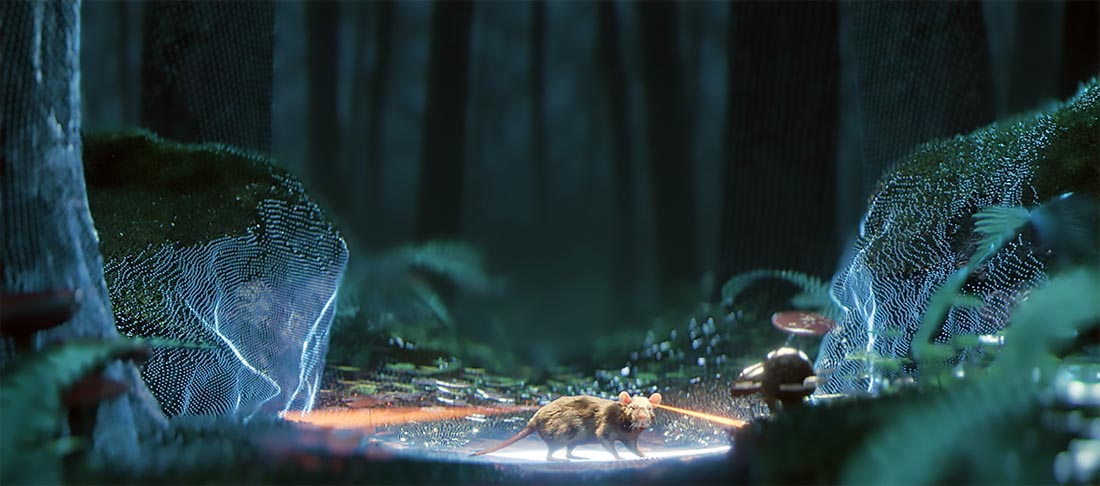
Grid cell sweeps in default mode. Ten times a second they send probes out into the mental map, alternating right and left. The cone stays locked to the animal’s head direction, like the headlights on a car. Illustration from the animated film “The brain’s Searchlight” / Helmet for the Kavli Institute for Systems Neuroscience, NTNU
Ten times a second the cells sent a signal out from the animal’s position and into the surrounding map. First to the right, then to the left, then right again. A metronome. The researchers called these steady probes sweeps, and on their screens they look like the cones of light from a pair of headlamps, shooting out from the head and scanning the terrain ahead of the animal.
It was a beautiful finding. It was also a finding that itched. A metronome is impressive, but it is also stupid. It does the same thing forever.
“We saw these sweeps, which are there all the time, going right and left across the map, very rigid,” says Abraham Zelalem Vollan, the study’s first author, of those early days.
“And then we wondered what they’re used for. What their function is. Is it just something stereotyped that happens automatically with no regard for the surroundings, or are the sweeps actually being used to probe what’s relevant to the rat here and now?”
The fishing rod
You cannot ask a rat what it is paying attention to. All a human being in a laboratory has access to is what the rat actually does. If you want to know what the animal cares about, you first have to make it care about something, and do so in a way that is precise enough to measure.
The solution was almost comically low-tech. They tied a piece of food to a string on a fishing rod and moved it fast and unpredictably across the arena while the rat gave chase. Prey that darts and swerves forces a hunting animal to track it continuously and correct its course as it goes.
The setup gave the researchers something invaluable. At every moment they knew where the rat’s attention was. It was over there, where the food was.
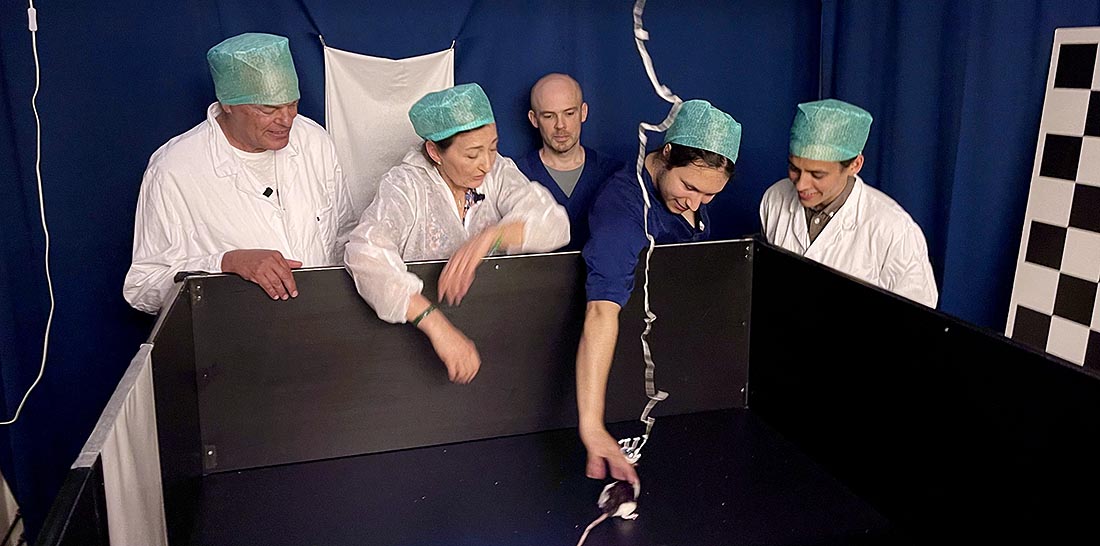
The rat Eskarina is placed in the enclosure, ready to hunt the prey darting around at the end of a fishing rod. Photo: Rita Elmkvist-Nilsen
Now they could look at the sweeps and ask whether they cared.
Vollan describes the workflow: Wire up the rat, run the experiment, let the computer chew through the recordings overnight. Then decode which location on the inner map the grid cells were representing and compare it to where the food actually was.
“It was almost a little too good to be true when we saw it,” he says. “That it actually worked. What happened was exactly what we’d hoped for.”
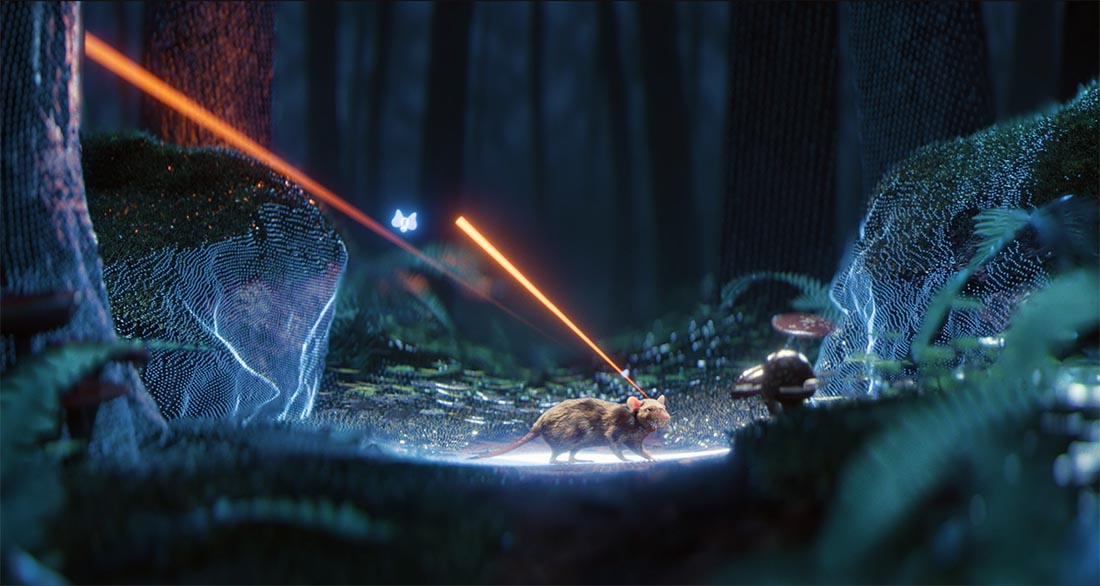
The rat senses a prey behind its back. The sweeps narrow into a focused beam, the rhythm quickens, and the beam breaks free of head direction and point backwards at the prey. Before the animal has begun to turn. The brain has aimed the searchlight where the body has not yet followed. Illustration from the animated film “The brain’s Searchlight” / Helmet for the Kavli Institute for Systems Neuroscience, NTNU
The sweeps stopped behaving like a metronome. When the rat spotted the moving bait, they narrowed from a wide angle to a focused beam, the rhythm quickened, and the beam tore free of the head direction and pointed at the food. Over and over they probed the narrow strip between hunter and prey. The headlamps had become a searchlight.
Attention runs ahead
Now and then, in the middle of a chase, the bait swings suddenly to one side and the rat loses track of it. For a few hundred milliseconds the animal is at a loss. Then it finds the prey again and throws itself forward.
It is inside these pauses that the researchers find what they are looking for. The sweeps have already turned. The beam points at the food’s new position before the rat turns its head to follow.
“You can see that the sweeps are faster than the motor movement,” says Edvard Moser.
We know this about ourselves without having thought much about it. You know where you are going to look a moment before your gaze arrives there. What the recordings show is that sensation made measurable. A signal deep inside the map swings towards something the animal cannot see yet, a beat before the muscles are told anything.
But here Vollan and his colleagues stop, because there is a duller explanation, and it is not easy to dismiss. Perhaps the sweeps do not care about the food at all. Perhaps it is only the brain preparing to turn the body, with the head lagging behind.
In that case they have not found a beam that follows interest. They would have found a twitch in a motor programme. The two explanations would produce almost identical data.
There is only one place to look for the difference. They need the rare moments when the bait swings in an arc behind the rat. Then the animal has to turn its head one way while the food continues the other. And for the first time, prey and movement point in opposite directions.
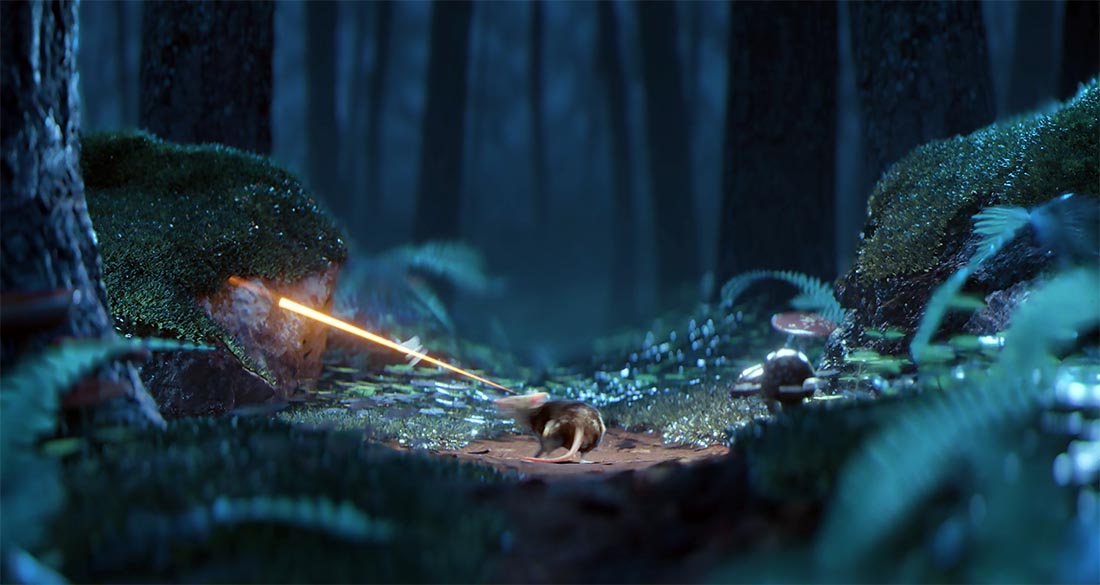
The body catches up. The rat turns and gives chase, the sweeps still locked on the moth. Illustration from the animated film “The brain’s Searchlight” / Helmet for the Kavli Institute for Systems Neuroscience, NTNU
The sweeps follow the food. Clockwise, around behind the animal, cut loose from the head direction. In some cases the rat sits completely still while the inner beam points at the prey’s actual position and not at where the body is about to go. The sweep is not preparing an action. It is pointing at what matters.
- You may also read: For Twenty Years, Grid Celles Kept a Secret
Two rings out of sync
If the beam can break free of the head direction, something must be doing the uncoupling. This is where the discovery, which could have remained a curiosity about grid cells, becomes something more structural. A claim about how the brain is wired.
The classical account of the brain’s sense of direction runs through the head direction cells. These are neurons connected in a ring that behave rather like a compass needle, with the difference that they do not point north but in whichever direction the head is facing.
They are found across large parts of the brain in a great many species, humans included. When the sweeps tracked the bait as it swung around behind the rat, the head direction cells in the thalamusA central hub deep within the brain. It relays sensory information to the cerebral cortex. Some head direction cells are also located here. Together, the thalamus and the presubiculum form key components of the brain’s stable internal compass. and presubiculumA neighboring region of the parasubiculum. The activity of cells in this area always points in the direction the head is actually facing, regardless of what the rat is attending to. went on pointing where the head was facing, indifferent to the food.
The sweeps are steered by a different group of cells, in a cortical region called the parasubiculumA neighboring region of the presubiculum. This area contains cells that encode direction but can detach from the animal’s actual head direction and instead orient toward whatever is currently relevant to the animal. The sweeps originate here.. These cells are also arranged in a ring, and they are also concerned with direction, but with a twist that Moser is careful to phrase precisely.
“It isn’t that this ring overrides the compass,” he says. “There are two parallel circuits.”
“One is the plain head direction compass, bolted to the head axis. The other, in the parasubiculum, “can uncouple from the body’s orientation. That ring can be turned anywhere. The default is that it’s aligned with head direction. When nothing else is going on, it is. But then it can uncouple from head direction and instead couple onto a goal, or a target, or whatever it might be. Those are the ones that steer the sweeps.”
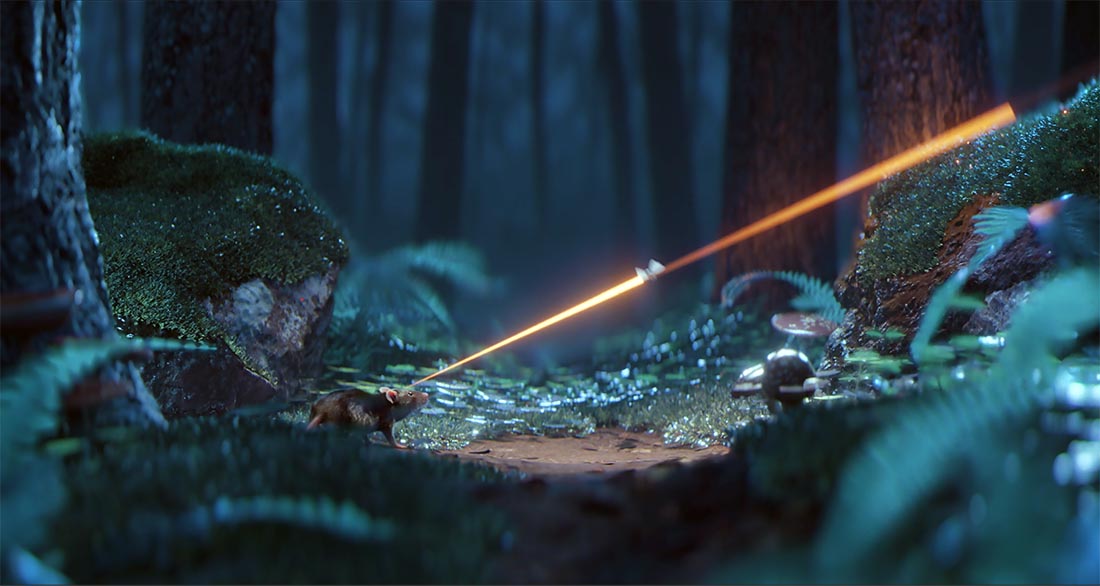
Now both the sweeps and the head point at the moth. Searchlight and body are here aligned in the last moment before the leap. Illustration from the animated film “The brain’s Searchlight” / Helmet for the Kavli Institute for Systems Neuroscience, NTNU
So the architecture is two rings. One is always fastened to the body and keeps track of the head direction. The other is usually fastened to the body as well, but it can tear loose and anchor itself to whatever the animal is preoccupied with. Moser’s own summary is hard to improve on.
“One is always attached to the body. The other is always attached to the mind. Sometimes they overlap.”
Backwards out of the tunnel
A worry hangs over the chase experiments. A piece of food hurtling past is a blazing signal to every sense. Of course the brain lights up towards it. Perhaps the sweep is merely being dragged around by raw sensory information. Impressive enough, but at bottom a reflex. The world pulling the beam along on a leash.
What if the food were not there at all? Vollan spent a long time looking for a moment when the beam swings towards something with nothing outside tugging at it, when the only thing steering it is the animal’s own plan. He describes it as a long series of attempts that did not work.
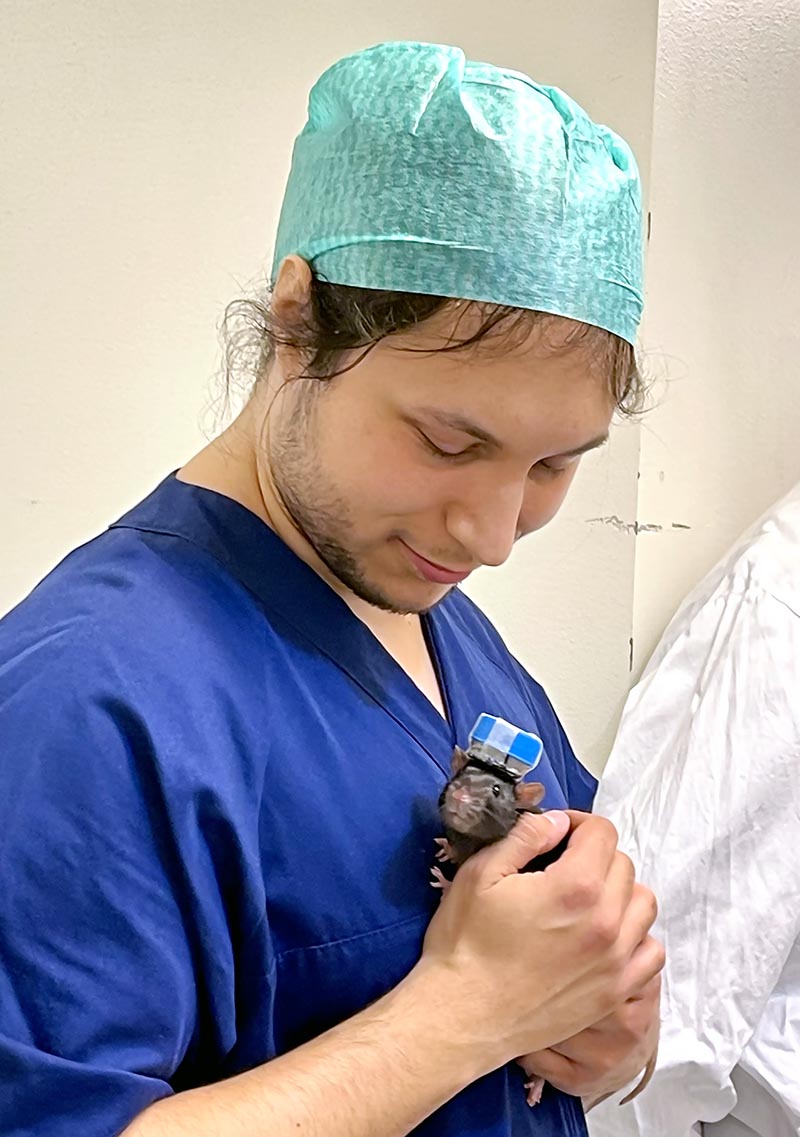
Researcher Michael F. Schellenberger is playing with the rat Eskarina, that is named after a witch. Which felt only right for an animal whose brain turns out to do all its best work on a sweep. Photo: Rita Elmkvist-Nilsen
“I was messing about trying to find a way to get them to walk backwards, or to move them this way and that way,” he says.
He lifted rats, wheeled them around in little carts, kept trying new things. Analyse overnight. Plot the signal. Watch it fail. Back to the lab, try something else.
“You feel your way forward. You do something, then you look at what worked, and then you change it.”
What finally worked was a dead ended corridor with a reward at the far end of it, too narrow for the rat to turn around in. To get out again the animal had to reverse back down the tunnel while its head still faced forward. The behaviour was already there and needed no training. Rats build burrows underground, and moving backwards through tight spaces runs deep in them.
Here head direction and direction of travel part company, with nothing outside to lure the beam. If the sweep is a slave to the senses, it should go on pointing forward, where the head is aimed. If it can be steered from within, by the wish to get out, it should turn.
It turned. The moment before the rat began to reverse, the inner direction signal rotated 180 degrees and locked onto the direction of travel, towards the mouth of the tunnel. The head faced one way. The searchlight faced the other. The body followed the beam.
A brain signal driven not by any outside stimulus but by an intention formed in the mind. Perhaps a message from the frontal lobe that the plan has changed, I want out of here, handed to the mental map to be carried out.
The two experiments point at the same mechanism from opposite directions. The chase shows that it can be driven bottom-up, by sensory input. The corridor shows that it can be driven top-down, by plans and goals. A double anchoring of exactly this kind is what you would expect of a system that has something to do with attention.
Isn’t that what we’re talking about
So I ask Edvard Moser outright. Isn’t this attention?
“I actually think it is a form of attention,” he answers without hesitating.
The paper puts it more carefully. There it is attention-like, and the sweeps are described as a focusing mechanism for gathering information from the surroundings. The distance between those two formulations says something about how high the bar sits in this field.

“In practice you can go a long way towards saying that this is attention. Gathering information from one place means you are not gathering it from another. To choose is to leave out.” Edvard Moser. Foto: Rita Elmkvist-Nilsen
Attention is a demanding concept in the literature. It is not enough to show that the brain gathers richer information from one place. You also have to show the other side of it, that the animal is actively overlooking the rest. That choosing one thing costs you something elsewhere.
A faster reaction where you are watching. Missed events where you were not. Moser mentions the famous experiments in which people counting basketball passes fail to notice a person in a gorilla suit walking straight through the picture. There are fine distinctions here that specialists care about, he says, and then, in almost the same breath, the plain version.
“In practice you can go a long way towards saying that this is attention. Gathering information from one place means you are not gathering it from another. To choose is to leave out.”
Active sensing
No animal takes in the world evenly and photographically. They aim their senses. The rat sweeps its whiskers, the snake flicks its tongue, the dolphin steers its sonar. The closest parallel, and the one the researchers keep returning to, is the bat. It maps the dark by throwing out clicks in an alternating left-right pattern.
As it closes on prey it adjusts the rate, the direction and the width of its calls. It narrows its acoustic attention onto the target. Set that beside a rat’s sweep narrowing onto a piece of food and the likeness is almost uncanny.
The only difference is where the probing happens.
“The bat’s echolocation happens in external space,” says Vollan, “while the sweeps happen in the inner map.”
The brain has taken the trick the bat uses to interrogate the world outside and turned it on its own model of space.
It is tempting to read this as a technical story about navigation. But when an inner map can search, select and follow what matters to the animal, we come close to a much older question. How much of our experience comes from outside, and how much is made within?
The idea that the mind does not receive the world passively but actively shapes experience reaches back to Immanuel Kant. Space and time, he argued, are not things we find in the world but structures the mind itself lays down in order to be able to experience anything at all. Grid cells have long been read as a biological echo of that thought, a coordinate system we carry with us into every new room.
“We have an arsenal inside us,” says May-Britt Moser” – “of inner things. That we can now measure. That’s what’s so exciting about this work, that it’s possible to measure the inner life.”
“Attention contains a great deal of what we now call active sensing,” says Edvard Moser. That is, that you sense from where you need it.
“The finding shows that the sense of place is also subject to active sensing.”
The inner steering is clearest during sleep. The researchers recorded from rats during REM, the phase of sleep in which humans have their most vivid dreams. Nothing comes in through the eyes. Nothing moves. And the map runs anyway. Grid cells trace long paths across the inner map, with sweeps that narrow as the speed increases, exactly as they do during a chase.
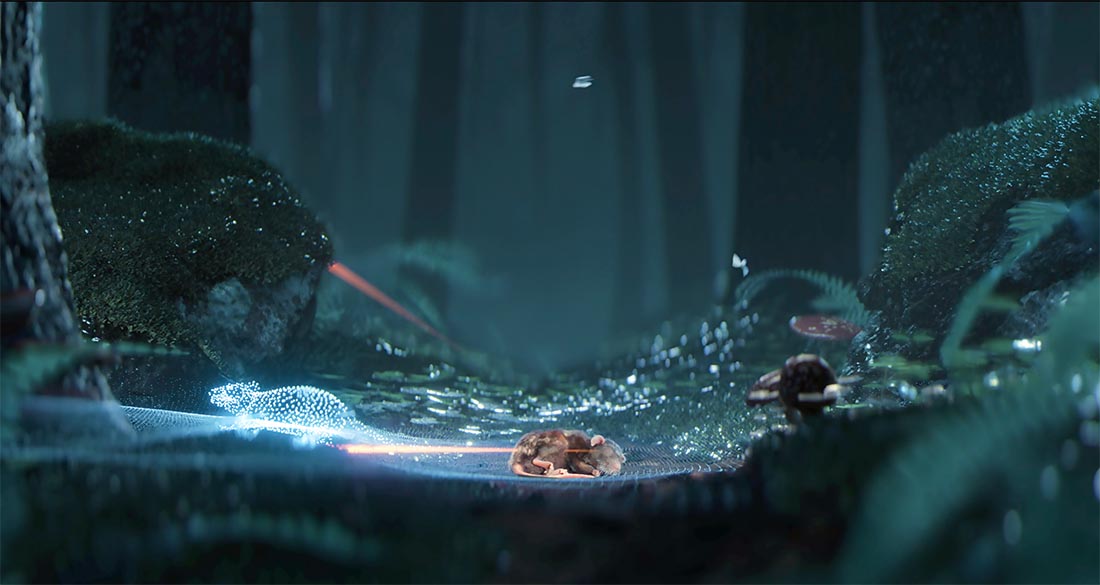
And even in the dreams of REM sleep, when there’s no movement, no world to see, the searchlight still roams. The brain goes on exploring its map, with no physical world to act on. Illustration from the animated film “The brain’s Searchlight” / Helmet for the Kavli Institute for Systems Neuroscience, NTNU
While the drama plays out in the rat’s brain, the body lies perfectly still. Whatever is steering the beam here, it is not the outside world. There is no outside world to act in.
Vollan is careful about what this shows and does not show. The paths do not look like a simple replay of places the rat has been. They may run through places that never existed. *We don’t know* is a phrase he uses often and on purpose.
May-Britt Moser goes a little closer to the edge of the wonder. “You can almost imagine that they’re dreaming they’re out running, or that something is coming up behind them.” And then, more soberly, on why it matters.
“We’re scratching at the door of something. You begin to feel the texture of what’s in there. Something we don’t know.”
- You may also read: Ten years after the Nobel Prize
Something you do
The brain regions this concerns are among the first to fail in Alzheimer’s, and May-Britt Moser knows the question is coming.
“As cells die, holes can open up in the inner map. The delicate coordination of thousands of cells that the sweeps require may be one of the first things to go.”
But she is emphatic that this is speculation.
What she would rather talk about is closer to everyday life.
“A sense of place isn’t something you have. It’s something you do”, she says.
People have come to her convinced they were born without any sense of direction, as though it were a missing organ.
“But a normal brain has the equipment”, she insists.
What is missing lies in the use of it. The habit of noticing stable landmarks and anchoring the mental map to them. She prefers that word, anchoring. An unanchored map floats and slips. A map fastened to something stable is a map you can navigate by.
The person who “has no sense of direction” has usually just never anchored it, often because their attention was somewhere else entirely, on people and animals and everything that moves, rather than on where the roads, the houses and the mountains lie.
“It isn’t a verdict. It’s a recipe. If you think you were born with a poor sense of direction, you have to live with it. If you understand that the map is something you build and fasten yourself, you can do something about it,” she says.
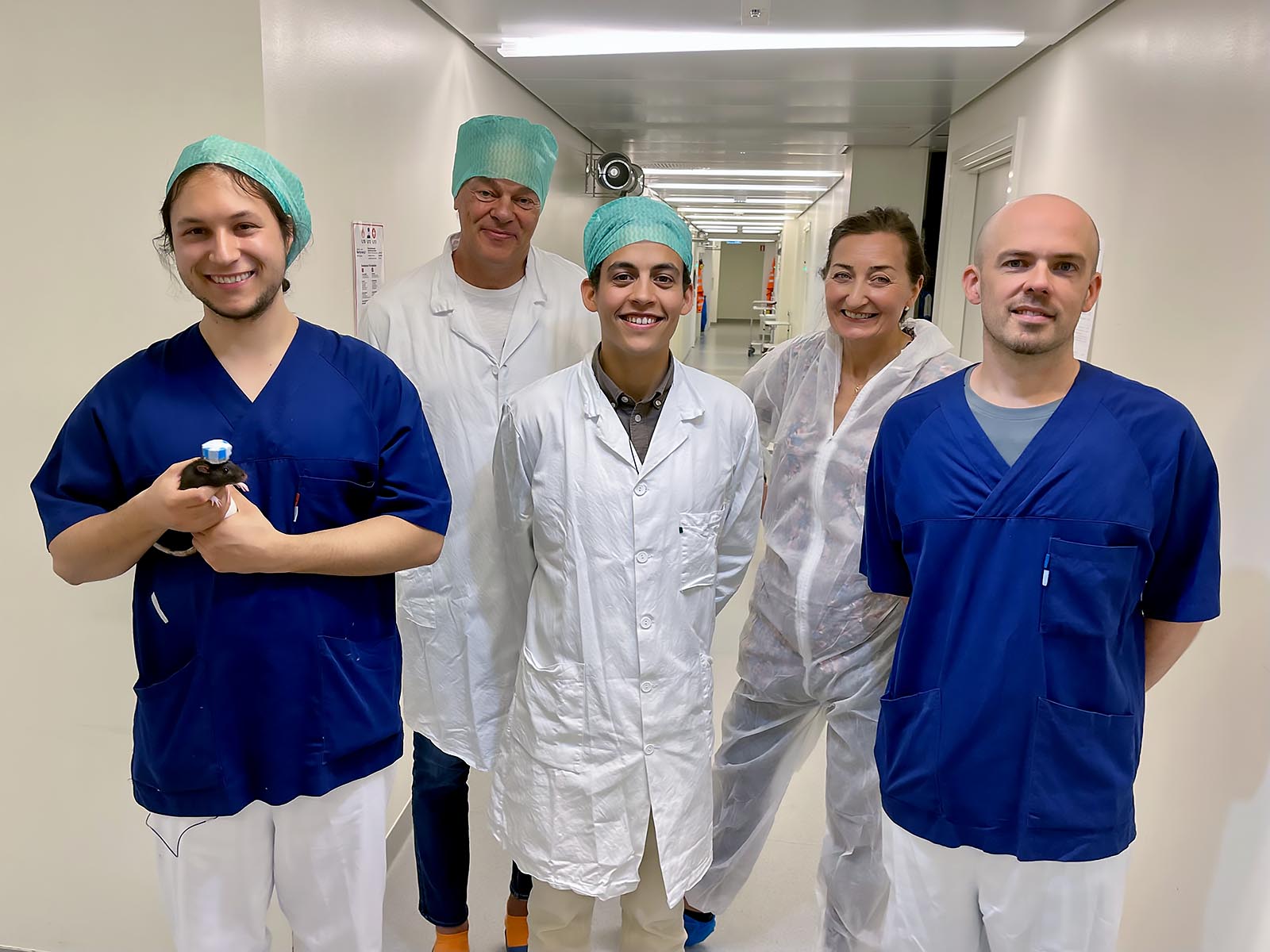
Here is the proud research team behind the discovery, from left Michael F. Schellenberger with the rat Eskarina, Edvard Moser, Abraham Z Vollan, May-Britt Moser, and Rich Gardner. Photo: Rita Elmkvist-Nilsen
And there the two threads meet. The sweeps are how the mental map reaches out towards the world. They are how you relate places to one another, and to yourself. Now we see that they also turn towards whatever preoccupies the animal.
The philosopher’s question is whether we have an inner model of the world or whether we are continually making it through action. The rat answers by refusing to take sides. The map is there in advance. But it counts for little until it is aimed at the world and put to use.
The brain does not merely build a map of where you are. Ten times a second, awake and dreaming alike, it reaches out into that map and points at what matters.
Referance
Abraham Z. Vollan, Michael F. Schellenberger, Richard J. Gardner, May-Britt Moser og Edvard I. Moser: Adaptive modulation of theta sweeps in the brain’s navigation circuit, Science 6. august 2026