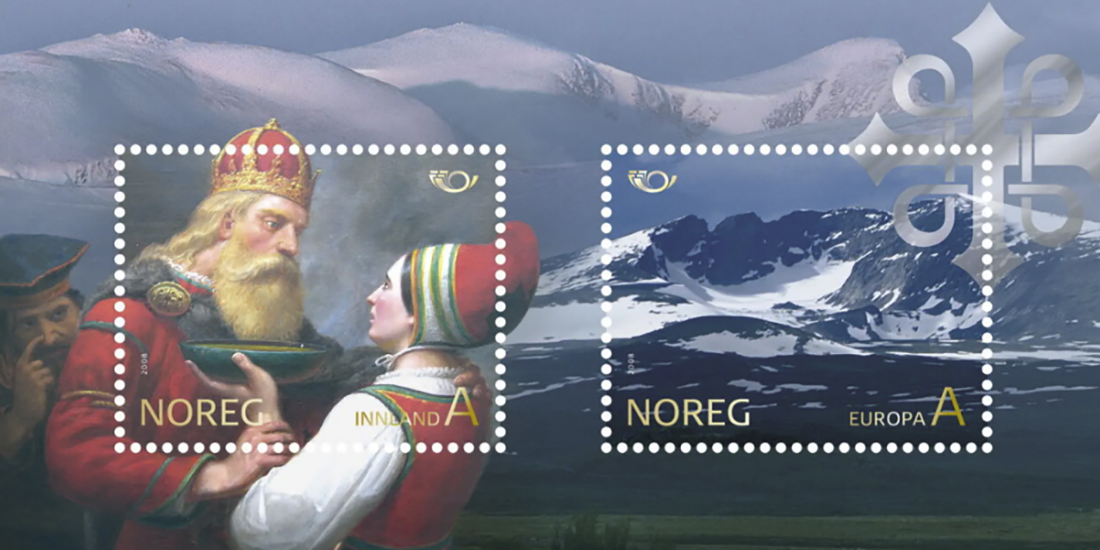
Snøfrid the Sámi: matriarch of Norway’s royal bloodline?
The Norse origin myths include a distinct South Sámi presence, as exemplified by Snøfrid, daughter of the “Finn-king” Svåse of Dovre, who is said to have married Harald Fairhair.
In brief:
Researchers from NTNU have identified clear traces of a South Sámi presence in Central Norway within written sources from the Middle Ages.
Previously, Sámi references in these texts were often dismissed as mere elements of folklore or fairy tales.
The researchers have uncovered clear references to intermarriage and distinct Sámi traces within the genealogies of powerful families from the Viking Age and the Middle Ages.
They have also found Sámi traces within royal lineages.
The genealogies of kings and powerful families during the early Middle Ages considered certain ancestral connections important to highlight, such as that they descended from the gods, that their forebears originated from foreign lands, and that they were related to the Sámi people.
This shortened version is summarized and written by the article’s author, not by AI.
For a long time, some researchers believed that the South Sámi population arrived in Central Norway in the 18th century at the earliest, and that Norwegian farmers were present long before the Sámi. This is known as the “hypothesis of late immigration”.
Now researchers at NTNU have delved into written sources from the Middle Ages and discovered clear traces of a South Sámi presence in Central Norway dating much further back.
Peter Sigurdson Lunga and Emil Mård Vaadal Eliasson, members of the research group Middelalderdidaktikk (Medieval Didactics) at NTNU, confirm this finding.
Both researchers are historians at NTNU’s Department of Teacher Education, and they recently published a special issue of the journal Historisk Tidsskrift (Historical Journal) focusing on traces of the South Sámi from the Middle Ages. Researchers from Germany and the Netherlands collaborated with the NTNU team on authoring several analyses.
Well-documented presence
“A key finding across several of the articles is that a South Sámi presence is, in fact, well-documented in written sources from the Middle Ages. This stands in stark contrast to the ‘hypothesis of late immigration’ that many researchers previously championed,” says Lunga, who leads the research group.
“South Sámi history was a living presence in the consciousness of the learned and the literate population during the Middle Ages. This serves as strong evidence that they were physically present and played an important role,” says Lunga.
What did researchers find?
The texts examined by the researchers originated in Norway, Iceland, and the Orkney Islands, and were written down between the 12th and 14th centuries. The researchers found traces of names and other concrete evidence of the Sámi—including, significantly, references within mythological origin stories.
The narratives concern their ancestry and geographical origins.
The researchers focus specifically on origin stories that highlight South Sámi representation. Previously, the presence of the South Sámi in medieval texts was dismissed as a merely fantastical or fairy-tale element.
- You might also like: Norway’s Sámi population posed an enigma for the occupying Nazis
What do these origin myths reveal?
“The period from 1250 to 1650 is a gap in the research; no systematic study has been conducted regarding the South Sámi during this time. Relevant questions simply haven’t been asked. We’re examining the purpose of these origin myths and what they reveal about the era in which they were recorded,” says Eliasson.
“The Sámi play a central role in these origin myths,” Lunga says. “They appear quite naturally within the written sources.”
He noticed the frequent mentions of the Sámi and concluded that they were likely physically present and perceived as significant. “The Sámi also appear in Icelandic genealogical chronicles because, in reality, they were part of these family lineages,” he says.
Genealogies of kings and powerful clans
Certain traits and kinship ties were considered particularly important in the genealogies of kings and powerful families during the Viking Age and the early Middle Ages. Among the traits that supported a family’s high status were:
- that the lineage descended from the gods
- connections to, and kinship with, the Sámi, who possessed mastery over magic
- ancestors who came from abroad
Lunga writes in his analysis: “…in the 13th century and later, it was believed that a long line of Norwegian and Icelandic noble families had Southern Sámi among their ancestors.” Norse chieftain families could use Sámi ancestry – whether genuine or constructed – to bolster the high status of their lineage.
Eliasson says: “We see clear traces of intermarriage, and several powerful families have distinct Sámi elements in their genealogies. We also see Sámi traces in royal genealogies, such as that of Harald Fairhair.”
“Not that long ago, having a Sámi background was a source of shame in Norway. But during the Viking Age and the Middle Ages, this was something people took pride in,” says Lunga.
- You might also like: English version not found (Sámi names among the stars)
Jotuns and the Sámi
The gods in Norse mythology – called Æsir – lived in Asgard at the centre of the world. On the fringes lay Utgard, where the Jotuns and other supernatural, troll-like creatures resided. When the Norse people projected their religious map of the world onto the real world, they perceived parallels between the peoples and landscapes of their myths and those they encountered in reality:
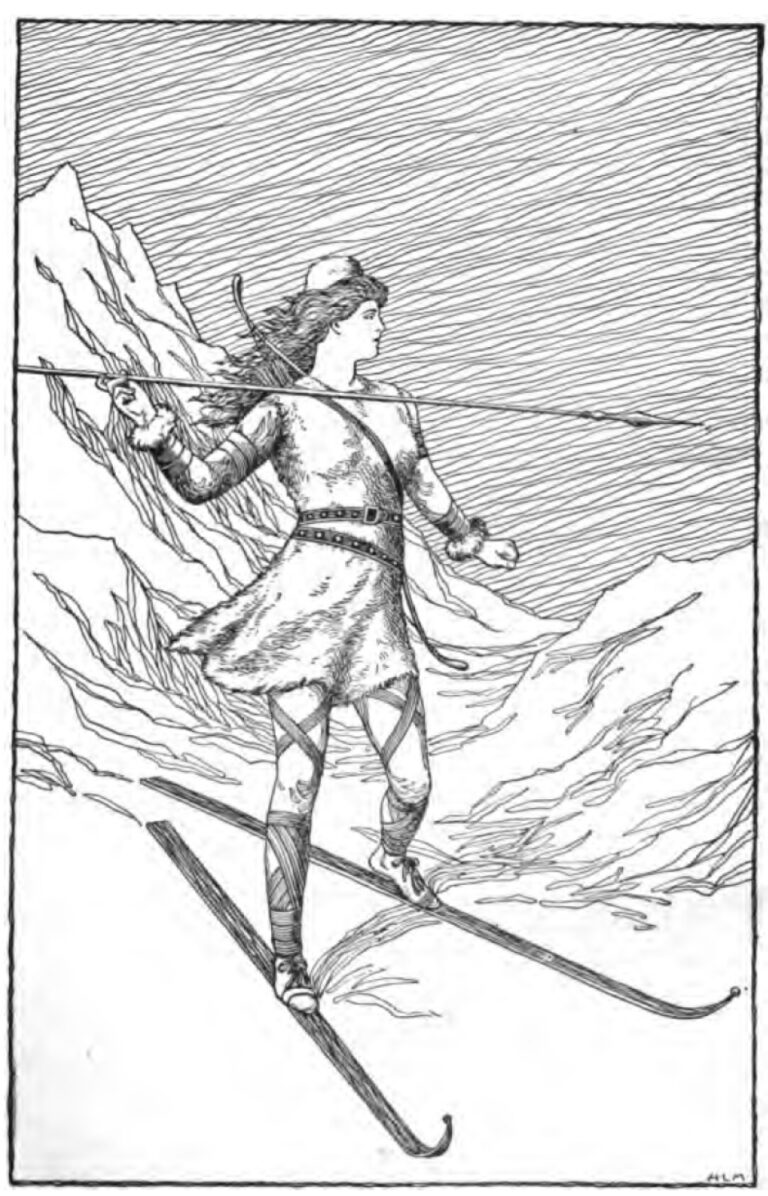
The Jotun woman Skadi was the goddess of skiing and hunting. One theory suggests that Skadi, with her skiing and hunting prowess, symbolizes the Sámi people. The drawing Skadi Hunting in the Mountains appears in Mary H. Foster’s book, Asgard Stories: Tales from Norse Mythology (1901).
The Sámi dressed differently from other Norwegians, and they often lived in outlying areas, like the mountains and high plateaus, much like the Jotuns.
The Jotuns were closely linked to natural forces, such as wind, water, fire, ice, and snow, as well as to supernatural powers. They represented the wild and magical aspects of the Nordic landscape.
Opposition and conflict existed between the Jotuns and the gods, but so did alliances and interactions. The gods descended from the Jotuns, and the world of the Jotuns held knowledge that was vital to the gods.
Because the Jotuns were the ancestors of the gods according to mythology, and because they possessed knowledge of both natural and supernatural forces, the Sámi came to occupy a significant place within these ancestral lineages.
The Sámi represented knowledge of witchcraft and magic, and they also represented an economic resource through their access to skins and their knowledge of making practical and beautiful winter clothing, Eliasson says.
Harald Fairhair and Snøfrid
According to the logic of the myth, Norway’s elite and kings were related to the Jotuns. Old texts sometimes refer to the same person as both a Jotun and a Finn (Sámi ). The Sámi Svåse in Snorri Sturlasson’s saga of Harald Fairhair is an example.
The most famous Sámi character in the Norwegian royal sagas is Snøfrid Svåsedatter, the woman who “bewitched” Harald Fairhair, the first king of Norway, and married him. According to the accounts, she was the most beautiful woman of the time.
Snøfrid’s father was the Sámi Svåse the Finn-king, also referred to as Svåse the Jotun. He lived in Dovre and became the ancestral figure of the Dovre dynasty.
The story is first mentioned in the medieval Ågrip manuscript and later in Snorri’s Sagas. Ågrip is the oldest surviving work in the Old Norse language about the kings of Norway and their genealogies, stemming from the 12th century.
The author, who is unknown, shows good local knowledge of Nidaros and the surrounding area, and events in Trøndelag in central Norway are given more space than events elsewhere.
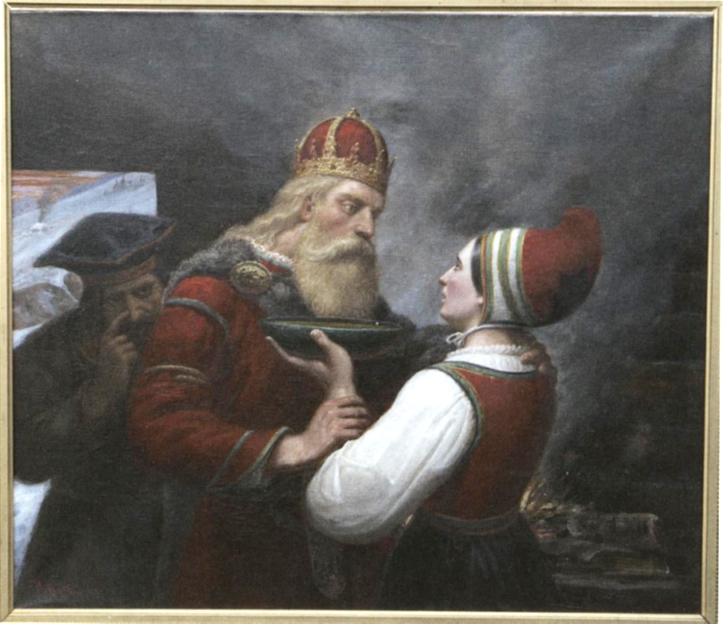
Harald Hårfagre and Snøfrid Svåsedatter. The painting that hangs at Tofte guesthouse in Dovrefjell was the starting point for the Norwegian postal stamp motif.
Brothers Nor and Gor
The Norse origin myth of the brothers Nor and Gor tells the story of how Norway was founded. The brothers are considered the mythical ancestors of the kings of Norway.
The Founding of Norway saga (Fundinn Noregr), relates that the brothers Nor and Gor are descendants of Snø the Old, and of the giant Fornjot who was king of Finland and Kvenland.
The brothers have a sister, Goe, who suddenly disappears. Nor and Gor set out to look for her. Gor heads south via the Baltic Sea and to Denmark, while Nor heads west to Central Norway. Along the way, the brothers conquer a lot of land. They divide the kingdom between them: Nor acquires the mainland and Gor gets the islands.
Nor finally finds his sister Goe with King Rolv in Berget. He is the son of the Jotun Svåse from Dovre. After a duel between Nor and Rolv that neither is able to win, the combatants finally agree on an arranged marriage: Rolv gets Goe as his wife, and Nor marries Rolv’s sister.
Thus, both Nor and his sister Goe are married into a powerful Jotun family in Central Norway.
Nor’s new in-laws, and also his ancestors in the Winter Dynasty in the east, are attributed Sámi characteristics and live in landscapes that have Sámi references: wintry names, connections to distant areas, and Jotun connections. These references have been used to identify Sámi characteristics.
- You might also like: Witchcraft trials in Norway ended in the 18th century
The Dovre Dynasty
Another element that reinforces the Sámi dimension in the myth of Svåse is the connection to Dovrefjell. This area holds a central place in South Sámi history.
Old Norse sources attributed characteristics to Dovrefjell that render the area a kind of “outer zone” beyond civilization – a realm governed by nature and supernatural forces.
At the threshold of Dovrefjell, just a day’s journey from ancient Sámi settlements by Aursjøen lake, Harald Fairhair is said to have hosted the banquet where he met the stunningly beautiful Snøfrid Svåsedatter.
“We can assume that Svåse and his kin represented a Sámi presence in the Dovre region. The myth positions the South Sámi as indigenous to the South Sámi territory,” says Eliasson.
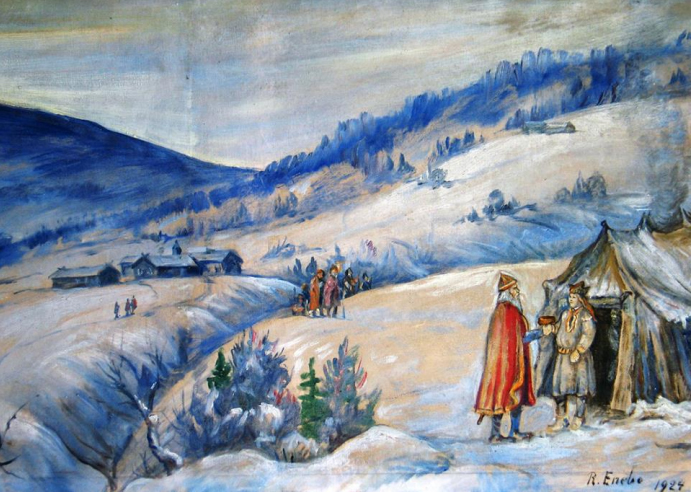
Harald Fairhair in front of the Sámi king Svåse’s gamme, a traditional Sámi dwelling, on Dovrefjell. Painting by Ragnvald Einbu from 1924.
Clues in names
Several personal names suggesting Sámi ancestry appear among the descendants of the “Finn-king” Møttul, who is mentioned in the Landnámabók (Book of Settlements): Finn, Finnvard, Kolfinna, Tind, and Grima.
Møttul appears in Norwegian, Danish, and Icelandic sources. He seems to have occupied a position in the Old Norse worldview similar to that of Svåse: a figure existing outside the Scandinavian kingdoms, yet one who occasionally intervenes through the use of magic.
The Fagrskinna text identifies Møttul as the magic-wielding foster father of “Mother of Kings” Gunnhild (Gunnhild Kongemor), who married the Norwegian king Eirik Bloodaxe.
“Much like Svåse, Møttul is likely not a historical figure; nevertheless, he appears to have played a significant role in the genealogies of Icelandic families, as well as in the lineage of the Norwegian royal dynasty,” says Lunga.
Collaboration with Saemien Sijte museum
“We intend to continue our research and have developed a new project focusing on the South Sámi in the Middle Ages. This is being carried out in collaboration with Saemien Sijte, a South Sámi museum and cultural centre,” says Lunga.
Archaeological discoveries of South Sámi settlement sites date back many centuries and indicate that the Sámi have inhabited these areas since the Middle Ages, if not earlier.
“Numerous finds have been made, such as the remains of traditional Sámi dwellings and hearths; however, many of these discoveries have yet to be precisely dated. Archaeologists state that significant gaps in our knowledge here still exist, but that these could easily be filled if given priority,” says Eliasson.
References:
Lunga, P. S. (2026). Svåse «finnkonungr» fra Dovre og forestillinger om samisk avstamning i norrøne stamtavler [Svåse the “Finn-king” from Dovre and perceptions of Sámi ancestry in Old Norse genealogies.] Historisk tidsskrift, Vol. 105 (issue 2), 125–142, (includes English abstract).
Mård Vaadal Eliasson, E. (2026). Fra satirisk allegori til økonomisk alliansepartner? En revurdering av Snøfrid-tradisjonens opphav. [From satirical allegory to economic ally? A re-evaluation of the origin of the Snøfrid tradition.] Historisk tidsskrift, Vol. 105 (issue 2), 163–178, (includes English abstract).
Wang, S. M. (2026). Samenes sørlige utbredelse i sagaene: Framrykningsteorien som opphavsfortelling og nye tolkninger. [The southern distribution of the Sámi in the sagas: The “hypothesis of late immigration” as an origin myth and new interpretations.] Historisk tidsskrift, Vol. 105 (issue 2), 111–124, (includes English abstract).
Allport, B. (2026). Samer, jotner og det genealogiske landskapet i myten om Nor og Gor. [The Sámi, the Jotuns, and the genealogical landscape in the myth of Nor and Gor.] Historisk tidsskrift, Vol. 105 (issue 2), 143–162, (includes English abstract).