They are single-celled, tiny, and vital to life on Earth. Phytoplankton, which drift freely in the water column, provide food and oxygen for other marine organisms, while consuming CO2 and nutrients – much like plants on land.
Researchers at NTNU have investigated how noise from wind farms affects phytoplankton. This study is part of a larger project examining how noise from wind farms impacts marine life – ranging from the smallest single-celled phytoplankton and zooplankton to large marine animal species.
“We specifically wanted to study the noise generated when wind turbines are in operation,” says Justine Courboulès, a researcher and expert on phytoplankton.
The researchers used a 22-hour underwater sound recording from a wind farm in the North Sea. Four operating wind turbines surrounded the recording apparatus, with the closest one located 300 metres away.
“When the wind farm is in operation, the turbines rotate,” says Courboulès. “The generator and other mechanical components create vibrations that propagate through the structure and down into the submerged turbine section. This produces a characteristic, low-frequency underwater noise.”
Researching underwater sound is complicated
The sound that spreads underwater can be perceived as a steady, engine-like drone.
“There is always natural background noise in the ocean. If you submerge your head, you might just hear a steady hum. But this actually comprises many distinct sounds – from wind, bubbles, waves, and various organisms. If you use a hydrophone to listen more closely, you can distinguish these individual sounds.”

Justine Courboulès is a marine biologist and researcher with NTNU’s PURE WIND project. Photo: Tanguy Soulié
The researchers wanted to observe what happens when the sound from wind turbines is introduced.
“Studying noise is challenging. Typically, we work with plankton cultures in the laboratory, subjecting them to specific stimuli. But sound presents a different set of issues. If you place an underwater speaker in a standard aquarium and play a sound, the organisms living there will not hear the exact sound emitted. The sound reflects off the walls; some frequencies are amplified, while others are dampened,” says Courboulès.
Furthermore, very low-frequency sound does not propagate well within small containers. The wavelength is so long that there is insufficient space for a full oscillation to occur. This makes it difficult to conduct realistic laboratory experiments. Other researchers have experimented using large tanks and specialized sound-absorbing walls, much like those found in a recording studio.
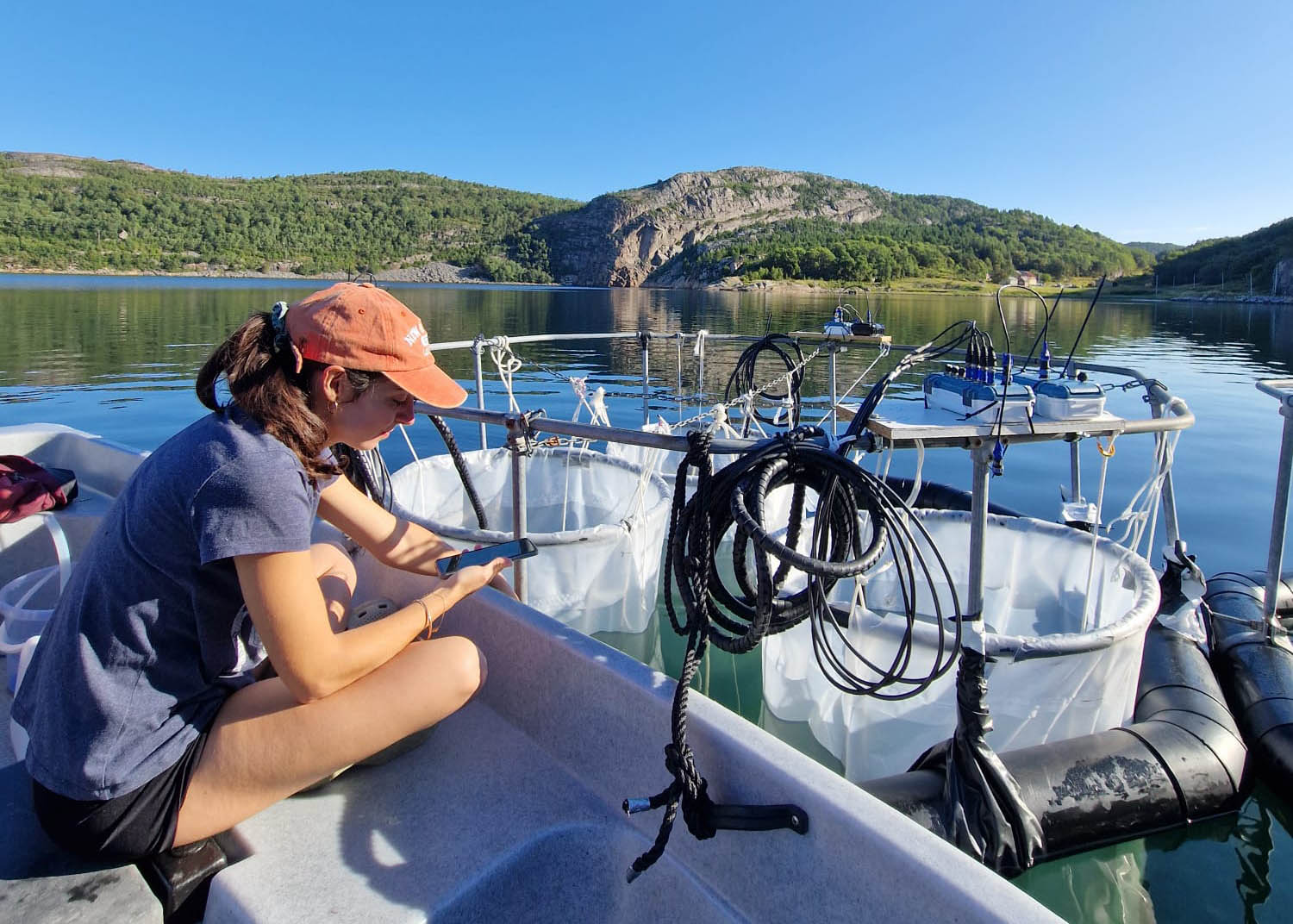
“We wanted to take the research a step further and conduct the experiment out in the natural environment. The challenge was finding a location where we could expose the plankton to noise while simultaneously having a comparable, quiet control area,” says Courboulès.
Some phytoplankton grew faster with the noise
The solution was found in Hopavågen near NTNU’s field station on Agdenes Bay, about 100km west of Trondheim. A large sandbank lies the middle of the bay. The soft sediments dampened the sound to such an extent that it could no longer be detected. This provided the researchers with a control area where the water conditions were identical to those in the experimental area.
During the experiment, the researchers played the recording through an underwater loudspeaker. A few metres from the speaker, the sound level reached 106 decibels, while a few metres further away, it measured 94 decibels. These figures correspond to high and medium noise levels, respectively, measured as underwater sound pressure.
These are sound levels that might be experienced at 500 to 1,000 metres from a wind farm.
“Since sound can travel long distances underwater, this remains a relevant level of exposure. What’s interesting is that we observed effects on the plankton even at these levels,” says Courboulès.
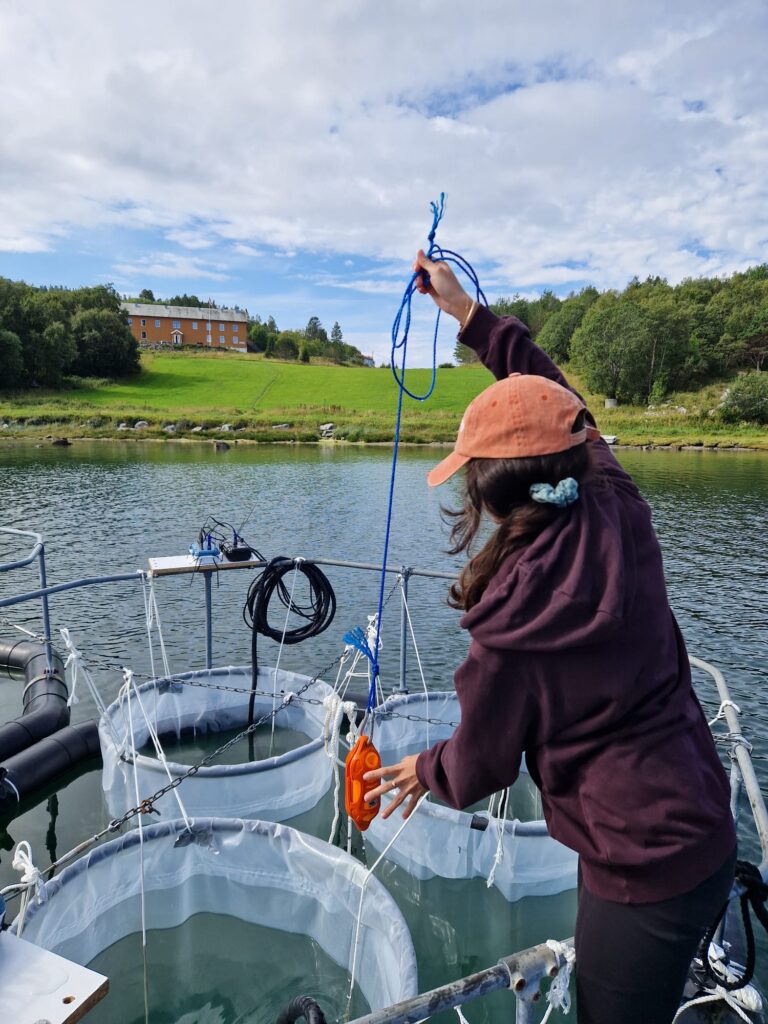
The NTNU researchers have also carried out a more extensive experiment, in which the algae were exposed to noise over a longer period. The results from these experiments have not yet been published. Photo: Nicole Aberle
The results showed that certain groups of phytoplankton grew faster when exposed to noise. The researchers found a marked increase in the chlorophyll b and fucoxanthin pigments, which are characteristic of small green algae and diatoms.
The growth rate, calculated based on changes in chlorophyll b, was 369% higher at high noise levels and 521% higher at medium noise levels. Fucoxanthin – a pigment found in diatoms – showed increased growth of 70% and 81%, respectively.
Expanding the experiments
However, the researchers found no statistically significant differences in grazing by zooplankton during the experiments.
“We might imagine that increased growth in phytoplankton would provide more food for zooplankton, which would, in turn, graze more. However, our experiment lasted only 22 hours. Zooplankton often react more slowly than phytoplankton. So, the fact that we did not observe a clear response in this experiment does not mean that the sound had no effect on the grazers,” says Courboulès.
She does not have an answer as to exactly what causes certain phytoplankton species to respond to noise with increased growth.
“It’s possible that specific combinations of frequency and sound level stimulate cells in a way that affects their metabolism – either positively or negatively.”
The researcher suggest that perhaps different algae have specific frequencies and sound levels at which they grow best – much like how organisms have a temperature range for optimal growth. Beyond a certain level, the effect might weaken or become negative.
“This is a very preliminary hypothesis, however, and not something we have proven. I imagine the responses might have something to do with resonance and how the cells react to vibrations. We don’t know exactly what happens inside the cells, but I believe it is only a matter of time before we understand the underlying mechanism,” Courboulès says.
Other similar studies have found noise to have both positive and negative effects.
“The response appears to depend on the sound frequency, the sound pressure level, and the species being studied.”
Following the publication of the results from this initial experiment, the NTNU researchers conducted a more extensive study, in which the algae were exposed for 18 days rather than just 22 hours.
“In that study, we observed that the grazers also responded. However, these results have not yet been published, so we can’t draw any conclusions just yet,” says Courboulès.
Research:
Courboulès, J., Soulié, T., Rojas, E. et al. Low frequency offshore wind farm noise affects natural planktonic communities during an in situ microcosm experiment in Norwegian coastal waters. Sci Rep (2026).
https://doi.org/10.1038/s41598-026-71531-0