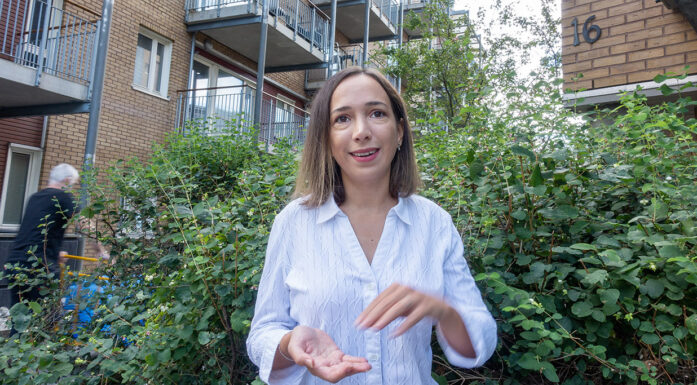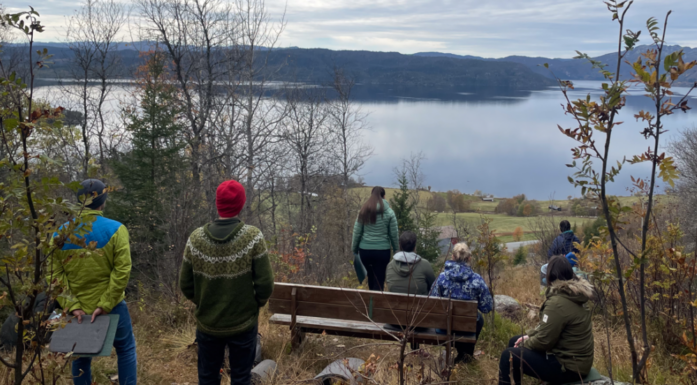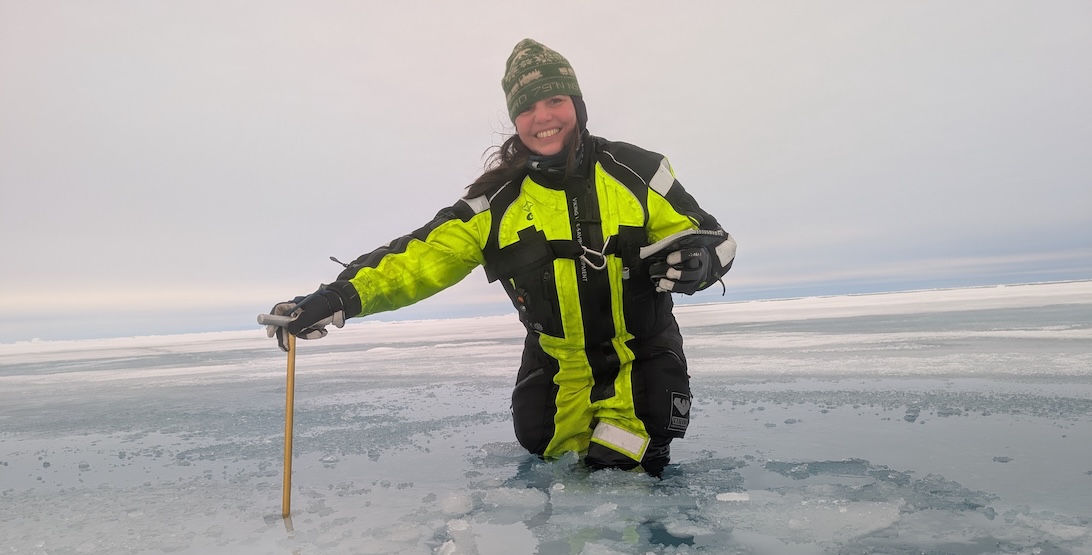
NTNU postdoc Natalie Summers spent 50 days on the Norwegian icebreaker FF Kronprins Håkon, cruising the Arctic Ocean.
She measured photosynthesis and piloted a suitcase-sized surface vehicle, festooned with bright orange floats to collect data.
Natalie Summers. Photo: NTNU
But most of the time, she filtered seawater. Lots and lots of seawater – 1,000 litres all told.
A little tedious, perhaps, but “you don’t go on a seven-week cruise for research, at least in biology, if you don’t like what you’re doing,” she said.
Some of this seawater came from the Arctic seafloor, 4,000 meters down, and from parts of the Arctic that have rarely been visited by Norwegian research vessels.
Seawater has a chemical fingerprint that can show if the water came from the Atlantic, far to the south, or from the Arctic. That information can help researchers gauge the ocean’s ability to capture carbon dioxide from the atmosphere.
The amount and variety of phytoplankton can eventually determine what kinds of food there will be for young fish, like cod larvae.
But what Summers was most interested in was photosynthetic phytoplankton, the tiny organisms that form the base of the food web.

Home away from home: Natalie Summers spent hours filtering seawater with the setup shown to the left. To the right, what a filter covered with phytoplankton looks like after she is done. Photo: Natalie Summers.
Using a technique called hyperspectral imagingphotography that records hundreds of narrow colours of light for every point in a scene, instead of just red, green and blue, so it can reveal what things are made of. , she can identity different kinds of phytoplankton in her filtered samples. That matters because the amount and variety of phytoplankton can eventually determine what kinds of food there will be for young fish, like cod larvae.
- You might also like: Autonomous robots track plankton in the Arctic
Twenty-nine scientists collecting data for 400 people
Summers’ work is just one piece of a huge, decade-long , NOK 2 billion Norwegian research project called Arctic Ocean 2050 (PolHavet2050). Eighteen Norwegian research institutes, including NTNU, are involved.
We aim to make significant discoveries regarding atmospheric and oceanic processes, the structure and function of ecosystems, and human dimensions – both within and beyond the Arctic.
NTNU PhD research fellow Jon Estil Krågebakk was also on the cruise to deploy special cameras to study sea ice. His work focuses on using AI to help autonomous ships navigate waves.
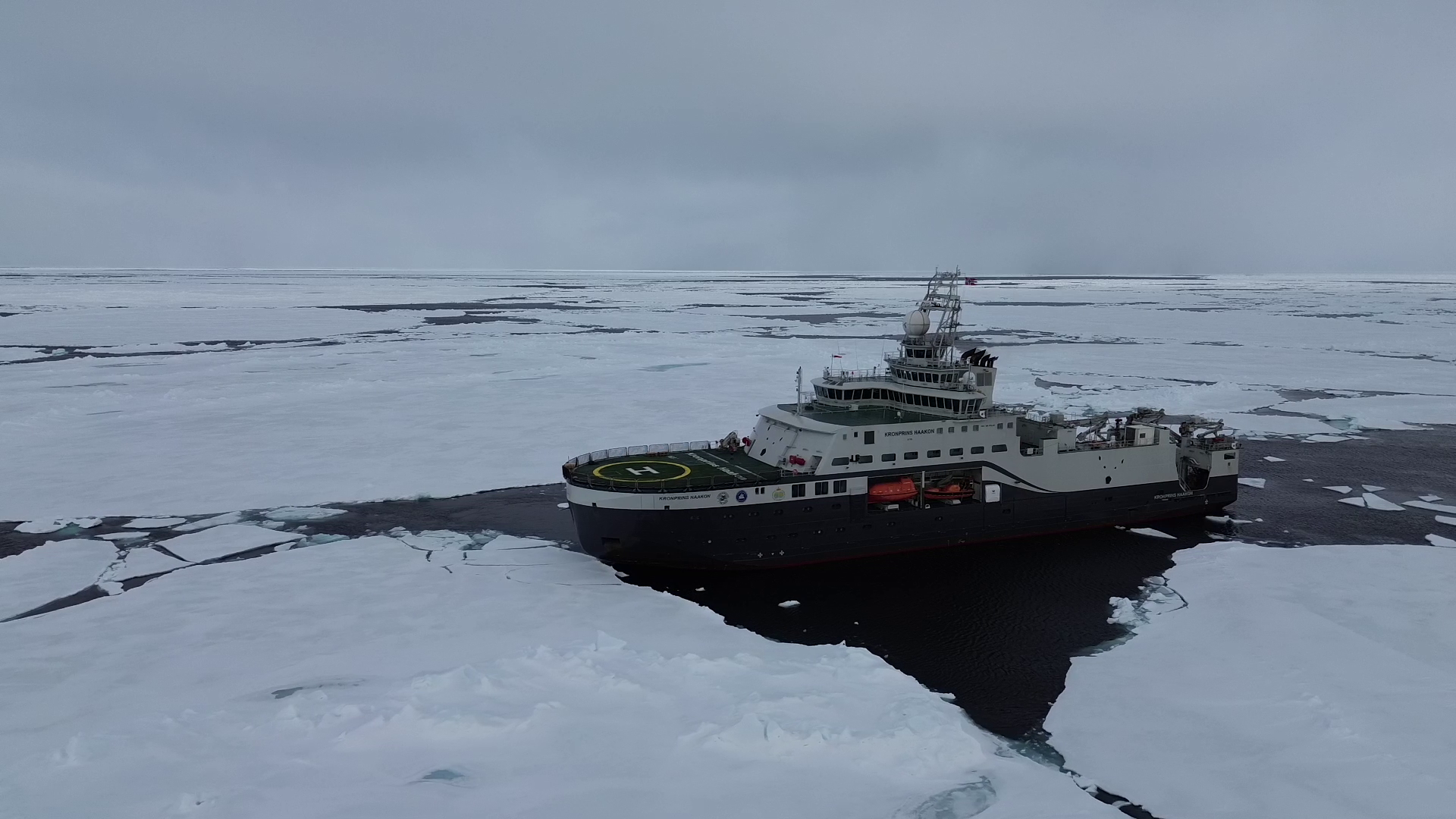
The FF Kronprins Håkon, Norway’s newest icebreaker designed for research, at the North Pole at the end of July, during the first Arctic Ocean 2050 cruise. The cruise report describes little ice cover and said this was only the 5th Norwegian expedition ever to reach the North Pole by ship. Photo. Vegard Stüerzinger, Norwegian Polar Institute.
“Arctic Ocean 2050 is Norway’s largest national research programme,” said Paul Renaud, Arctic Ocean 2050 project leader, in an email. “We aim to make significant discoveries regarding atmospheric and oceanic processes, the structure and function of ecosystems, and human dimensions – both within and beyond the Arctic.”
This cruise was the first of roughly 20 planned over the next 10 years, Renaud said. The 29 researchers aboard this first cruise focused on collecting measurements and samples for later lab analysis – and for use by other researchers who couldn’t join because the ship had limited space.
“With just 29 scientists, we are representing and collecting data for about 400 people in the Arctic Ocean project,” Summers said.
- You might also like: Shedding light on the polar night
Three important, basic measurements
Summers’ main job was filtering water for three important variables, particulate organic carbon (POC), particulate organic nitrogen (PON) and Chlorophyll a. The samples are collected from Niskin bottlesa water sampler, open at both ends, that is lowered to a chosen depth on a cable and then closed so it can bring a sealed sample of seawater back for analysis, long bottles mounted in a ring around a CTD.device that measures salinity, temperature and depth, which can tell scientists where the ocean water they’re sampling has come from. Seawater with its origins in the Atlantic is salty, warm and dense, whereas Arctic water is the opposite – less salty, colder and more buoyant.
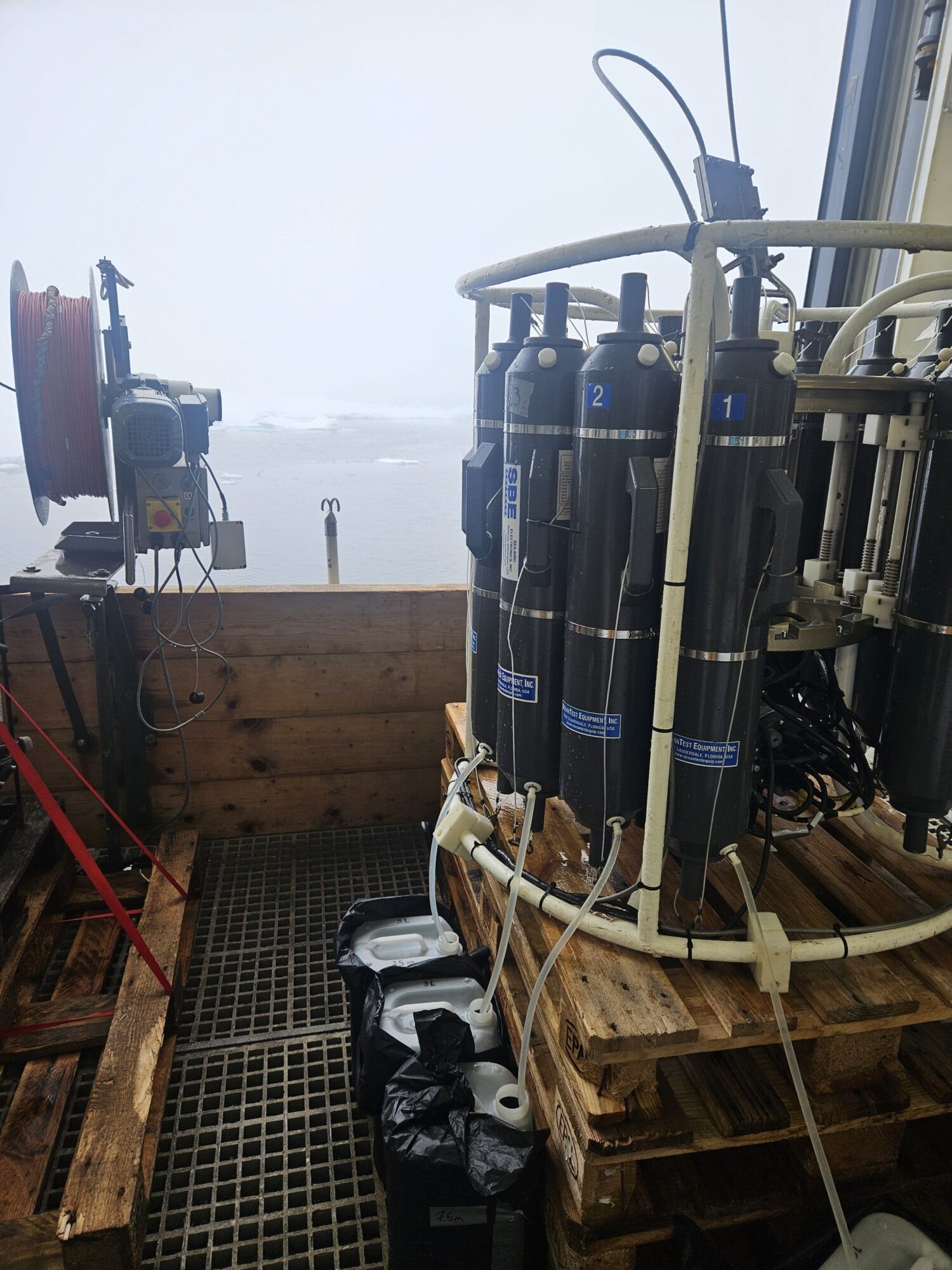
The CTD and its rosette of Niskin bottles, here being drained of their precious seawater samples. The design of the bottles allows researchers to close them at different depths, providing a snapshot of sorts of what’s in the water. Photo: Natalie Summers, NTNU
Samples from the 65 stations and 25 ice stations where the Kronprins Håkon stopped to take measurements will give researchers a 3D picture of the ocean’s layers in space and time. The same goes for Summers’ samples.
“The carbon that’s found in the water column is linked to the biological processes that are in the water column. How much carbon there is versus nitrogen is important,” she said.
Phytoplankton take in carbon dioxide from the atmosphere and turn it into living tissue, food for all, through photosynthesis. When they die, their remains become particulate organic carbon which clumps into particles and sink to the seafloor where bottom organisms use it as food. That’s why the oceans are so important in storing excess carbon dioxide.
Nitrogen is a key nutrient for phytoplankton, so it controls how much they can grow, and in turn how much carbon the ocean can absorb.
Together, the three measurements show how much phytoplankton there is and that they “are photosynthesizing, they’re making oxygen, they are capturing carbon. They are active. They’re not just particles,” explained Summers.
The measurements are so fundamental that nearly every researcher on the cruise can use them.
“But that’s also going to be interesting to put my own work in context,” she said.
- You might also like: Observing marine life from the seabed to space
A hyperspectral world
Here the fundamental role of phytoplankton runs into a knotty scientific problem: how do we measure how much phytoplankton is out there in the Arctic?
The Arctic Ocean is huge, and in places covered with ice. Some is thick multiyear ice, some is thinner, first-year ice, with open ocean in between.
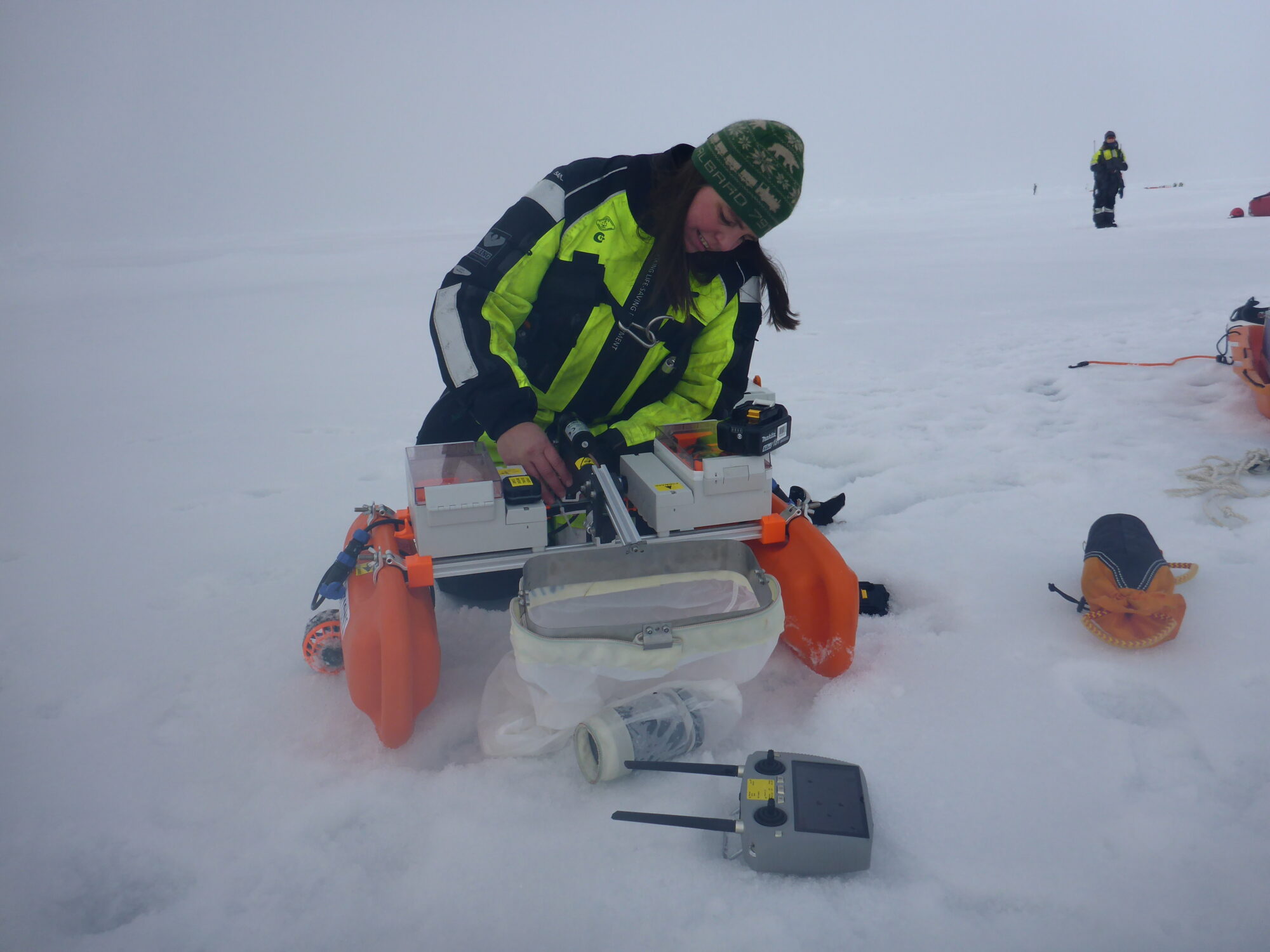
Natalie Summers works on the uncrewed surface vehicle called Pamela, invented being commercialized by two NTNU researchers. She used it in several ponds to take samples and take hyperspectral images. Photo: Morven Muilvijk, Norwegian Polar Institute
Each offers phytoplankton and ice-algae a different place to live. Changing ice conditions “will change the whole dynamic of life,” Summers said.
Summers’ PhD and now postdoc look for better ways to track what’s in the Arctic over time using hyperspectral sensors, which take point measurements, and imagers.
Her work can help lay the foundation for interpreting hyperspectral images taken by satellites or drones, so that researchers can see how much plankton is there and where it is located.
These organisms have to find strategies to survive the polar night. And how they survive, and where they stay is still sort of unknown. We have some clues, but we don’t know.
Now she’ll use different hyperspectral methods to look at the samples she filtered for phytoplankton.
“What other information can we get from these (hyperspectral) signals? Can we get health information? Not just are they there, but are they active photosynthetically? How good is their machinery working?” she said.
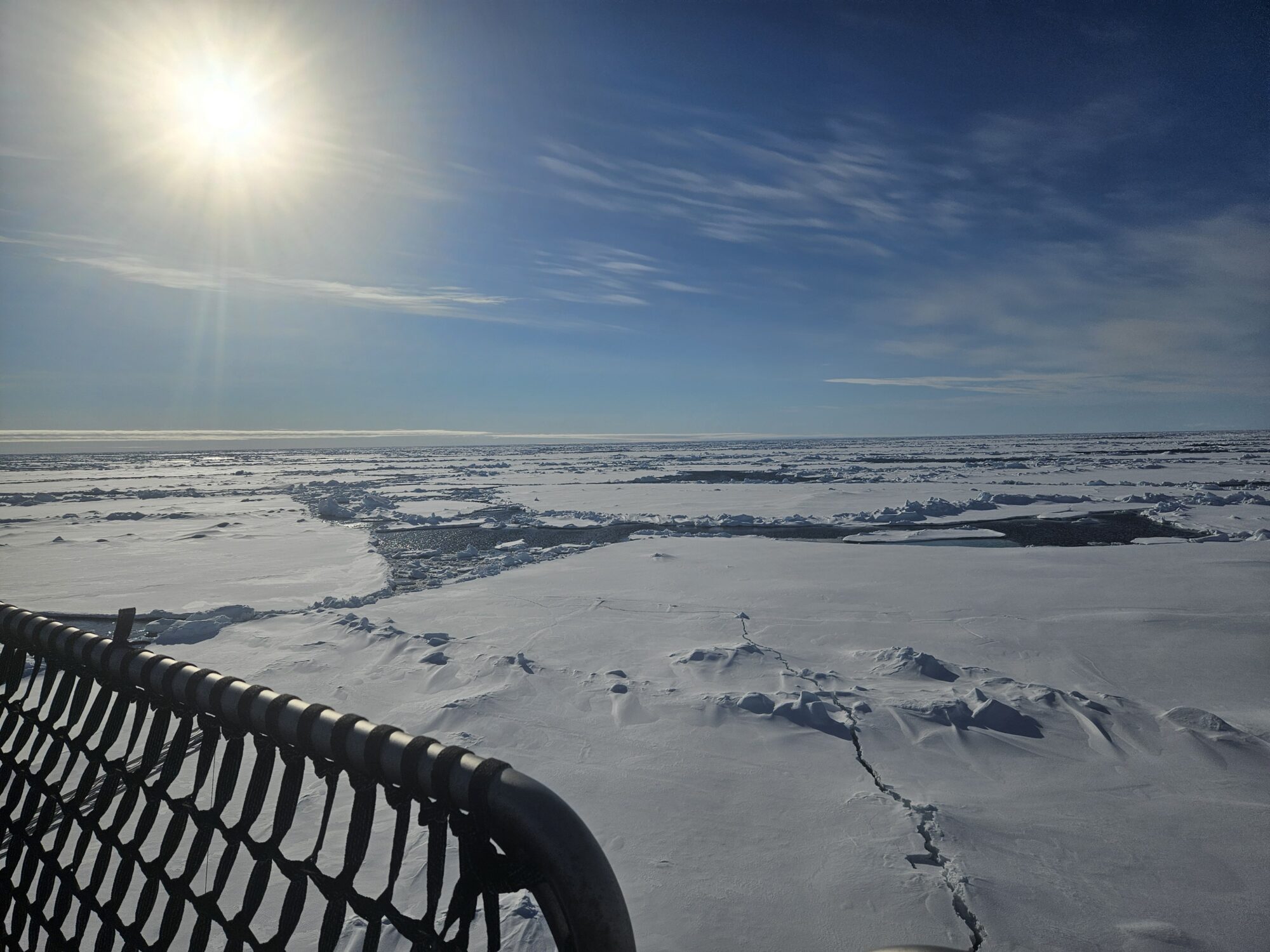
View of the essentially ice-free North Pole from the deck of the Kronprins Håkon. Photo: Natalie Summers, NTNU.
- You might also like: “Pamela” makes studying the ocean easy and affordable
Cold, dark and poorly known
Phytoplankton can grow in a layer on the ice or in the water itself, but they face many challenges, Summers said.
“It’s such an extreme environment, not just that it’s cold, but it’s dark half of the year. So these organisms have to find strategies to survive the polar night. And how they survive, and where they stay is still sort of unknown. We have some clues, but we don’t know. It’s a very important habitat, but it’s one where biological side has not been studied that much,” she said.
Combining all these measurements with her hyperspectral imaging could give her an larger picture of what’s going on.
“I can try and make links between all these different measurements to get an overall picture and see what I can get from the optical signature. It’s a balance between what are the minimum things we need to measure to get an overall idea of how healthy the phytoplankton are,” she said.
New technologies like hyperspectral imaging, drones and underwater remotely operated vehicles are speeding up what researchers can learn about this remote, important place, she said.
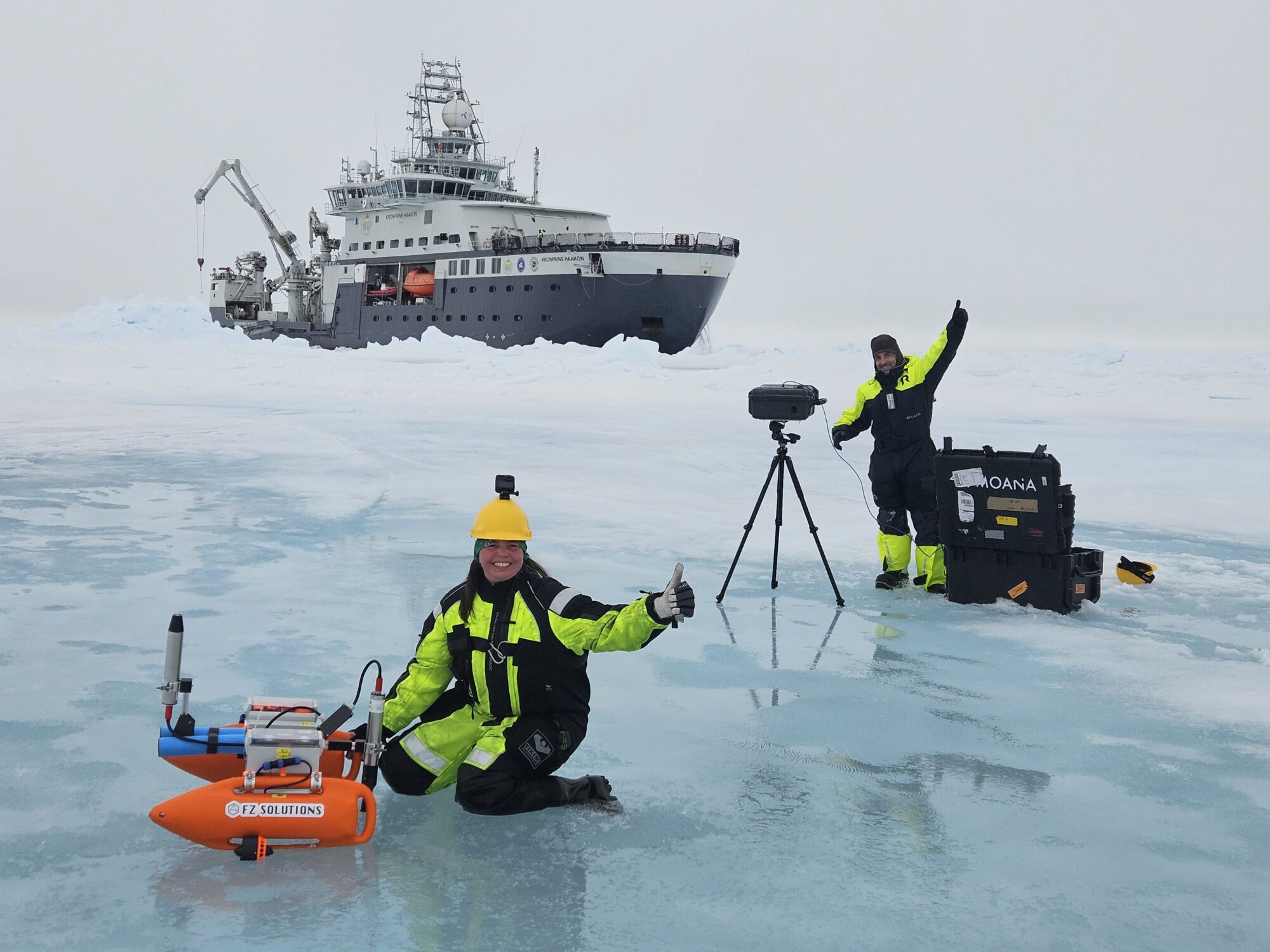
Researchers on ice – or more accurately, in a meltwater pond on the ice. Photo: Natalie Summers, NTNU
In an academic publication from earlier this year, Summers described how she and her colleagues sent a small remotely operated vehicle into the sea ice during a 2021 cruise in the northern Barents Sea. The ROV carried a hyperspectral camera that looked straight up at the underside of the sea ice and captured the colours of light passing through it, in very fine detail. That, along with samples taken by divers and subsequent laboratory analyses suggested that it could be possible to tell different types of algae apart based on the colours of light that pass through the ice.
Her work during the Arctic 2050 project helps build on these findings.
“Now we’re at the right time to use these evolving technologies, and we need trained biologists to help make sense of the data,” she said.
References:
Summers, Natalie Maria; Bremnes, Jens Einar; Liu, Hongbo; Løvås, Håvard Snefjellå; Moreira Fragoso, Glaucia; Johnsen, Geir. (2026) Assessing Arctic under sea-ice light regimes and ice algal bio-optical properties using ROV-based hyperspectral imaging. Polar Biology. 49:23. https://doi.org/10.1007/s00300-026-03462-5
Eurasian Basin Transect 2026 Cruise Report
Polhavet Arctic Ocean 2050 Report Series, 5/2026
https://doi.org/10.7557/ph.8944