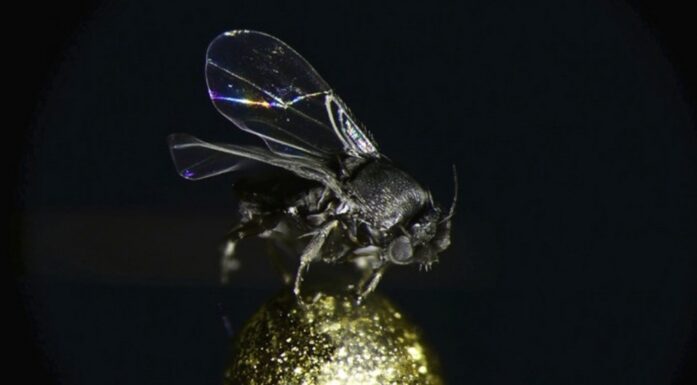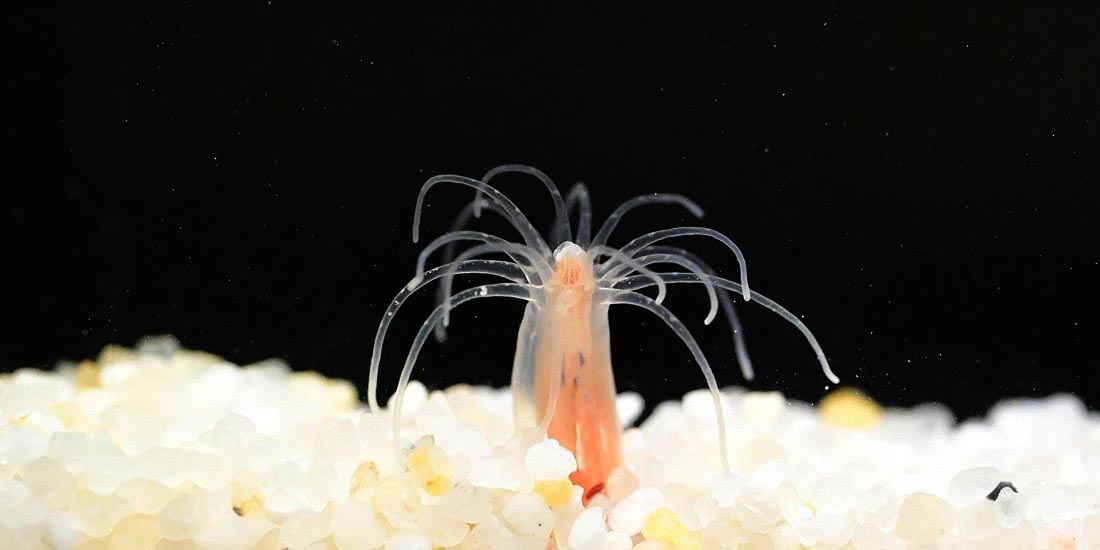
Coral reefs are beautiful and important, both for humans and for marine biodiversity. Corals are living creatures, although they appear to remain fixed in one place, catching small crustaceans and other tasty morsels that drift past.
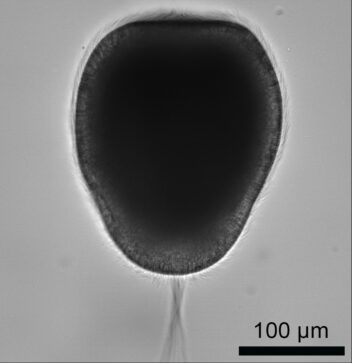
A free-living stage of Nematostella vectensis. Photo: Marte Lønnum, NTNU
Yet they manage to spread to new areas. How do they do it?
“Corals and other cnidarians have a free-swimming larval stage. The main task of these larvae is to choose somewhere to live and get there,” says PhD candidate Marte Lønnum of NTNU’s Department of Biology.
These animals are in fact not fixed in one place throughout their lives. Their larvae are actually remarkably active.
“Although cnidarian larvae can hitch a ride on ocean currents, they are not passive particles. They can display surprisingly complex patterns of behaviour,” says Lønnum.
Together with colleagues, Lønnum investigated how larvae develop and mature from younger to older stages. She carried out the research as part of her doctoral work, supervised by Associate Professor Lena van Giesen from the same department.
Movement is important
What inspires the movement? Would it not as beneficial to stay in one place, if the conditions were good enough?
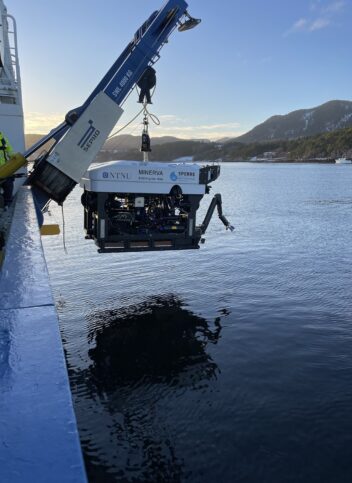
An underwater robot is launched to investigate the corals. Photo: Lena van Giesen, NTNU
“In the animal kingdom, movement is an important part of life, whether it’s to find food, locate a suitable habitat or escape danger,” says Lønnum.
The world is not a stable place, even for corals. Sometimes moving somewhere else can be an advantage.
“Migration can also be beneficial, particularly if unpredictable changes in climate and the natural environment make existing habitats uninhabitable,” says Lønnum.
Adult corals leave this task to the next generation: their larvae. It’s rather like humans sending babies out house-hunting.
Vulnerable coral reefs require greater understanding
We know that coral reefs can be extremely vulnerable to bottom trawling, pollution and changes in temperature. This makes it essential to understand more about how corals function.
“Yet we don’t know how their swimming abilities and sensory systems change as they develop, or what this means for larval dispersal and settlement,” says Lønnum.
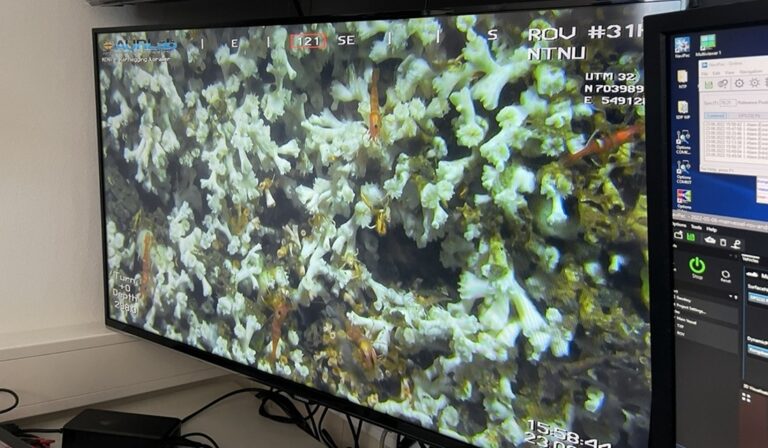
The screen shows the coral reefs. Photo: Lena van Giesen, NTNU
To investigate how larvae mature from younger to older stages, the researchers described larval behaviour and anatomy at selected developmental stages in both the cold-water coral Lophelia pertusa and the sea anemone Nematostella vectensis. (See fact box.)
Two species
- The researchers worked with two different cnidarians: the cold-water coral Lophelia pertusa, which lives in the depths of the Norwegian Sea, and the sea anemone Nematostella vectensis, which inhabits shallower waters and is found in England and the United States.
- Nematostella is a so-called "model organism" that is widely used in research into cnidarian development.
- Comparing the two species therefore makes it possible to explore different developmental and ecological strategies that are important for the movement, dispersal and settlement of cnidarian larvae.
Older larvae are better swimmers
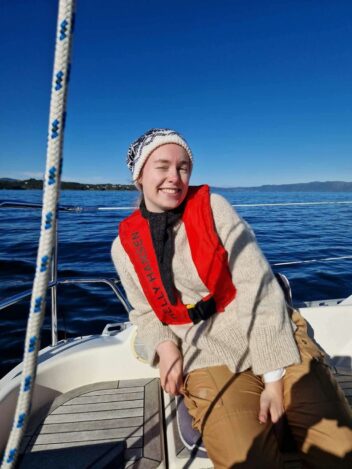
Marte Lønnum. Photo: Private
“We found that the larvae’s behaviour reflected their stage of development. Younger larvae had relatively limited swimming abilities, while older larvae were active and displayed more complex behaviour,” says Lønnum.
To understand why their behaviour changed, the researchers investigated how the sensory and nervous systems developed throughout the larval stage.
“Older larvae had more nerve cells and sensory receptors than younger larvae. This corresponded well with the improved sensory abilities we observed in the behavioural experiments,” says Lønnum.
“This may suggest that older larvae are better equipped to sense their surroundings and use these abilities to swim more efficiently.”
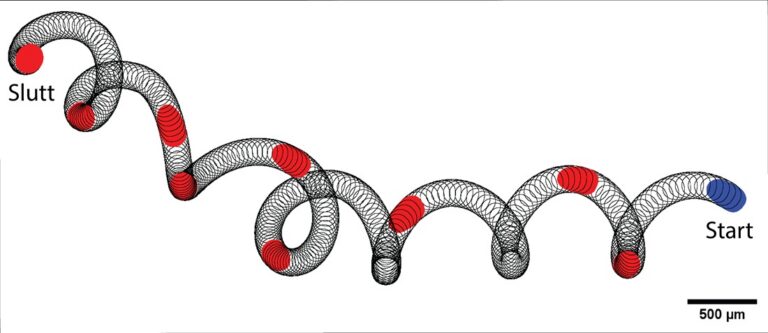
The illustration shows how larvae of Nematostella vectensis move. Illustration: Marte Lønnum, NTNU
The species use different strategies
The researchers were surprised to discover that the cold-water coral and the sea anemone used different dispersal strategies.
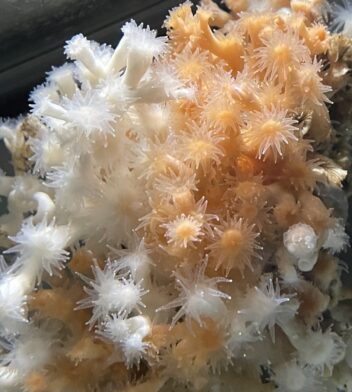
A cold-water coral of the species Lophelia pertusa. Photo: Lena van Giesen, NTNU
“Lophelia pertusa is found around the world and can disperse over long distances, such as from Norway to America. By comparison, the sea anemone Nematostella is much more localised and is poor at dispersing over long distances.”
Despite these differences, both species appear to develop age-appropriate sensory abilities and dispersal strategies suited to their lifestyles and the environments they inhabit.
Even at the larval stage, the coral adapts to the different the circumstances and habitats, experienced by the two species.
“Dispersal in cnidarian larvae appears to be a regulated process shaped by the larvae’s developmental stage, sensory abilities and ecological adaptations,” says Lønnum.
Understanding the biology and ecology of these organisms is essential if we are to protect corals and help new coral reefs become established.
“By learning more about how cnidarian larvae swim and sense their surroundings, we can better understand how corals and other cnidarians spread and establish new populations,” says Lønnum.
Research:
Lønnum, M., Schuldt, M. M., Hovland, J., Davila-Velderrain, J., & van Giesen, L. (2026). Developmentally timed sensory integration enables efficient larval dispersal. iScience, 29(9). https://doi.org/10.1016/j.isci.2026.117222
Lønnum, M., Hovland, J., Schuldt, M. M., Nilssen, E. S., Davila-Velderrain, J., Järnegren, J., & van Giesen, L. (2026). Dispersal behavior in a cold-water coral is orchestrated via stage and species-specific physiology. bioRxiv. https://doi.org/https://doi.org/10.64898/2026.06.03.729899