First complete record of global underground CO₂ storage
The first-ever audited account of the actual amounts of CO2 stored underground by CCS projects globally has been released. It was created by a new international consortium of scientists and industrial partners, including NTNU.
The first annual report by the new collaboration, the London Register of Subsurface CO₂ Storage, reveals that over 383 million tonnes of carbon dioxide had been stored since 1996 – the equivalent of 81,044,946 petrol-powered cars driven for one year.
This mass storage is mostly the result of projects in the United States, China, Brazil, Australia and the Middle East, with continued growth projected in 2024-5.
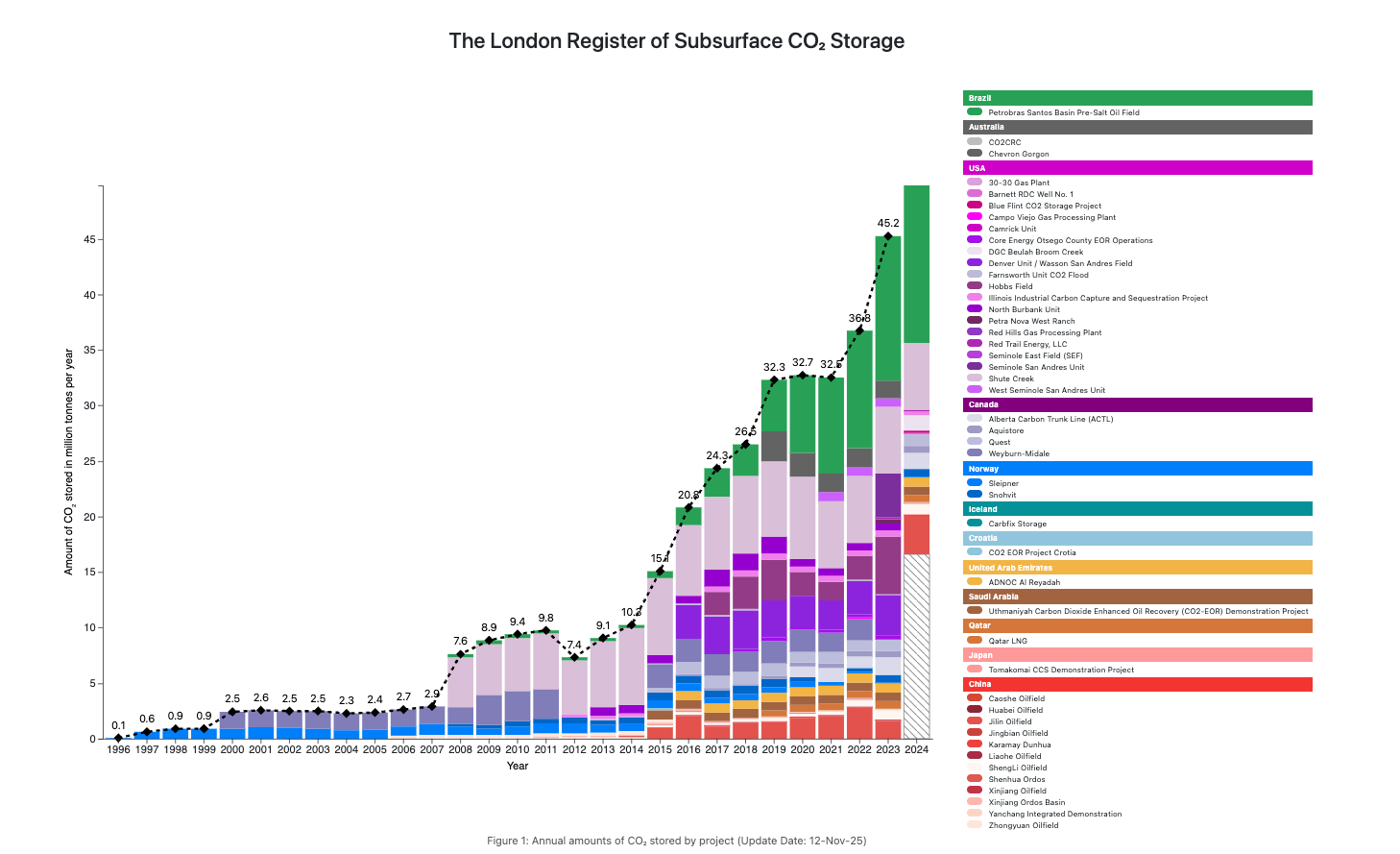
This graphic from the London Register of Subsurface CO2 Storage shows the international growth of the technology since the first carbon dioxide was successfully stored in Norway’s Sleipner Field. Graphic: Screenshot from the register’s annual report.
“The central message from our report is that CCS works, demonstrating a proven capability and accelerating momentum for geologic storage of CO₂,” said Professor Samuel Krevor, Director of the Register and Professor of Subsurface Carbon Storage in the Department of Earth Science and Engineering (ESE) at Imperial.
“We have found that industrial-scale carbon management is already a reality and can safely sequester CO₂ deep underground, which will be a key strategy – alongside vital efforts to cut emissions – for decarbonising hard-to-abate industries and cutting the total CO₂ in the atmosphere,” he said.
The report provides unequivocal evidence that the technology is an essential tool to avoid and remove this greenhouse gas from the atmosphere, at the scale needed to tackle climate change, the consortium said in a press release. It highlights that CCS isn’t a concept for the future, but a proven, scalable technology operating effectively today.
- You might also like: Can we tap the ocean’s power to capture carbon?
Documents actual progress
“There has been much speculation about CCS over the last decades – but here we document the actual progress,” said Philip Ringrose, Professor in Energy Transition Geoscience at NTNU, and a member of the consortium. “Global Carbon storage has seen a 17% annual growth rate since 1996 and by 2023 the storage rate was 45 million tonnes per annum.”
Ringrose said NTNU is very pleased to have contributed to this new report, which is the first ever audited account of the actual amounts of CO₂ stored underground by CCS projects globally.
“Carbon removal and storage clearly needs to continue to grow in support of climate action plans – but now we can build on an a firm foundation… Carbon in the ground!,” he said.
Trapped underground
CCS prevents CO₂ released from industrial processes and power plants from entering the atmosphere by separating it from other gases and injecting it underground (typically at depths of one kilometre or more), where it is permanently trapped in geological formations like depleted oil and gas reservoirs.
It is essential for decarbonising industrial sectors that can’t easily run on renewable electricity alone, such as iron and steel production, and is currently the only technology available to directly address emissions from these processes. International bodies like the UN Intergovernmental Panel on Climate Change (IPCC) recognise CCS as a crucial technology for achieving net-zero emissions.
The London Register of Subsurface CO₂ Storage is an initiative funded by the UK’s Royal Academy of Engineering that details the progress of CCS, starting with a single pioneering project in Norway in 1996 to what is now a global enterprise.
The Register’s 2025 Annual Report tracked the annual rates of CO₂ stored underground from operational projects worldwide from 1996 to 2024. It compiled public information (such as government databases on greenhouse gas reporting) and surveyed project operators in a co-ordinated effort to establish the first and most comprehensive record of CCS growth and maturation to date.
It found that, cumulatively, 383 million tonnes of CO₂ have been stashed away by CCS since 1996.
CCS critical part of many climate plans
While the views on CCS are polarised among the climate science community (it is considered by some as a distraction from reducing carbon emissions, or that CCS isn’t well developed and proven possible to rollout at sufficient scale), plans for CCS nevertheless underpin many national, international and corporate decarbonisation plans.
The consortium of scientists and industrial partners is led by Imperial College London academics, and includes experts from around the world at the Department of Energy Science & Engineering at Stanford, MIT Civil and Environmental Engineering, Global CCS Institute, Carbon Capture & Storage Association, IEAGHG, CSIRO, and the Norwegian University of Science and Technology (NTNU).
Reference:
Gao, X., & Krevor, S. (2025). The London Register of Subsurface CO₂ Storage: 2025 Annual Report. Imperial College London.