Stroke patients need better follow-up
Patients who have had a stroke are prescribed medication to prevent new strokes. Nevertheless, fewer than half achieve the optimal treatment targets.
A sample of 431 Norwegian patients who had suffered a stroke were followed up in an NTNU study three years after their initial hospitalization.
The majority of the patients reported that they were still taking the medications they had been prescribed.
However, fewer than half had achieved the treatment targets for both blood pressure and cholesterol.
“One in ten patients who have had a stroke experiences another stroke within five years, and the second stroke is often worse than the first. Therefore, following up on these patients is crucial,” said Erlend Fagerli, a resident doctor and the study’s lead author.
At the same time, research shows that 80 per cent of recurrent strokes can be avoided with optimal prevention and follow-up of patients after the first stroke. Lowering blood pressure and reducing levels of harmful LDL cholesterol are most important.
Struggling with blood pressure
Strokesoccur suddenly and are caused by a blood clot (86 per cent of cases) or a brain haemorrhage (13 per cent of cases). They affect approximately 9000 people in Norway each year. Almost 5000 people experience a transient ischemic attack (TIA), a temporary disruption of blood flow to the brain that causes stroke-like symptoms but no lasting damage. The risk of having another stroke is roughly the same for individuals who have had either a cerebral infarction or a transient ischemic attack.
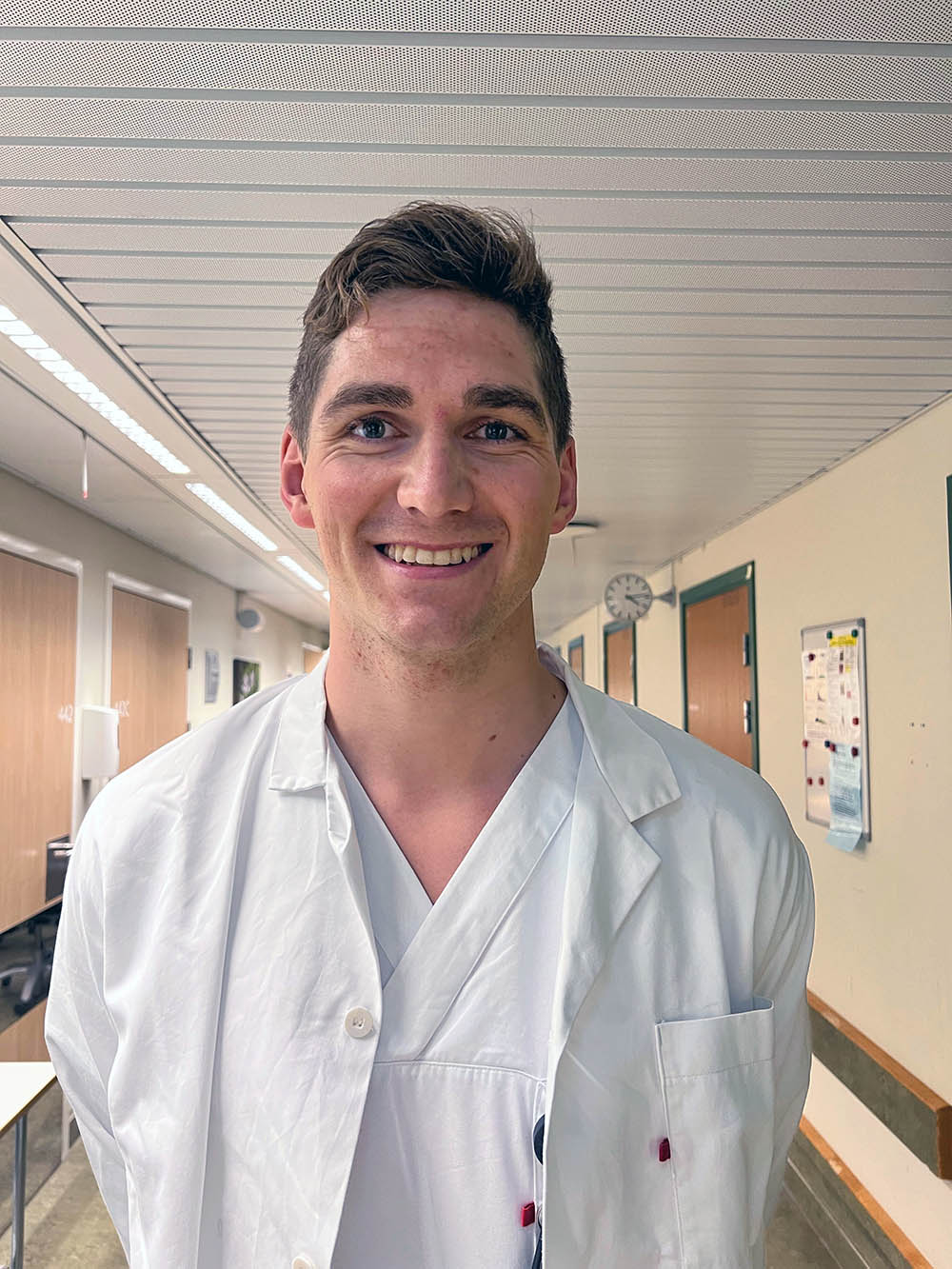
Erlend Fagerli is a resident doctor (LIS 1) at Volda Hospital. Photo: Private
Fagerli is particularly struck by the fact that many people do not achieve their blood pressure treatment targets.
Three years after having a stroke, only 42 per cent of patients have managed to lower their blood pressure to an optimal level. This is despite the fact that more than nine out of ten patients continued taking the blood pressure medications they were prescribed after their stay in hospital.
“Blood pressure is the most important factor when it comes to stroke risk. If there is one thing you should do, it is to get your blood pressure under control,” explained Fagerli.
The study also shows that most of the patients with high blood pressure were only taking one single type of blood pressure medication.
“When someone has had a stroke, it is very important for them to lower their blood pressure, and combining different blood pressure medications can help achieve that. It can therefore be better to take two different medications at a slightly lower dose rather than a high dose of just one single medication,” Fagerli said.
What is a stroke?
A stroke causes a sudden loss of bodily functions due to disruptions in the brain’s blood circulation.
In the vast majority of cases, a stroke is caused by a blood clot, meaning that a blood vessel in the brain becomes blocked.
In 10–15 per cent of cases, a stroke is caused by a brain haemorrhage. This is where a blood vessel in the brain bursts.
What happens in your brain when you have a stroke?
During a stroke, the brain receives too little or no oxygen, causing brain cells to die.
A stroke can result in different functional impairments depending on where in the brain the damage occurs and how extensive the haemorrhage or blood clot is.
Stroke symptoms
Stroke symptoms appear suddenly and can vary. The most common symptoms are:
- paralysis on one side of the face
- paralysis on one side of the body, in one arm or leg
- Language and speech impairments
Other symptoms that may indicate a stroke include slight weakness in one hand or arm, a severe headache, vision problems, or dizziness.
A stroke can be transient. This is often referred to as a ‘mini-stroke’ or transient ischemic attack (TIA). In a transient ischemic attack, or ‘mini-stroke’, blood flow to parts of the brain is reduced or stopped for a short period of time.
Call the emergency services immediately
A simple test can save lives. If you suspect someone may have had a stroke, you can ask the person affected to do the following:
- FACE – try to smile, laugh, or show your teeth.
- ARMS – try to lift both your arms.
- SPEECH – try to say a simple, coherent sentence.
- TIME – If the person can't complete any one of these tasks, it's time to call emergency services.
It's important to get potential stroke patients to a hospital quickly in order to prevent permanent damage. Every minute counts.
Source: Helse Norge
More medicine gives better results
The study shows a similar tendency for treating high cholesterol. Despite 83 per cent of patients still taking their prescribed cholesterol medications, only 47 per cent manage to lower their harmful LDL cholesterol to the desired level.
“We see that patients on higher doses of cholesterol-lowering medication are more likely to reach their treatment target. We also observed that patients with multiple illnesses more often achieved their targets than patients with fewer other illnesses. It often takes two different cholesterol-lowering medications to reach the treatment targets.”
The study also showed a difference between men and women in respect of cholesterol. The women had higher levels of harmful LDL cholesterol than the men and were less likely to reach the treatment target.
“This may be connected to the fact that LDL cholesterol levels rise after the menopause. Other studies also show that women often receive lower doses of cholesterol-lowering medications, which might be part of the explanation,” explained Fagerli.
Doctor–patient collaboration
The conclusion is that risk factors after a stroke are still not being adequately followed up, despite the fact that many patients take their medications and follow the advice they are given. Fagerli also points out that they lack data on why patients do not achieve their targets.
“That is a limitation of the study. For example, we do not know why the patients were not given higher doses of medication. There are often good reasons for that,” said Fagerli.
He emphasizes that the follow-up of stroke patients is complex.
“Each patient is different, and medications, dosages and needs vary. Sometimes it may be due to patients not continuing their follow-up or the doses being too low. Other times, it has to do with the patient’s personal preferences. It is complex.”
Perhaps the patient does not want to take multiple medications. Fagerli feels it is important that patients understand why their doctor wants them to reach the treatment targets.
“This is to avoid another stroke or other cardiovascular events. We want there to be an alliance between the doctor and the patient, and that they collaborate to achieve the treatment targets.
Check your blood pressure
So what should you do if you have had a stroke and are unsure whether you are being followed up adequately?
“Good follow-up is crucial. Most patients receive a check-up at the hospital within three months, but after that, follow-up is left to the GP and the patient. Blood pressure and cholesterol should be measured regularly,” said Fagerli.
If you have had a stroke, you are a high-risk patient.
“If, after a while, you still have slightly high blood pressure or slightly elevated cholesterol levels, it should be followed up.”
He also emphasizes that lifestyle changes can be important.
“In this study, we found no clear correlation between physical activity and control of blood pressure or cholesterol. Nevertheless, adapted and regular physical activity can be considered a treatment target in itself and is recommended for everyone who has had a transient ischemic attack or cerebral infarction,” said Fagerli, adding:
“Three out of four participants in our study were not physically active enough, based on the Norwegian Directorate of Health’s definition.”
Reference:
Fagerli E, Ellekjær H, Spigset O, Saltvedt I, Gynnild MN. Three-year adherence to secondary prevention and vascular risk control after ischemic stroke. European Stroke Journal. 2025;0(0). doi:10.1177/23969873251329210