Harald V, King of Norway, opens a new dementia research centre in Trondheim
A new, national centre will continue the quest to understand how Alzheimer’s and other dementias arise in the brain. The hope is to develop a treatment for dementia diseases.
Alzheimer’s disease is the most common form of dementia, and is one of the greatest public health challenges of our time. The disease causes great suffering for both those who get the disease as well as for their families and friends.
Now, the Norwegian National Association for Public Health, NTNU’s Kavli Institute and Department of Neuromedicine and Movement Science and St. Olavs Hospital have gathered forces in one centre in Trondheim. The goal is to figure out why people develop these diseases, and hopefully, in the long run, to find ways to treat them.
The new coalition represents a powerhouse for dementia research, education and social impact.
- You might also like: New radioactive drug can detect Alzheimer’s
From Nobel laureates to groundbreaking Alzheimer’s research
The initiative makes it possible to build a bridge between Nobel Prize winners Edvard Moser and May-Britt Moser’s basic brain research and groundbreaking research on Alzheimer’s disease.
Dementia is now the disease that costs society the most.
The goal of the new centre is to understand the mechanisms that give rise to Alzheimer’s disease, and to develop effective diagnoses, treatments and drugs for the disease.
“We see that our basic research on the sense of time, sense of location and memory is relevant to understanding Alzheimer’s, and thus brings us closer to finding ways to both curing and preventing the disease. With the National Association for Public Health on our team, the connection to relatives and patients is safely addressed,” says Professor Edvard Moser.
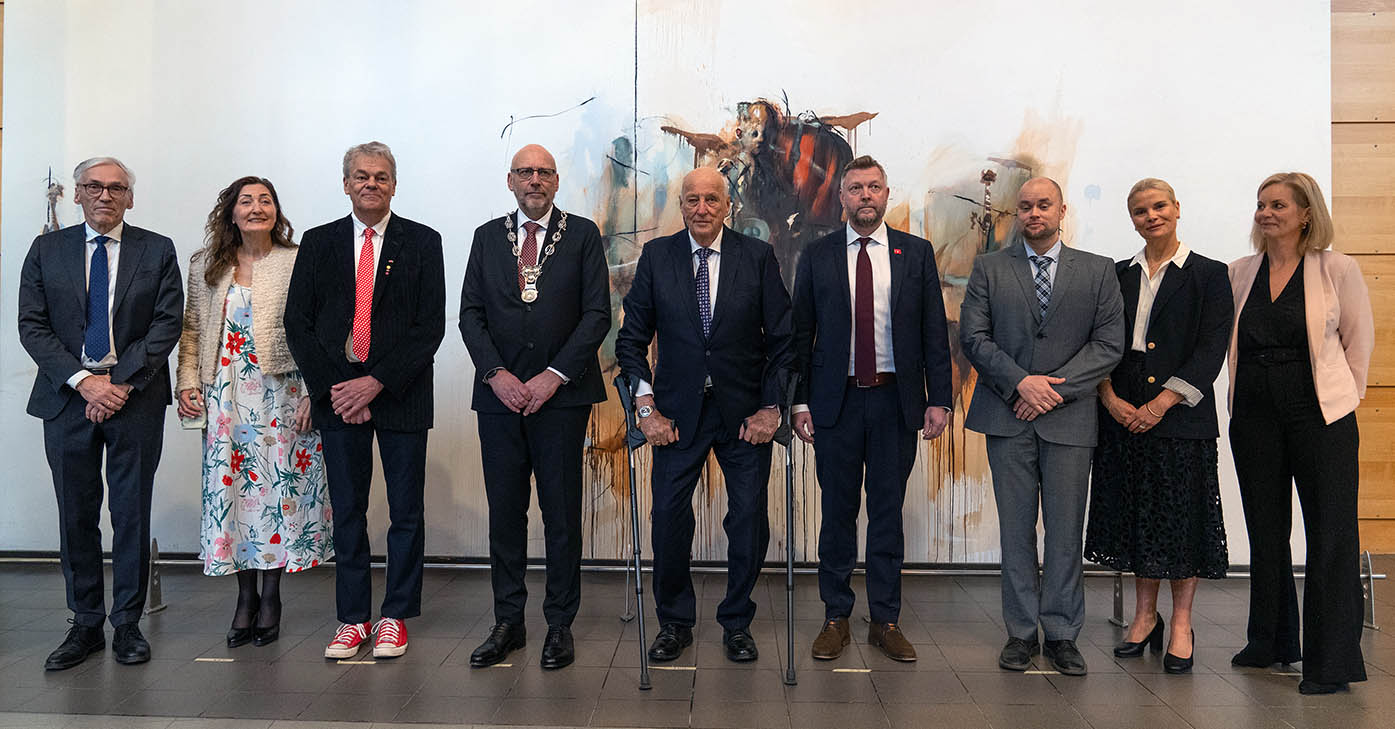
The new centre was officially opened on 15 December, 2025. From left: Board chair Bjarne Foss, Professor May-Britt Moser, Professor Edvard Moser, Rector Tor Grande, HM King Harald V, Secretary General of the National Association Bo Gleditsch, Centre Director Asgeir Kobro-Flatmoen, Centre Director Gøril Rolfseng Grøntvedt and Minister of Research and Higher Education Sigrun Aasland. Photo: Einar Mæland Jensen
Co-location a major advantage
Professor May-Britt Moser emphasizes how important it is to co-locate the various research efforts.
“Research is not just sitting by yourself like an Einstein and solving formulas. It requires a great deal of creativity, and training diversity in approaches, discussion, and communication. We now have that with this team, which will be in close proximity to each other here in Trondheim,” she says.
“The vast majority of us come into close contact with Alzheimer’s disease in one way or another. I therefore feel a sense of pride when outstanding basic research at NTNU reaches all the way to the clinic in the form of better diagnostic methods,” says Bjarne Foss, chairman of the National Association’s dementia research centre.
An important social mission
Dementia is now the disease that costs society the most.
It affects many people, inflicts great suffering on the sick and their relatives, and costs society large sums of money. Nevertheless, there is no cure. Norway – and especially the research community in Trondheim – is at the forefront internationally, and the researchers have high hopes for the future.
In the past, dementia was largely perceived as a natural part of the ageing process. As a result, research in the field has grown more slowly than for many other diseases.
Researcher Asgeir Kobro-Flatmoen is the centre director of the National Association’s dementia research centre. He emphasizes that the centre will benefit society.
“This is a social mission – it is something we must stand together on. We are completely dependent on society wanting us to do so. The grassroots have to be involved for something to happen, both to help people who are sick now, and to support the research that is required so that new generations do not have to suffer the same fate,” says Kobro-Flatmoen.
- You might also like: From running rats to brain maps
Dementia diseases once seen as normal ageing
Associate Professor Gøril Rolfseng Grøntvedt is also the centre director. She works with clinical research, and has close contact with dementia patients.
“In the past, dementia was largely perceived as a natural part of the ageing process. As a result, research in the field has grown more slowly than for many other diseases. Today, fortunately, there is more attention paid to dementia and more money given to this type of research. Thus, we have the opportunity to make more, and faster progress than before, and that gives us hope!” she said.
The National Association’s Secretary General Bo Gleditsch echoes Grøndtvedt’s sentiments.
“This collaboration, with so many of the best researchers, gives hope to everyone affected by dementia today and in the future,” says Gleditsch.