ERC grants totalling NOK 48 million for projects on ecojustice and a more efficent power grid
The European Research Council has awarded two grants to NTNU researchers for very different projects related to the environment.
One project would give nature its own rights, and make violence against nature an international crime. The other will develop solutions that allow us to make better use of the power grid.
Professors Nabil Ahmed and Dimosthenis Peftitsis are very different, but both work to ensure that humans have less impact on the environment.
The European Research Council (ERC) has granted EUR 2 million to each, a total of roughly NOK 48 million.
The award to Professor Ahmed is somewhat unusual. It isn’t every day that artistic researchers receive grants from the ERC.
The money comes in the form of ERC Consolidator grants. These are given to researchers who want to expand cutting-edge research groups. The grants require research at an outstanding level. They are among the most prestigious in the world, and the competition is fierce.
Nature must be given rights
“We have a simple but ambitious goal. We want to change the way we understand the most serious crimes against the environment, and open new paths to justice,” says Nabil Ahmed, professor at the Trondheim Academy of Fine Arts

The US Vietnam War. The US Air Force used Agent Orange to defoliate the Vietnamese jungles so that North Vietnamese troops couldn’t use them for cover. The consequences for both humans and the environment are still being felt. Photo: U.S. Air Force
Making nature an independent legal entity, with all the rights that this entails, is a key part of Ahmed’s efforts to achieve this goal.
Using methods from artistic research, Ahmed also wants to have ecocide, or violence against nature, recognized as a fifth international crime, along with genocide, crimes against humanity, war crimes and wars of aggression.
“With this project, I hope to contribute to dialogue between academia and politicians. We want to encourage Norway to take a more active role in getting ecocide recognized, and in protecting the planet and people from the most serious environmental damage,” he said.
He is the first employee from The Trondheim Academy of Fine Arts and the Faculty of Architecture and Design to receive an ERC grant of this type. The money from the ERC grant will be used to finance a project group called SEECODE. Ahmed will work closely with PhD student Olga Lucko.
Ahmed has previously worked with Lucko on an environmental justice project called Interprt, a project that pursued environmental justice through spatial and visual investigations.
ERC Grants
- The European Research Council (ERC) was established by the EU in 2007 and is the foremost European funding organisation for excellent research. Every year, the ERC funds the very best creative researchers to run projects based in Europe.
- The ERC grants are divided into: Starting, Consolidator, Advanced and Synergy Grants.
- NTNU is investing heavily in ensuring that researchers at NTNU receive these very important research funds.
- The ERC has been part of the Horizon 2020 programme, it continues as part of the Horizon Europe framework programme.
More efficient power grid
Our need for electricity will only increase in the future. Digital technology and data centres for storage and artificial intelligence alone gobble up enormous amounts. At the same time, the energy sector must move away from fossil fuels such as coal, oil and gas.
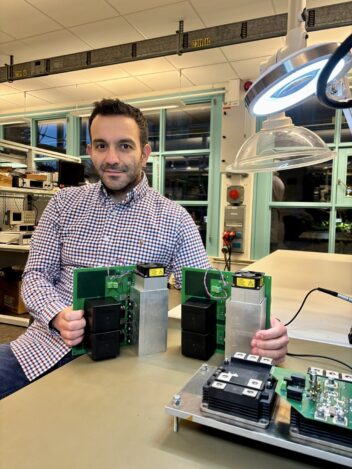
Professor Dimosthenis Peftitsis in the laboratory with a prototypes of the electronic system he is developing. Photo: Timm Felix Baumann, NTNU
“We can create power converters that, in addition to converting electricity, also function as small computers. Then each inverter can collect and process data itself, and control its own operation in real time,” says Professor Dimosthenis Peftitsis at the Department of Electrical Energy at NTNU.
If this succeeds, the power grid will become more efficient. This means that we can make better use of the electricity we already produce.
He will use the money from the ERC to hire three doctoral research fellows and one postdoctoral fellow. The money will also cover the costs of prototypes, testing in the laboratory and dissemination of the research.
Great recognition
“These are two strong awards that make us proud. The ERC award is highly regarded, and it is wonderful recognition of the research and academic communities at NTNU,” says Pro-Rector for Research and Innovation Toril Hernes.
“The award to Nabil Ahmed shows the impact that artistic research can have in the face of complex environmental and societal challenges. This is interdisciplinarity at its most inspiring,” Hernes said.
“Dimosthenis Peftitsis’s research is innovative and exciting and can potentially ensure that our society makes better use of electricity as a limited resource,” she said.