New material can help combat water shortages where water is needed most
A newly developed plastic material of the same type as is used in baby diapers can collect clean and safe drinking water from the air.
Climate change, population growth, conflict and humanitarian crises are putting increasing pressure on the world’s water resources. That is why Norwegian researchers are looking into whether atmospheric water generators can become part of the solution.
This type of water generator extracts moisture from the air using moisture-absorbing materials and converts it into drinking water. But they need to become more efficient.
“The solution works well when the air is humid, but energy consumption becomes very high when the humidity is below 50 percent. This in turn makes the technology expensive and thus challenging to use in dry areas, where the need is greatest, says Roberto Mennitto.
Mennitto is a SINTEF research scientist and has led the work to develop the new material.
The goal of the research team is to make the water collection method more relevant in regions with low humidity. This solution gives hope for a thirsty world: WHO and UNICEF estimate that nearly two billion people are without access to safe drinking water. The need was emphasized during COP30 in Brazil, where water scarcity was highlighted as one of the world’s most critical challenges.
The material has tiny “magnets” that attract water molecules, much like the absorbent material used in diapers for infants.
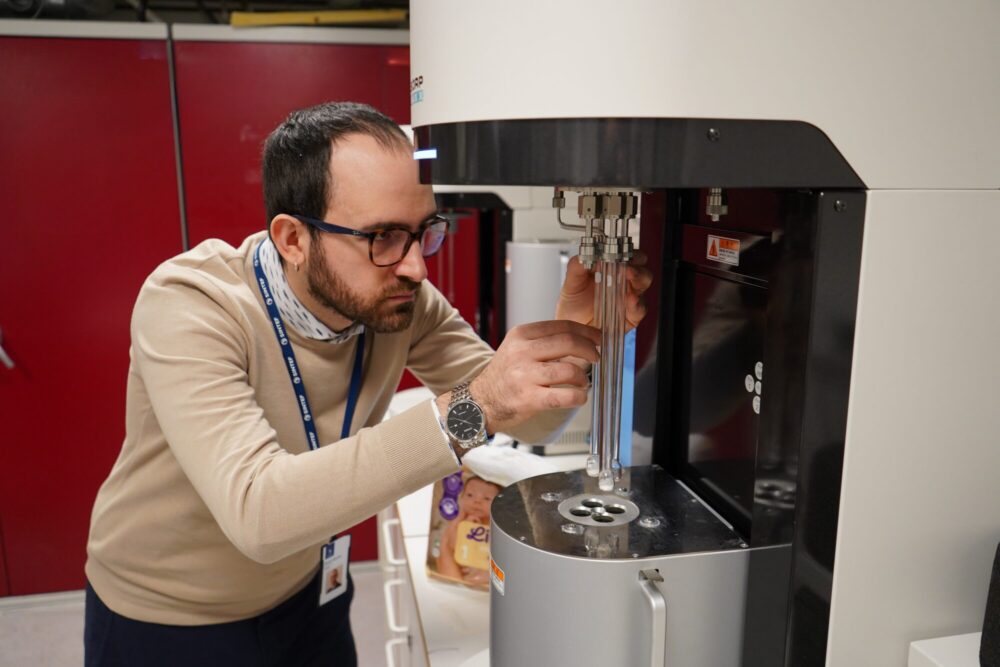
Researcher Roberto Mennitto and the newly purchased equipment for advanced water testing. Photo: William Husby Hoven/SINTEF
Discovered the solution in a polymer material
The research community at SINTEF has experience in developing and analysing what are called sorbents. These are porous materials that can capture, separate or bind various chemical substances.
During the one-year project funded by SINTEF, Mennitto and his colleagues investigated several compositions of different raw materials with varying properties.
Through careful testing and comparisons, they came up with a polymer-based material that consisted of two components: a soft elastomer – similar to the silicone or rubber used in many consumer products – and a water-absorbing polymer similar to that used in diapers.
The result was a new material that can collect large amounts of liquid while remaining stable.
“The material has tiny “magnets” that attract water molecules, much like the material used in diapers for infants,” explains Mennitto.
When the polymer is saturated with water, it heats up. This allows the water to be released and collected in a tank, ready for use.
Facts about the technology:
Water generators (AWG) have a wide range of applications, from defence and first aid to homes and offices. Most water generators work by cooling the air below room temperature so that water condenses, and then collecting it in a tank. The water becomes drinking water quality. The principle is the same as in common dehumidifiers at home and is often referred to as "cooling and condensation." The market for the technology is currently around USD 2.5 billion and is expected to reach more than USD 4 billion by 2030.
“Think of it like using a hairdryer on wet hair. The hot air draws the water out of the polymer and creates an air stream that is supersaturated with water. When this air is sent into the tank, the water is converted into droplets and condenses in the tank,” the researcher says.
Can also be made from biomass
The polymer material is flexible and can be shaped in many ways, such as a laminate or a coating on surfaces. It can also be 3D printed. This offers greater opportunities for optimizing the design, which in turn can reduce the energy needed to power the generator.
The material is also based on inexpensive and readily available raw materials, and could also potentially be made from biomass, according to the researcher.
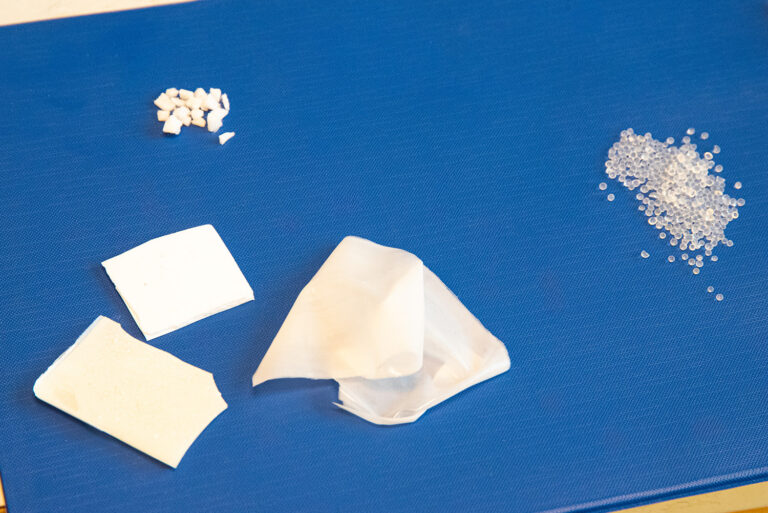
The research project has tested various materials for water harvesting. Top left, the first polymer that was tested; bottom left, a 3D printed and laminated polymer for water harvesting; and on the right, spheres from the reference material silica gel. Photo: SINTEF
“We observed that this polymer performed well, and at the same time the cost of producing it is low. We achieved this by using affordable raw materials, a production process with only a few steps and without using expensive or toxic solvents or chemicals,” says Mennitto.
The new material is also strong. It can withstand several cycles of water harvesting without losing its properties or ability for absorbing water.
“Similar materials have often been shown to quickly degrade during water production. In testing, our material showed no degradation after 120 hours of stable operation,” says Mennitto.
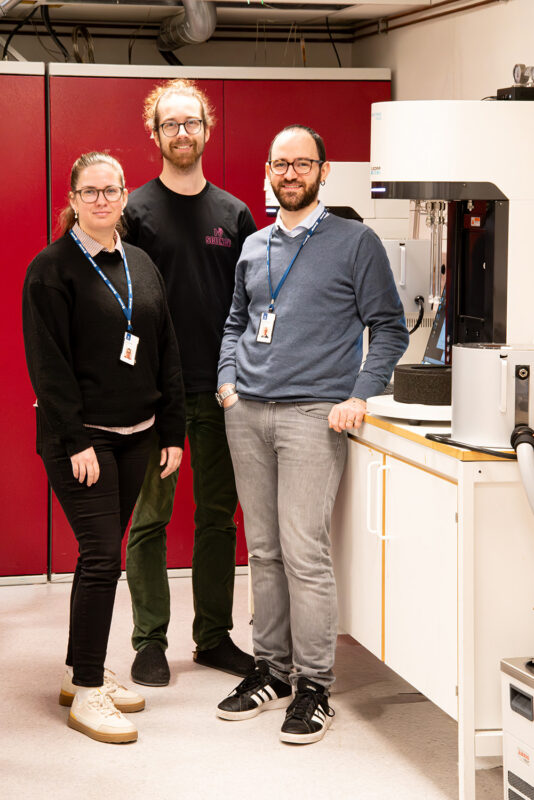
Hoping to provide the world with clean water: Research team Leesa Jane Klau, Maurice Dörr and Roberto Mennitto. Photo: SINTEF
Making the solution cheaper
For now, the costs of water harvesting with the new material will be in line with water generators already on the market. Researchers are working to reduce the costs by 25 percent.
They plan to do this by improving features and scaling up production from grams to kilograms.
“We need to increase production to a large enough scale so that this solution is affordable to produce, and develop a standardized process that is easy to maintain and requires as little human oversight as possible,” says Mennitto.
The goal is to make water harvesting as inexpensive as possible.
“If we consider the cost of bottled water in dry and sparsely populated areas – or even worse, places where the water supply is interrupted – water generators become a very good and safe alternative. It is important for the generators to be able to deliver water under a wide range of atmospheric conditions,” he says.
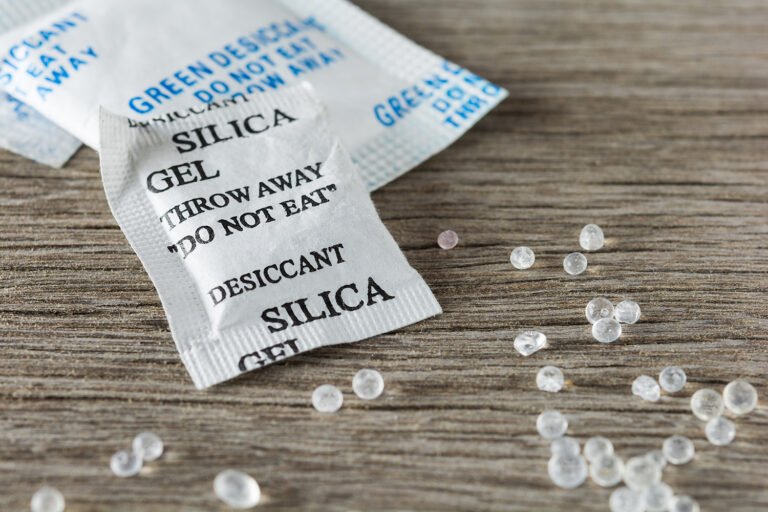
A well-known example of moisture-absorbing materials is silica gel, which often comes in small packets you find in vitamin bottles or with new shoes. Photo: Shutterstock/yamatmeung
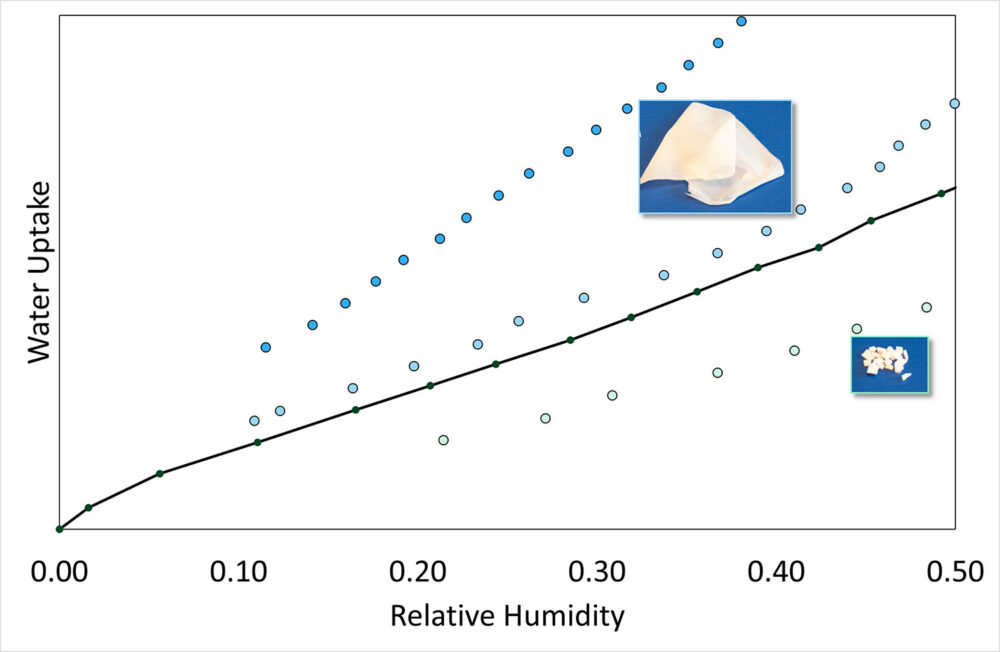
The figure shows how much water the material can absorb (i.e. grams of water per gram of material) when exposed to a given humidity (x-axis). The higher the humidity, the greater the water uptake. The solid black line shows that the polymer absorbs more water than the reference material silica gel. Source: SINTEF
Interest from start-ups
The researchers are now looking for new sources of funding to further develop their solution. They also plan to build a prototype to optimize and test the material’s capacity.
So far, the researchers have received positive feedback and interest from several start-ups and sponsors that may be interested in using the technology.
“Scaling up a new material and developing a new process for water harvesting is something that needs to be resolved by collaborating with different types of expertise. We’re dependent on putting together a team of chemists and engineers to be able to bring the technology to market,” concludes Mennitto.
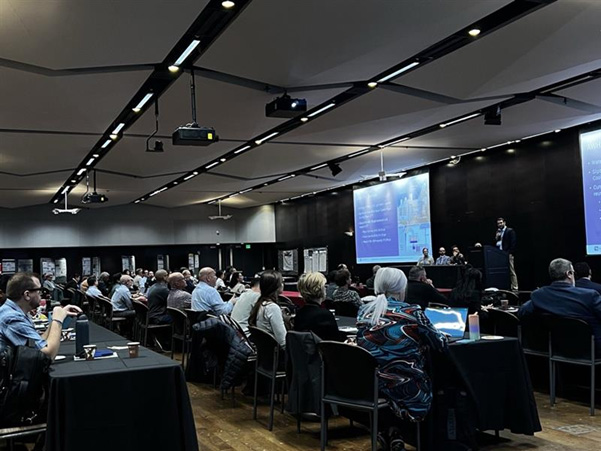
Roberto Mennitto in a panel discussion at the International Atmospheric Water Harvesting Summit at Arizona State University, where the researcher presented the latest research results from the project. Photo: Jocelyne Moore /Arizona State University
References: