An autonomous “flying” boat
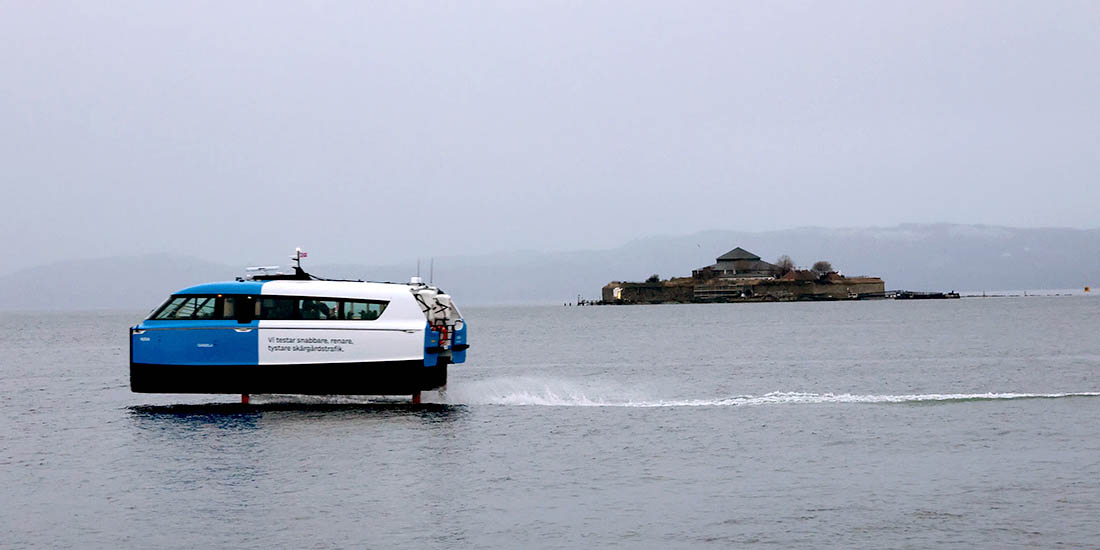
This past winter, people in Trondheim have caught glimpses of a boat that seems to fly over the water out on the fjord. Many have also taken part in test trips. NTNU researchers have investigated what it will take for people to trust a boat that runs almost without a crew on board.
The short version
- A fast, quiet boat that uses little energy and produces minimal emissions has been tested on the Trondheim Fjord.
- The goal is to establish a boat route between Trondheim and Frosta to reduce travel time and lower environmental impact.
- The electric hydrofoil vessel could become a supplement to today’s diesel-powered high-speed ferries on several routes.
Trondheim Fjord is both wide and long, and is surrounded by many small towns and villages of varying sizes. Two ferry services and two express boat services operate daily, transporting passengers across the fjord to various destinations. A few decades ago, there were several boat routes in operation and far more places that had boat calls.
The journey between Trondheim and Frosta over the fjord takes well under half the time compared to car or bus transport.
Very energy-efficient
We are out on a trial run with the new Frosta boat, locally called Frostabåten. It is designed so that it almost seems to fly over the water. Once we get a little way out on the fjord, I wait for it to pick up speed and “fly”.
“But it already is!” says Linda Hald, project manager for the Frosta boat.
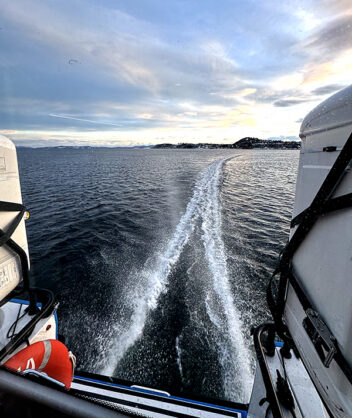
The speed is almost not noticeable on board the boat. Photo: Idun Haugan, NTNU
This electric hydrofoil boat is very smooth and quiet in its transition from starting speed to full speed. Approximately 80–85 per cent of the water resistance disappears when the ‘winglike’ hydrofoils lift the boat’s hull out of the water. This means that it is very energy-efficient.
The boat is electric and emits only 112 grams of CO2 per nautical mile. To put that into perspective, today’s diesel-powered express boats emit 32 kg of CO2 per nautical mile.
Its cruising speed is 25 knots.
The electric hydrofoil boat is designed to be driven with a high degree of autonomy, although there is a captain on board who can handle the controls if necessary, and ensure a safe journey.
What do passengers say?
In both December and January, the boat has carried out trial runs with passengers on board. The vessel can accommodate 30 people, but carries fewer during the trials.
Passengers have participated in surveys where they have answered questions related to their experiences. The survey is part of NTNU’s research contribution to the collaborative project around the Frosta boat project.
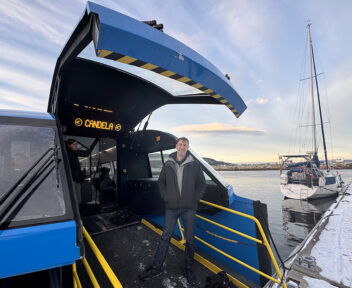
There have been many trips on the Frostabåten for Professor Ole Andreas Alsos. Photo: Idun Haugan, NTNU
Among other things, the survey focuses on what type of information passengers need before and during a trip and where and how they wish to receive it.
“Much of the research on autonomous surface vessels focuses on technical feasibility. Our study explores how passengers experience and interact with an autonomous ferry service,” says Ole Andreas Alsos. He is head of NTNU Shore Control Lab and a professor in Interaction Design at the Department of Design.
Collaboration Partners
- Login Group – Initiator and owner of the company
- Norsk Droneindustri – Communication, safety, and surveillance
- Trondheim Havn – Facilitator of quay access in Trondheim
- NTNU – Automation of customer/user interfaces
- Maritime Robotics – Autonomy functions and communication
- Boreal – Project manager and operator of the service during the project period
- Supercharge – Charging with proprietary energy production in Trondheim
- WTW – Ticketing and route information
- Frosta Brygge – Collaboration partner
- Trøndelag fylkeskommune – Collaboration partner
- Trondheim kommune – Collaboration partner
Specific recommendations on design
Using service design methodology, the researchers have conducted interviews, workshops, prototyping and usability evaluations to identify user expectations, pain points and design requirements throughout the entire voyage.
“Key findings highlight the importance of transparency, trust, intuitive touch-points and universal design. We believe that the passenger experience is a critical component in the introduction of autonomous vessels. We are proposing specific design recommendations that include a mobile app, a screen on the quayside displaying relevant information, and a screen on board. These will be the main points of contact and sources of information for the journey,” said Alsos.
On-shore control
A key part of the trial runs has been collaboration with NTNU Shore Control Lab at Nyhavna in Trondheim, which has demonstrated how these types of passenger boats can be monitored from land-based control rooms. This has been an important part of the trial process.
“We have equipped Frostabåten with cameras and communication equipment that enable us to stream 360-degree video from the vessel over the 5G network to our control room,” said Alsos.
NTNU has even developed its own Gateway; a compact box that connects to power, cameras and an antenna, and transmits high-quality audio and video streams directly from Frostabåten to the control room.
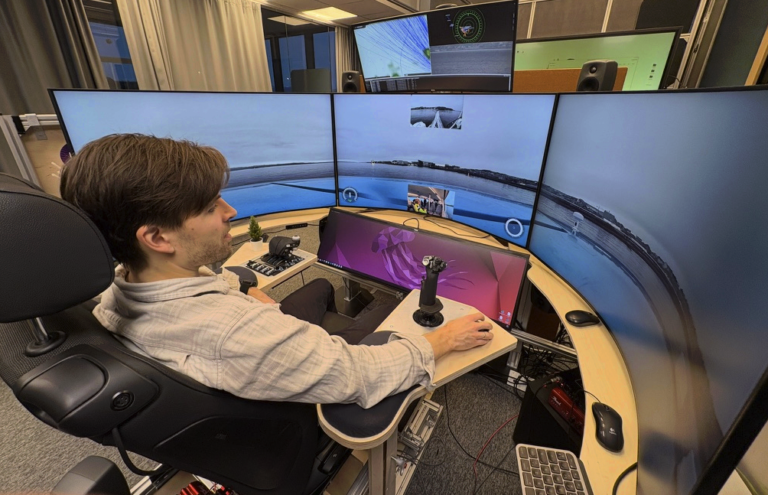
From the control room at NTNU’s Shore Control Lab, onshore operators can monitor operations and assist the captain on board with information and observations. Photo: Ole Andreas Alsos, NTNU
“In our lab, we also recreate the weather conditions on the fjord through sound and motion so that we feel as if we are actually on board the vessel,” explained Alsos.
But what is the advantage of having the crew work from shore instead of on board the boat?
“Crew shortages are a major problem. This technology enables a small team of operators to monitor an entire fleet of autonomous vessels, providing more efficient use of the crew. In addition, it is more comfortable for them, and it enables them to remain in the job longer and go home to their families immediately after finishing a shift,” said Alsos.
“If the boats can be remotely controlled from land, it will be possible in the future to operate a whole fleet of autonomous vessels. The purpose of the demonstration is to show that it is fully possible to remotely monitor passenger ferries from shore, which is an important step toward more autonomous and cost-efficient operation,” added Alsos.
- You might also like: Taking control of unmanned vessels at sea
A boat that can dock almost anywhere
The boat was built by the Swedish company Candela, which specializes in this type of vessel design. The trial runs on the Trondheim fjord have primarily focused on:
- Stability and comfort
- Operational performance
- Interaction between the vessel, infrastructure and surrounding environment under real conditions in the Trondheim fjord
Additional routes from Trondheim to various ports of call along the fjord may also be introduced. Frostabåten has already tested docking in Vanvikan, Leksvik and Kvithylla, where Fosen shipyard is located.
Munkholmen may also be introduced as a summer route, along with other tourist destinations.
“We can establish new shortcuts to and from Trondheim, which will have the additional benefit of replacing car traffic,” said project manager Linda Hald at FI Ocean Space Incubator.
One advantage of this type of boat is that it can dock almost anywhere. Unlike today’s traditional express boats, it does not require large quay facilities. However, new infrastructure with charging stations will be necessary.
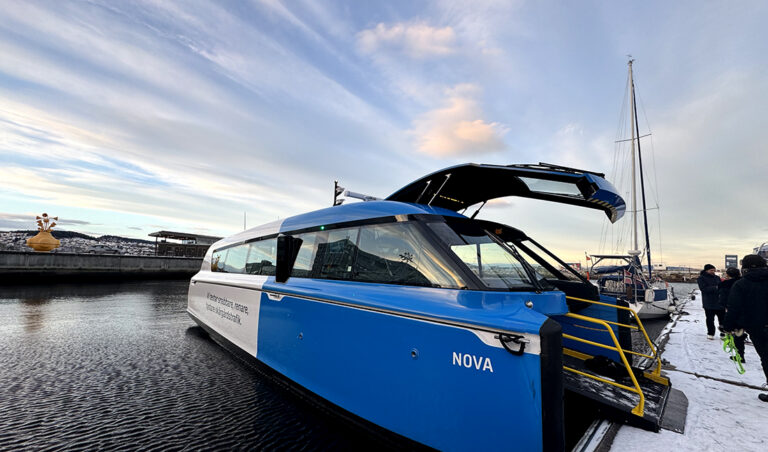
During the test runs in Trondheim, the Frostabåten has used a regular small-boat marina. Photo: Idun Haugan, NTNU
An alternative option
Today’s express boats carry many passengers on commuter routes in the morning and afternoon rush hours. However, at other times during the day, there are often few passengers. During these off-peak periods, smaller electric hydrofoil boats could provide an alternative option.
An electric hydrofoil ferry from Candela is already in service on one of Stockholm’s many waterways. In 2026, Candela will increase its production to 40 vessels per year. The Swedish manufacturer has received orders from customers in Mumbai, Thailand, Berlin and the Maldives.
Old Technology in a New Form
- A hydrofoil is a high-speed vessel in which the hull is lifted completely out of the water by means of underwater wings (foils) mounted on struts extending below the surface. This significantly reduces water resistance at high speeds compared to a conventional planing vessel.
- The principle is the same as that of an aircraft, except that the working medium is water rather than air.
- The pioneers of hydrofoil technology were Enrico Forlanini, Casey Baldwin, and Alexander Graham Bell. Forlanini had already built a prototype as early as 1909.
- Both the German and American navies used hydrofoil boats during World War II. Germany also attempted to develop an invasion fleet of hydrofoils during the war. This effort led to numerous technical improvements that proved valuable in post-war development work, particularly in Italy.
- Hydrofoils experienced their golden age from around 1960 and for a couple of decades thereafter.
- However, hydrofoils were expensive to operate and often faced technical challenges. From the late 1970s onward, they were gradually replaced by high-speed catamarans in passenger transport along the Norwegian coast.
- Source: Store norske leksikon
Reference:
Ane Solbakken-Melleby, Michelle Lous and Ole Andreas Alsos, Designing Passenger Touchpoints for an Autonomous Ferry Service, Journal of Physics
Watch this video from NTNU Shore Control Lab where researchers and students test remote control of Milliampere, NTNU’s self-produced ferry: