
Some brains are more similar than others when under stress
People who are resilient to psychological stress are similar to each other – not in terms of appearance, but in the brain’s response to stressful stimuli.
Psychological resilience – the ability to cope effectively with adversity – plays a crucial role in how we feel about ourselves. So why are some people better able to cope with stress and mental strain over time than others?
“The way you deal with adversity or stressful situations does not necessarily mean you lack resilience. But some people have greater reserves to draw on,” said neuroscientist Maryam Ziaei.
Visible on MRI scans
In collaboration with Alireza Salami at the Karolinska Institute in Sweden, Ziaei and her team at NTNU’s Kavli Institute for Systems Neuroscience have now taken a closer look at what happens in our brains when we are exposed to psychological stress.

Maryam Ziaei leads the research on ageing and the brain at the Kavli Institute for Systems Neuroscience. The goal is to understand the neural networks associated with the processing of social and emotional stimuli, and how this affects mental health as we grow older. Photo: Melissa Schubbert
“We wanted to test whether it was possible to understand why people experience situations so differently. And we could actually see it in the neural mechanisms. People with high tolerance – what we call resilience – react similarly. People with low tolerance react more individually,” Ziaei said.
In the study, the researchers observed 33 men and 29 women in an fMRI scanner while they watched two different films. The participants were aged 19 to 35, in good mental health and were not substance users. A ‘neutral’ film showed a woman making pottery, while the other film showed a woman desperately trying to avoid falling into an abyss. The participants’ brains were scanned as they watched the films.
“When an area of the brain is activated, such as an emotional response to something we see, blood flows to that specific area of the brain. Blood contains haemoglobin and oxygen, and as brain cell activity increases, the cells use oxygen. Oxygen leaves the haemoglobin and the blood becomes deoxygenated. This is what we measure with functional MRI,” Ziaei said.
- You might also like: How your brain helps you as you get older
Problems arise in different ways
The participants in the study were asked to complete a series of questionnaires about themselves, including questions about anxiety, depression and perceived stress. They were also asked to complete computer-based tasks.
The scans revealed that the participants who reported high psychological tolerance activated the same areas of the brain while watching the films. Those who reported low tolerance, however, activated other areas. Within this group, there were also fewer similarities in the areas that were activated.
“It’s not that the areas don’t work, they just work in different ways,” said Ziaei.
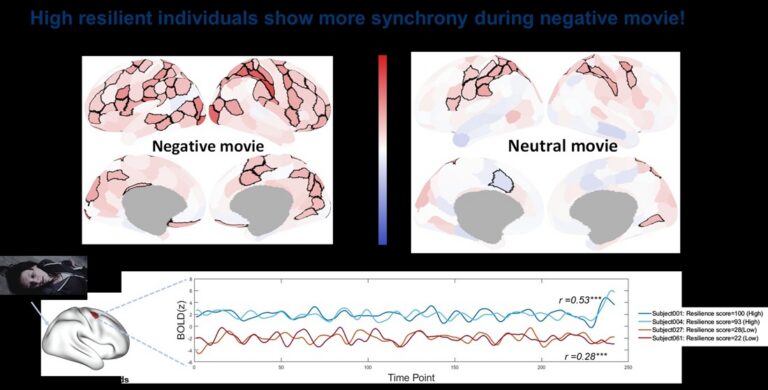
The study compared brain activity between individuals while they watched two films — one with neutral content and one with negative content. “The areas outlined in black show similar activity during the film among individuals with high psychological resilience,” said researcher Maryam Ziaei. Illustration: Kavli Institute for Systems Neuroscience
“All happy families are alike; each unhappy family is unhappy in its own way,” Leo Tolstoy wrote in his literary masterpiece Anna Karenina. Neuroscientists often refer to the Anna Karenina model: well-functioning systems are similar to one another, while problems can arise in many different ways.
“You can compare it to a car. Cars consist of many different parts, and all of them must work properly for the car to run. If one or more of the parts malfunctions, the car will eventually break down altogether,” Ziaei said.
An important aspect of mental health
The researchers explain that mental resilience is not a stable personality trait, but a dynamic process that influences how we perceive stress, assess situations and mobilize coping strategies. People with high resilience often experience more positive emotions, are quicker to let go of negative stimuli and regulate their emotions more effectively.

First author Shuer Ye. Photo: NTNU
“Psychological resilience is about our ability to cope with adversity and to adapt when something unpleasant happens. It is an important part of our mental health,” Ziaei said.
In addition to studying the neurobiological mechanisms, the researchers also wanted to investigate the role that being intolerant to uncertainty played in the relationship between brain activity and resilience. Intolerance of uncertainty (IU) is a personality trait in which uncertain situations are often perceived as threatening, stressful and upsetting.
- You might also like: Memories are the brain’s map of time
Discomfort in connection with uncertainty
UI is a risk factor for developing anxiety disorders.
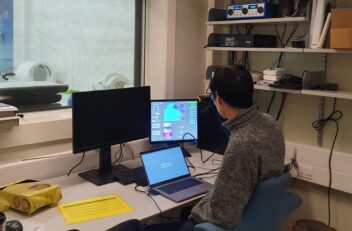
The participants in the study were asked to complete a series of self-report questionnaires, including measures of anxiety, depression, and perceived stress, as well as to carry out computer-based tasks. The brain scanning itself was done in the 7T MRI machine at St. Olavs Hospital. Here we see PhD candidate and first author Shuer Ye during the experiments. Photo: Maryam Ziaei
The researchers assessed this among the participants using a questionnaire in which answer options such as ‘Unexpected events make me very upset’ allowed patients to describe their tolerance of uncertainty.
“We found that individuals with higher intolerance of uncertainty exhibit lower resilience-related similarity in brain activity,” said Ziaei.
In other words, people who are less comfortable with uncertainty tend to have brain activity that is less ‘synchronized’ in the areas that help them focus and be resilient.
“This suggests that discomfort in connection with uncertainty can make it harder to recover from challenges because it affects what they focus their attention on in their surroundings,” Ziaei said.
Strengthening strategies
She believes that the findings are important for understanding how people can learn to become more resilient.
“If you become very anxious when something seems uncertain, it will affect how you function and how you use your resources to achieve mental well-being. People have different strategies for regulating their emotions, and these strategies can be worked on and strengthened,” emphasized Ziaei.
If an individual is intolerant of uncertainty, it will affect how they understand the world around them. They may experience it as being less resilient.
“Now that we know this component is important, we may be able to develop methods that can influence these mechanisms,” said Ziaei.
This may help people develop their ability to tolerate uncertainty or to regulate their emotions more effectively.
“That might be a good idea, considering that low resilience over time can make people susceptible to anxiety, depression and other neuropsychiatric disorders,” Ziaei said.
Reference:
Shuer Ye, Leona Rahel Bätz, Avneesh Jain, Alireza Salami, Maryam Ziaei; Resilience-related neural similarity during naturalistic movie viewing. Imaging Neuroscience 2026; 4 IMAG.a.1165. doi: https://doi.org/10.1162/IMAG.a.1165