“King Harald fulfilled his role exceptionally well”
Norway is an old monarchy with a long tradition of continuity. According to history professor Erik Opsahl, the country’s status as a kingdom is central to Norwegian identity and national self-understanding.
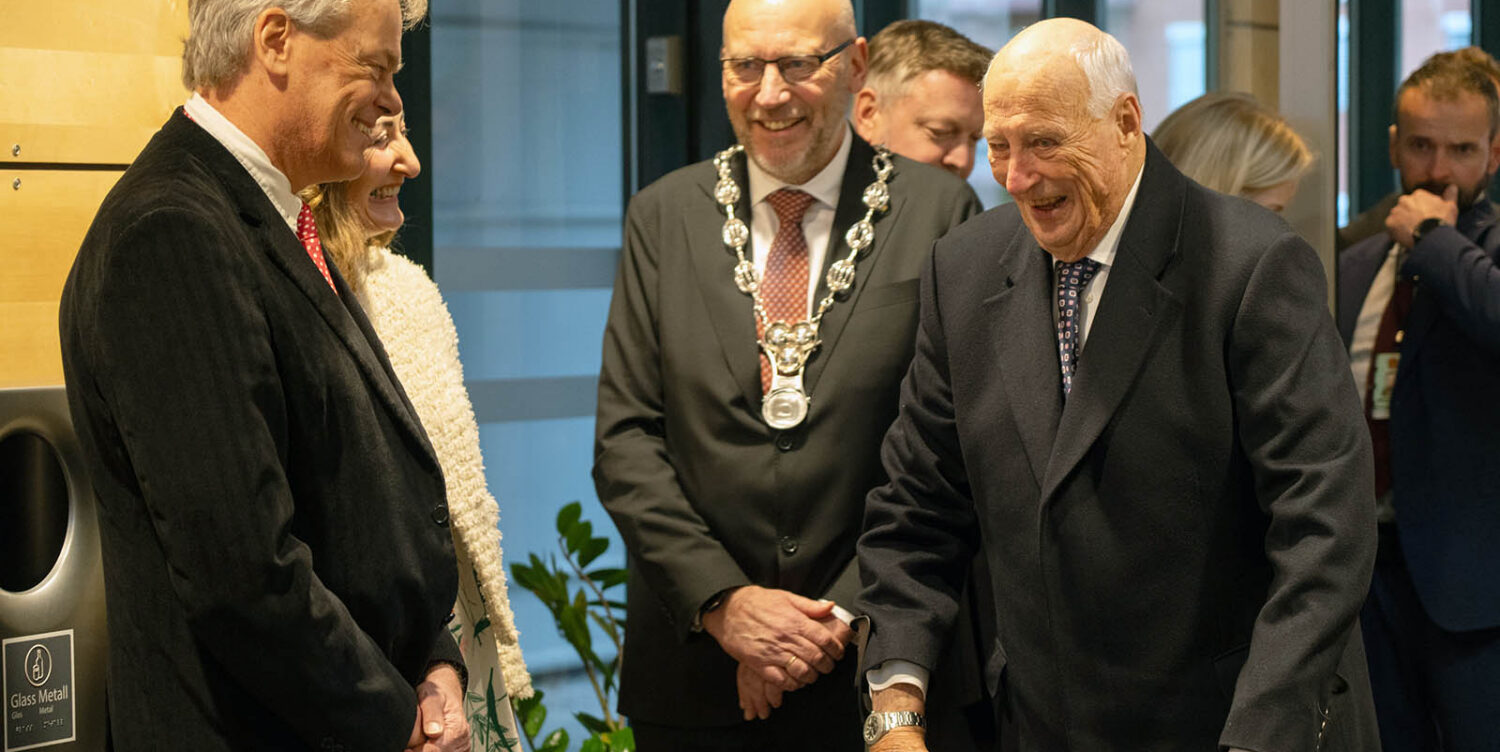
“We became very fond of the King,” explains Erik Opsahl, Professor of History at NTNU. “This fondness had a lot to do with his humility, his personality and his down-to-earth manner. He fulfilled his role excpetionally well, wisely and with great dignity.”
“Although there are clear constitutional rules governing the role of the monarch, every king has to find his own way of fulfilling it. It was not necessarily easy for King Harald to follow the much-loved King Olav, but Harald quickly became a popular king in his own right,” says Opsahl.
The historian also highlights the King’s disarming humour, his quick wit and his warm presence. “He used these qualities and his way of communicating to conveyed important messages. In principle, I am a republican, but the Norwegian monarchy has functioned well,” admits Erik Opsahl.
Opsahl met the King in connection with the launch of his book Norsk innvandringshistorie (A History of Immigration to Norway), at the Norwegian Museum of Cultural History in Oslo.
“When the King congratulated me and the other authors, he gave us a firm and distinctive handshake. I see that as a mark of character. Even though he must have shaken countless hands, there was nothing limp or routine about it; he was very present,” says Opsahl.
An ancient monarchy
“Norway is an old monarchy with a long tradition of continuity, and Norway’s status as a kingdom is important to Norwegian identity and national self-understanding,” emphasises Opsahl.
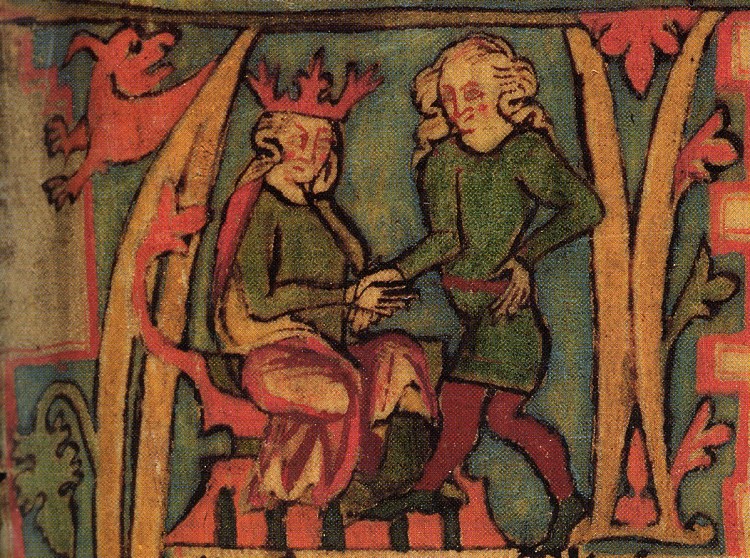
Harald Fairhair is crowned by his father, Halfdan the Black. The illustration is from the medieval manuscript Flateyjarbók.
The royal lineage stretches back to Harald Fairhair, who lived approximately from 870 to 930 and who, according to the sagas, united Norway into a single kingdom. Since then, the country has had 66 kings and one reigning queen.
The chronological list of Norway’s reigning monarchs, as shown on the Royal Court of Norway’s website, is often referred to as “the line of kings”, although it also includes one reigning queen and several earls who governed Norway on behalf of Danish monarchs.
Queen Margaret and the Kalmar Union
From the time of Harald Fairhair, Norway had 39 kings before assimilation under the common monarchy of Denmark and Norway in 1380, with Olav Haakonsson becoming king of both countries.
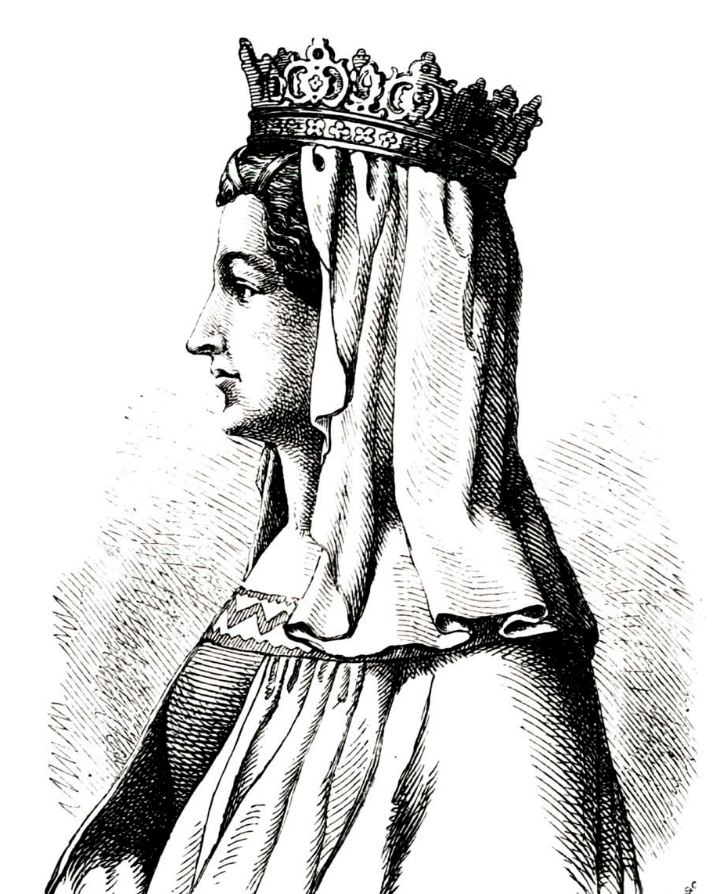
Queen Margaret.
By Hans Peter Hansen, 1884.
Licence: Public domain
The young Danish king was still a minor at the time, and so his widowed mother, Queen Margaret, became regent on her son’s behalf.
However, Olav Haakonsson died unexpectedly in 1387 and so Margaret was elected regent the following year. Margaret was effectively the reigning queen of Norway as “sovereign lady, lord and guardian”. She already held a corresponding position in Denmark, although without the title of Queen of Denmark, and later acquired the same role in Sweden.
Queen Margaret was the principal architect behind the political unification of the Nordic kingdoms in the late 14th century in what became known as the Kalmar Union. It was formally established at Kalmar Castle in Sweden in 1397, where Eric of Pomerania was crowned as the common king.
During the subsequent period of the Kalmar Union, Norway had eight different kings.
Danish rule
The Kalmar Union was dissolved when Gustav Vasa was elected King of Sweden in 1523 and Sweden left the union for good. Norway continued in a long-lasting union with Denmark, known as Denmark–Norway.
“In 1536–1537, Norway became politically subordinate to Denmark. The Norwegian Council of the Realm was abolished and the Reformation was introduced. Norway lost its formal equality with Denmark, but it continued to be described as a separate kingdom and was treated differently from the Danish provinces,” Opsahl explains.
The union with Denmark lasted until 1814. During this period, Denmark–Norway had 16 different kings.
Norway as a distinct entity
“For long periods of history, Norway was therefore ruled by foreign kings. But even when we were politically subordinate to Denmark from 1537 and later in union with Sweden, the Norwegian kingdom always remained a distinct entity,” says Opsahl.
“European states in the early modern period, from the 15th to the 18th centuries, were not nation states. They were composite states consisting of several kingdoms and territories, with one kingdom at the centre. The Danish-Norwegian union was part of a larger state ruled by the House of Oldenburg. It consisted of the kingdoms of Denmark and Norway, the duchies of Schleswig and Holstein, and the territories of the Faroe Islands, Iceland and – once it was rediscovered by Europeans – Greenland.”
“The Swedish-Norwegian union was a very loose one. Only the monarch, and therefore the foreign policy led by the monarch, was shared. It was a union between two states, with one monarch fulfilling two royal roles: the Swedish one and the Norwegian one,” summerises Opsahl.
An independent kingdom
The modern Norwegian monarchy emerged from 1905 onwards.
“During the dissolution of the union and the referendum in 1905, one of the questions was whether Norway should remain a monarchy or become a republic,” says Opsahl.
“Christian Michelsen, who was a highly capable prime minister during the dissolution of the union, was actually a republican. Nevertheless, he supported retaining the monarchy. He believed that, given the international situation, an independent kingdom was strategically important in order to secure full recognition from the great powers. Michelsen also believed that remaining a monarchy would send a stabilising signal both internationally and domestically,” clarifies Opsahl.
I snart 600 år har det norske folk aldri havt sin egen konge. Aldrig har han helt været vor egen. Altid har vi maattet dele ham med andre. Aldrig har han havt sit hjem iblandt os. Men der hvor hjemmet er, der bliver også fædrelandet.
In his welcoming speech to the young royal couple in November 1905, Michelsen said: “For almost 600 years, the Norwegian people have never had a king of their own. Never has he been entirely ours. We have always had to share him with others. Never has he had his home among us. But where one’s home is, there too is one’s fatherland.”
King Haakon VII remains Norway’s longest-reigning monarch to date, having spent 52 years on the throne from 1905 to 1957.
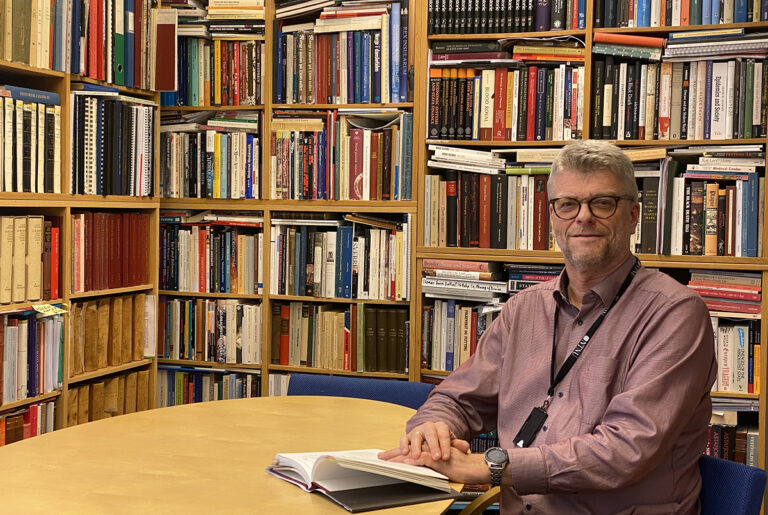
Professor Erik Opsahl is Director of the Centre for Medieval Studies at NTNU. Photo: Idun Haugan, NTNU
Will Norway still be a monarchy in 100 years?
“A historian should not really predict the future, but rather try to reconstruct the past. But let me put it this way: I would not be surprised if Norway were still a monarchy in 100 years. I think it is more likely than not. Norway as a monarchy has survived many periods of upheaval over more than a thousand years, which may suggest that the institution will endure,” says historian Erik Opsahl.
Kings who left their mark
Among the many monarchs who have ruled Norway, a number left a particularly strong mark. Erik Opsahl highlights some of those who have been most important to Norway, whether through tradition or through their actual political significance.
Harald Fairhair
Harald Fairhair was regarded as Norway’s first king to rule the whole country – the king who united the realm. He is believed to have reigned from around 870 to 930.
Olav Haraldsson, who became Saint Olav
Saint Olav is among Norway’s best-known kings. He came to be regarded as the man who Christianised Norway and, according to the sagas, performed several miracles after his death. He reigned from 1015 to 1028.
During the Middle Ages, he was elevated to the status of Norway’s eternal king and became a political and religious symbol of the Norwegian monarchy.
King Sverre, a gifted speaker and politician
Sverre came from the periphery of the kingdom, the Faroe Islands. He fought his way to the Norwegian throne in opposition of the regime of Earl Erling Skakke and his son, King Magnus Erlingsson.
Sverre reigned from 1177 to 1202, laying the foundations for the Norwegian Sverre dynasty, which lasted until the reign of Olav IV Haakonsson.
“We know more about Sverre than about any other Norwegian medieval king because of the saga written about him. Sverre himself supervised the early stages of its composition, and the saga was completed shortly after his death,” Opsahl explains.
Haakon Haakonsson and the Birkebeiner warriors
The Birkebeiner warriors famously carried the infant Haakon to safety on a perilous journey on skis through winter storms. The young heir had to be kept hidden because of a power struggle between the Birkebeiner and Bagler factions during Norway’s civil wars from 1130 to 1240.
The modern Birkebeiner ski race honours the best-known part of the journey, between Lillehammer and Gudbrandsdalen.
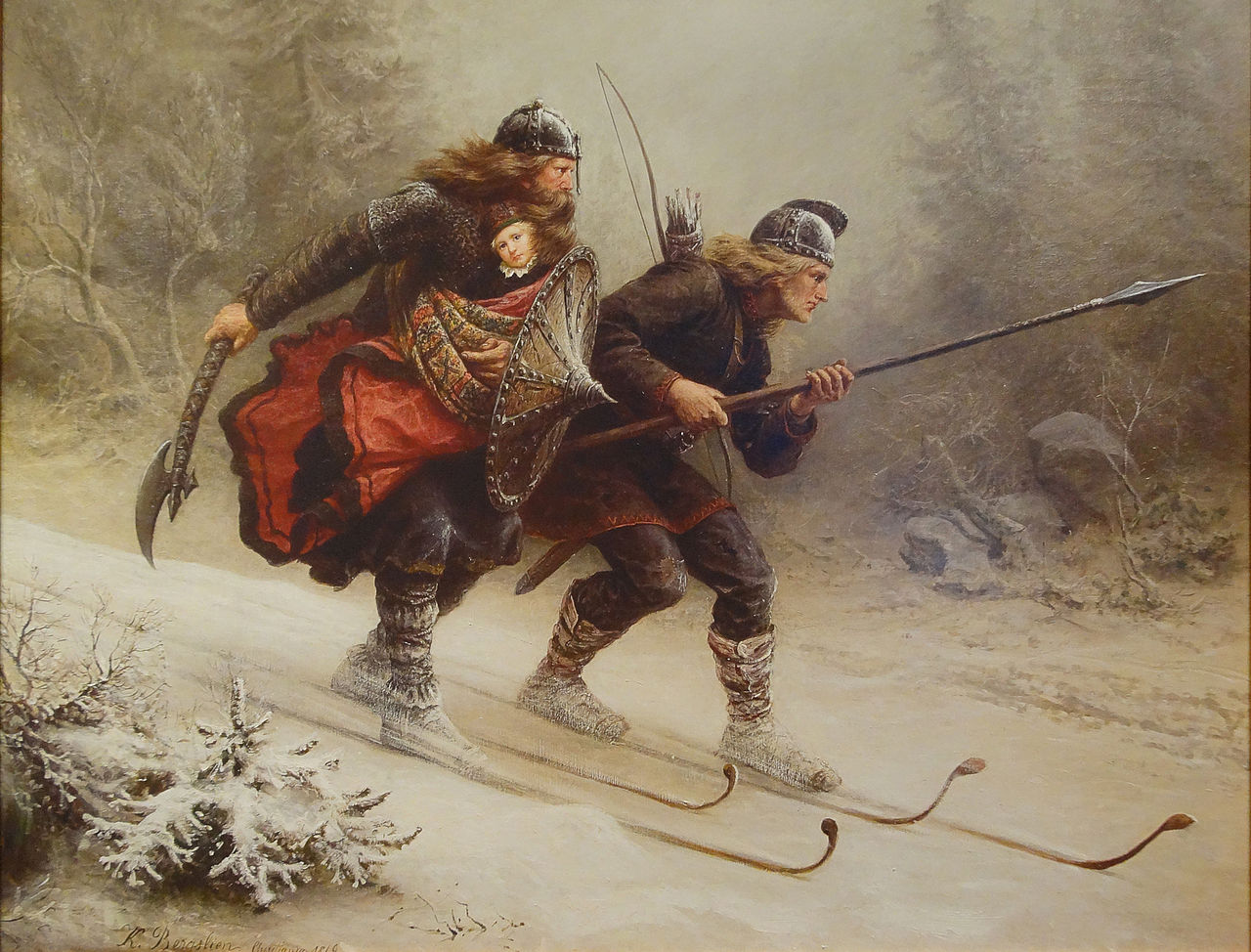
Knud Bergslien’s painting The Birkebeiner Warriors (1869) depicts the Birkebeiner warriors Torstein Skevla and Skjervald Skrukka fleeing from the Baglers with the young Haakon Haakonsson. The young heir was eventually reunited with King Inge Bårdsson in the Birkebeiners’ capital, Nidaros, in 1206. Photo: National Museum of Norway, public domain
During his long reign from 1217 to 1263, Haakon Haakonsson established a strong monarchy and became the foremost symbol of what is often described as Norway’s medieval golden age. Under King Haakon, the Norwegian realm reached its greatest geographical extent with teritories including Orkney, Shetland, the Hebrides, the Isle of Man, the Faroe Islands, Iceland and Greenland.
Magnus Haakonsson the “Lawmender”
Magnus the Lawmender was king from 1263 to 1280. He modernised and nationalised the Norwegian law-code, as well as introducing a separate law code for Iceland.
The 750th anniversary of the national law code was marked with major celebrations in 2024, with Erik Opsahl playing a central role in communicating its significance.
Magnus the Lawmender’s national law code was quite exceptional in a European context. It was only the third nationwide legal code introduced in medieval Europe, and the first to remain in use for a long period. Two years later, a separate urban law code was introduced for Norwegian towns. Town and countryside were governed by two separate legal systems in the Middle Ages.
Read more: Central Norway’s first high seat since the Viking Age
Christian IV – popular in Norway, but politically an unsuccessful king
Christian IV (often referred to as ‘Kristian Kvart’ in Norway) was the Danish-Norwegian king who, unlike the other Danish-Norwegian monarchs, visited the country regularly during his long reign from 1588 to 1648. One reason was that Norway was regarded as a land of opportunity, with major untapped resources, not least in mining.
The King was highly energetic and involved himself in matters both large and small. He moved the capital’s location and christened it Christiania (today Olso), and also established the town of Kristiansand. He secured Finnmark for the Norwegian kingdom, but lost the provinces of Jämtland and Härjedalen.
Overall, these actions had negative consequences, with disastrous state finances, lost wars and territories, and Norway becoming more closely integrated into a state under Danish control.
Karl Johan – the union king
The Swedish Crown Prince, Karl Johan, was regent and de facto head of state of Norway fom 1812. He was motivated to bind Sweden and Norway closer together politically. However, following a short war in 1814, he conceded to the establishment of a Norway as a politically autonomous state in 1814. It was the first step towards the country becoming a fully independent state from 1905 onwards.
By the end of his long reign from 1818 to 1844, Karl Johan had become popular among broad sections of the Norwegian population. He was the first king of Norway in modern times to be crowned in Trondheim, in 1818. Today, Oslo’s main thoroughfare bears his name, and he sits astride one of the very few equestrian statues in Norway, directly in front of the Royal Palace in Oslo.
The towering figure of Haakon VII
After the 1905 referendum on whether Norway should leave the union with Sweden, and on whether Norway should remain a monarchy, the King of Denmark demanded that a further referendum be held on whether the Norwegian people wanted him as their new king.
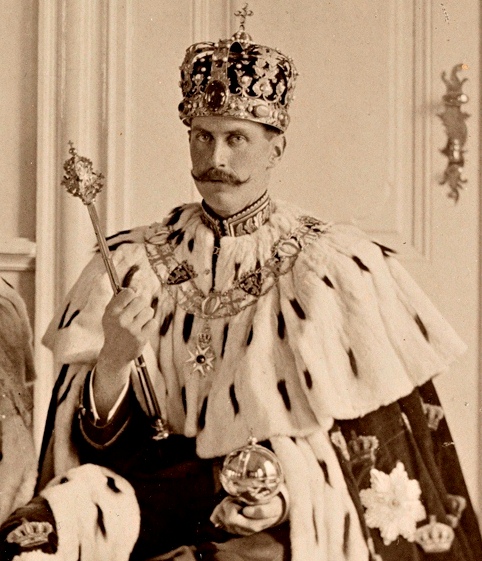
King Haakon VII was crowned in Nidaros Cathedral in 1906. Two years later, coronation ceremonies were abolished, and King Olav later introduced the tradition of royal consecration in Nidaros Cathedral.
Photo: Wikimedia Commons
The answer was yes.
King Haakon VII became a unifying and important symbol of the new, fully independent Norwegian state. He founded the modern Norwegian monarchy.
He handled his role well and embraced the whole of his new country. “I am also the king of the communists,” he is said to have remarked when he asked Christopher Hornsrud of the Labour Party to form a government in 1928 – Norway’s first Labour government.
King Haakon’s already strong position in Norway was greatly reinforced by his stance and his role during the Second World War.
His refusal in 1940 to accept Vidkun Quisling as prime minister and to submit to the German occupation made him the foremost symbol of a free Norway. From London, he worked tirelessly for the Norwegian cause
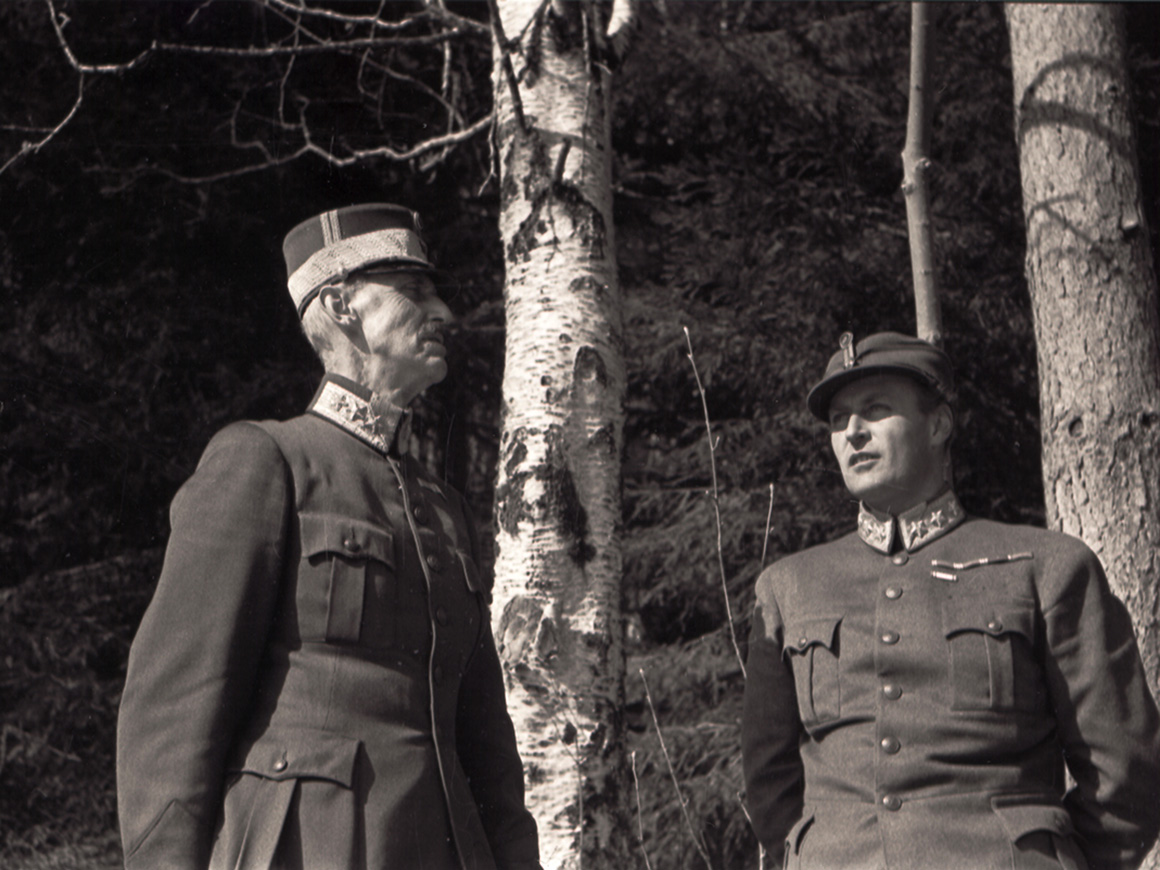
King Haakon VII and Crown Prince Olav on the outskirts of Molde during a German bombing raid on the town in April 1940.
Photo: Per Bratland / Wikimedia Commons