Maternal vitamin A deficiency may increase risk of larger babies
Pregnant women with low vitamin A levels during the latter part of their pregnancy gave birth to babies with significantly higher birth weights.
A study in Norway has identified a link between a mother’s vitamin A levels and her baby’s birth weight.
The recently published study shows that over 43% of the women had low vitamin A levels during the latter part of their pregnancy. While almost no one had levels classified as a severe vitamin A deficiency, two out of five had insufficient levels.
The study examined 723 women who experienced entirely normal pregnancies.
“We found a clear, unambiguous link between low vitamin A levels in the mother and high birth weight in the child. It is important to emphasize that while these factors appear to be connected, we cannot definitively state that one causes the other,” says Astrid Kamilla Stunes, a researcher at NTNU and the dental health centre TkMidt in the Trondheim region.
Very few women have extreme levels of vitamin A

Pregnant women in Norway are healthy in the international context. Very few smoke or consume alcohol, according to Stunes. Photo: Anne Sliper Midling
Many of the women who gave birth to babies with a high birth weight also had lower than average levels of vitamin A throughout their pregnancy, as compared to mothers of infants with normal birth weight.
Vitamin A is an important nutrient for both mother and child during pregnancy.
“Excessively high levels can lead to foetal malformations. In the worst-case scenario, a severe deficiency can result in the child being born blind. It is extremely rare for anyone to reach these extremes in Norway. As with many other things in life, the key is to stay in the middle, and to get just the right amount,” says Stunes.
She points out that Norwegian dietary guidelines are excellent.
“If you follow the dietary guidelines, you’ll get enough vitamin A. However, perhaps there has been too much focus on foods that pregnant women should avoid, and not enough on the foods they should be eating,” says Stunes.
- You might also like: Good for mum, but allergy incidences in her children increased fivefold
Ten percent have a high birth weight
Vitamin A is found in a wide variety of foods, such as fatty fish, eggs, dairy products, red and green vegetables (like carrots), and liver pâté.
In an international context, pregnant women in Norway are healthy.
“Very few smoke or consume alcohol. All pregnant women receive excellent follow-up care, and there is good access to a varied diet. We are a wealthy and well-nourished population. In low-income countries, it is a well-known global issue that pregnant women suffer from a vitamin A deficiency. It was surprising to see these findings in Norway as well—though fortunately, very few individuals had a severe deficiency,” says Stunes.
In Norway, babies weighing more than four kilograms are considered to have a high birth weight.
Over the past five years, the proportion of babies with a birth weight exceeding four kilograms (statistics in Norwegian) has remained at around 10%.
“A large foetus increases the risk of various complications, including during childbirth. We also know that babies with a high birth weight are more likely to become overweight later in life. However, it is important to clarify that our study is not sufficient to conclude that a mother’s vitamin A deficiency during the latter part of pregnancy causes childhood obesity,” says Stunes.
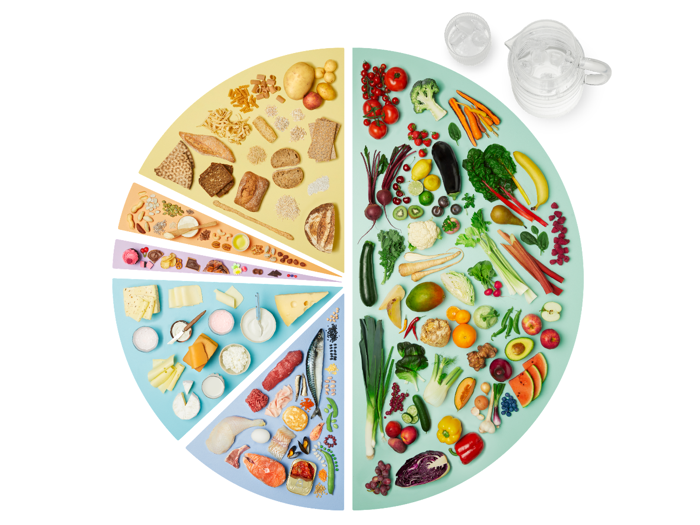
The Norwegian dietary guidelines developed by the Norwegian Directorate of Health are summarized in the form of an “Eat Well Plate”. These recommendations outline what you should eat to stay healthy and well. One of the recommendations is to maintain a varied diet and to choose primarily plant-based foods. Photo: Helsenorge
Changes in the Norwegian diet
Bente Prytz Mjølstad, a general practitioner and associate professor at NTNU, is particularly pleased that none of the women had overly high levels of vitamin A.
“Historically, the high levels of this vitamin have been a cause for concern. Vitamin A is fat-soluble, which means that if you consume too much, it can accumulate in the body over time,” says Mjølstad.
She notes that the concern regarding high vitamin A intake among pregnant women is that it can potentially harm the foetus.
“This was one of the reasons why the vitamin A content in cod liver oil was reduced. It is also encouraging that the study shows very few participants with a clinical deficiency of the vitamin,” says Mjølstad.

The study shows that the Norwegian diet may be changing, including among pregnant women. Bente Prytz Mjølstad, a general practitioner and associate professor at NTNU, advises that following the Norwegian dietary guidelines is the most important action they can take. Photo: Karl Jørgen Marthinsen
“A few years ago, studies revealed that some pregnant women were not getting enough iodine. Now we have recommendations regarding folate and vitamin D supplements, and for some women, iron supplements are recommended. It now appears that vitamin A status may also be lower than expected,” says Mjølstad.
The diets of young women and pregnant women are changing She suggests that this may also reflect the ongoing changes in the general population’s eating habits.
“A lot of young people today don’t drink milk or eat fish. For most individuals, a healthy and varied diet is the most important factor, but dietary supplements can be useful when meeting nutritional needs through food alone is difficult. It’s important to follow the current dietary guidelines during pregnancy,” says Mjølstad.
How the study was conducted
The researchers analysed data from 723 women with uncomplicated pregnancies. Information regarding health and blood samples was collected during both the second trimester (weeks 18–22) and the third trimester (weeks 32–36). Levels of retinol – a form of vitamin A – were measured in the blood using a precise laboratory method. Data on the infants’ birth weights were obtained from medical records.
The researchers then conducted a statistical analysis to determine whether there was a correlation between the mother’s vitamin A levels and the infant’s birth weight.
None of the women had a vitamin A deficiency during the second trimester, while 1.9% had low levels during the third trimester. A larger proportion had what are considered insufficient levels of vitamin A: 8.6% in the second trimester and 43% in the third trimester.
In total, 17.3% of the infants had a birth weight of four kilograms or more – a weight classified as undesirably high. The analyses further showed that a 0.2 micromole per litre reduction in the mother’s retinol level was associated with an increase in the child’s birth weight of between 31 and 68 grams. This association was observed whether vitamin A was measured during the second or third trimester, as an average of both measurements, or as the change between the trimesters.
Mjølstad points out that measured serum retinol does not necessarily reflect the body’s total vitamin A stores, and that the study alone cannot determine the clinical significance of these low levels or their underlying causes.

An easy way to ensure sufficient vitamin A intake is to eat carrots or other red and green vegetables, such as bell peppers. Illustrative photo: Colourbox
Research:
Dirnena-Fusini I, Stafne SN, Gustafsson MK, Mosti MP, Sujan MAJ, Syversen U and Stunes AK (2026) Maternal vitamin A levels during second and third trimester and associations with offspring’s birth weight: a longitudinal cohort post-hoc study. Front. Nutr. 13:1835994. doi: 10.3389/fnut.2026.1835994