An uninvited guest leads to a new antibiotic
Alexander Fleming famously discovered penicillin back in 1928, when an experiment he was running was accidentally was contaminated by mold. When bacteria contaminated one of her cancer cell cultures in 2011, researcher Marit Otterlei decided to follow in Fleming’s footsteps.
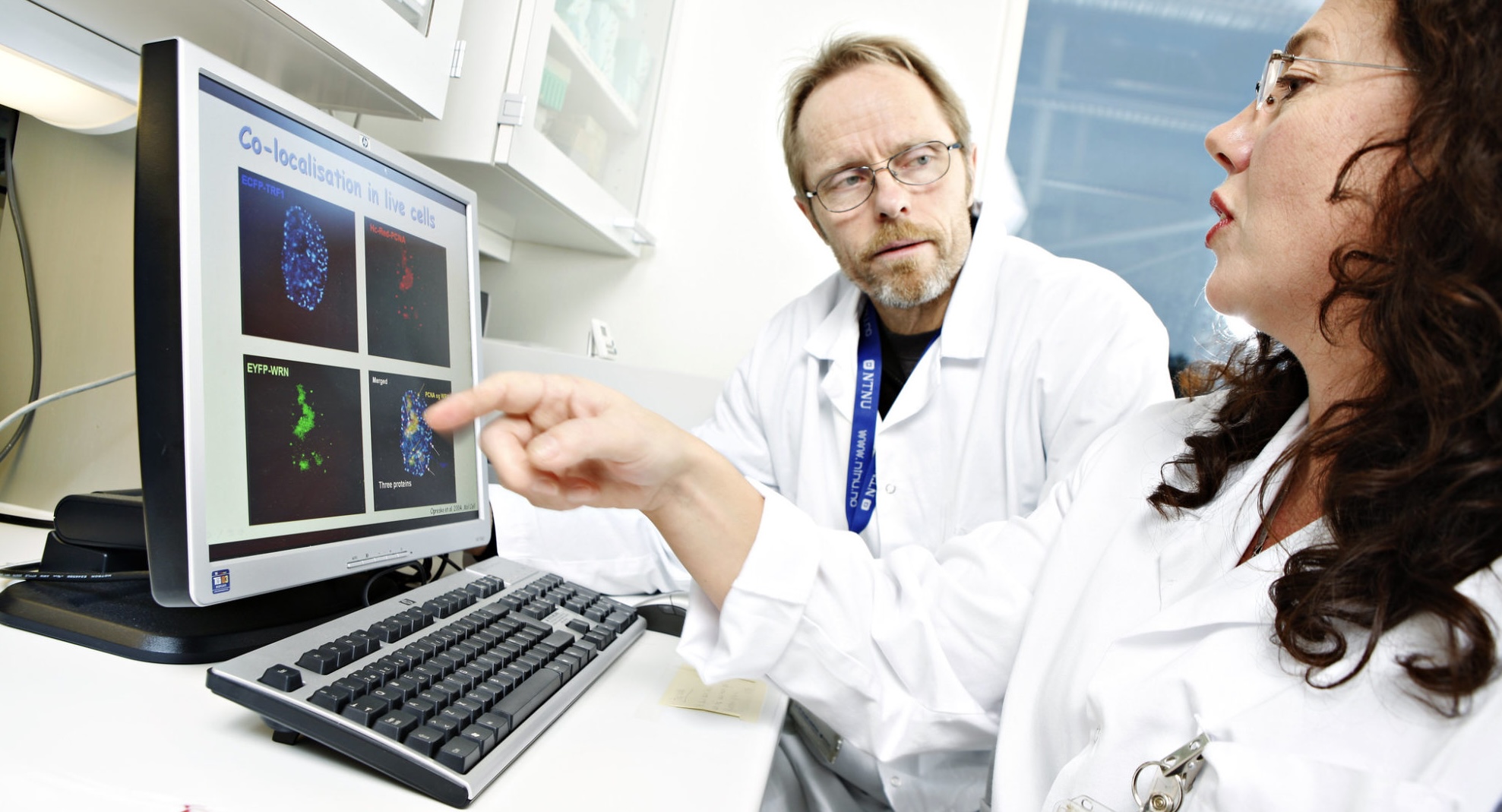
NTNU professor Marit Otterlei nearly threw out the contaminated cell culture where she and her colleagues were testing a new cancer drug.
It had been a hot summer day, in Trondheim, in a country not known for hot summer days. So the researchers opened the lab’s windows overnight.
Sometimes, the key to saving lives can be hidden in a protein that hasn’t changed much over billions of years.

Alexander Fleming in his laboratory at St. Mary’s Hospital in London during WWII. Fleming famously discovered penicillin in 1928, but the antibiotic wasn’t available for widespread use until the 1940s. Photo: Ministry of Information Photo Division Photographer, Public domain, via Wikimedia Commons
When they came back the next day, they found an uninvited guest, snuggled in with their cancer cell culture: Bacteria!!!
Here’s the thing, though: although the drug had been designed to work on human cancer cells, it looked like it had killed the bacteria, too!
That was remarkable, because the cancer drug targeted a specific mechanism that human cells use to replicate. It looked like the drug also targeted the same mechanism in bacteria — even though the tree of life had branched away from bacteria 3 BILLION years ago! How could that be?
This episode of NTNU’s 63 Degrees North podcast takes a peek into the challenging world of what it takes to bring a drug, especially an antibiotic, to market.
But it’s also an inside look into how some researchers, with their deep curiosity about the nuts and bolts of how life actually works, can come up with startling discoveries that may someday save our lives. Sometimes, the key to saving lives can be hidden in a protein that hasn’t changed much over billions of years.
To hear the full story, listen to this episode of 63 Degrees North:
References:
Gilljam, Karin Margaretha; Feyzi, Emadoldin; Aas, Per Arne; Sousa, Mirta; Müller, Rebekka; Vågbø, Cathrine Broberg. (2009) Identification of a novel, widespread, and functionally important PCNA-binding motif. Journal of Cell Biology
Nedal, Aina; Ræder, Synnøve Brandt; Dalhus, Bjørn; Helgesen, Emily; Forstrøm, Rune Johansen; Lindland, Kim. (2020) Peptides containing the PCNA interacting motif APIM bind to the beta-clamp and inhibit bacterial growth and mutagenesis. Nucleic Acids Research (NAR)
Nepal, Anala; Ræder, Synnøve Brandt; Søgaard, Caroline Krogh; Haugan, Maria Schei; Otterlei, Marit. (2021) Broad-Spectrum Antibacterial Peptide Kills Extracellular and Intracellular Bacteria Without Affecting Epithelialization. Frontiers in Microbiology