Babies are born to learn – and they learn by moving
In her 35 years as a psychologist, NTNU researcher Audrey van der Meer has studied everything from baby swimming to what infants learn before they are born. At the core of her work is the idea that babies are born to learn – and the key to their learning is movement.
We’re in a brightly lit room with blue and yellow tape on the floor, laid out at a 90-degree angle. On one of these lines is a little five-month-old baby whose name is Live. The room is in the NuLab facility, a developmental neuroscience laboratory at NTNU’s Dragvoll campus.
The onset of self-produced locomotion in the form of crawling really gives a boost to the baby’s brain.
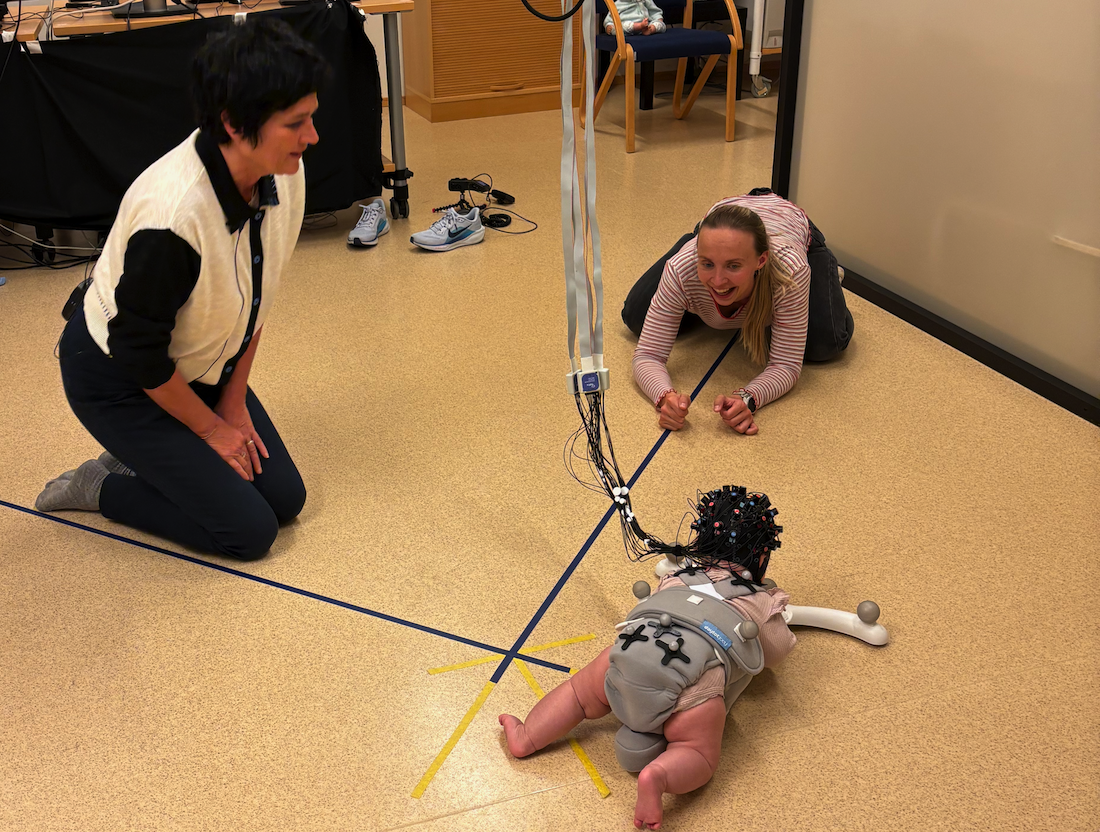
Brain researcher and professor of neuropsychology Audrey van der Meer looks on as Baby Live uses a kind of baby skateboard to move towards her mother, Ina. Live isn’t crawling yet, so scooting along on the skateboard is a new kind of movement for the five-month-old. The cap that Live is wearing enables researchers to measure what is happening in her brain as she for the first time moves in this new way. Photo: Nancy Bazilchuk, NTNU
Live is on her belly, strapped securely to what looks like a baby skateboard, or maybe a surfboard. The skateboard enables her to push with her arms and legs to move, like a turtle moves its body by pushing with its flippers. The advantage of the skateboard is that she can explore the world around her without having fully developed the strength to actually crawl.
Live’s head is covered with a black net cap festooned with very colourful discs. These discs are attached to wires hanging from a movable arm above her. The whole setup has a bit of a Hollywood feel, as if Live is a robot baby controlled by the wires. The wires, of course, enable van der Meer to peer into Live’s brain as she learns to move in a way she has never moved before. Her mother, Ina, calls to Live to inspire her to move.
“The idea is that when babies are only capable of lying flat on their backs, staring up at the ceiling, you don’t need advanced neural networks that inform you about distance, direction, time to collision and all these kind of important things,” she said on the latest episode of 63 Degrees North, NTNU’s English language podcast.
“But as soon as the baby has become mobile, it needs to process and pick up this information quickly and reliably and efficiently. We see in our research that the onset of self-produced locomotion in the form of crawling really gives a boost to the baby’s brain.”
- You might also like: Newborns’ clumsy arm movements show how smart they are
Inspired by her own children
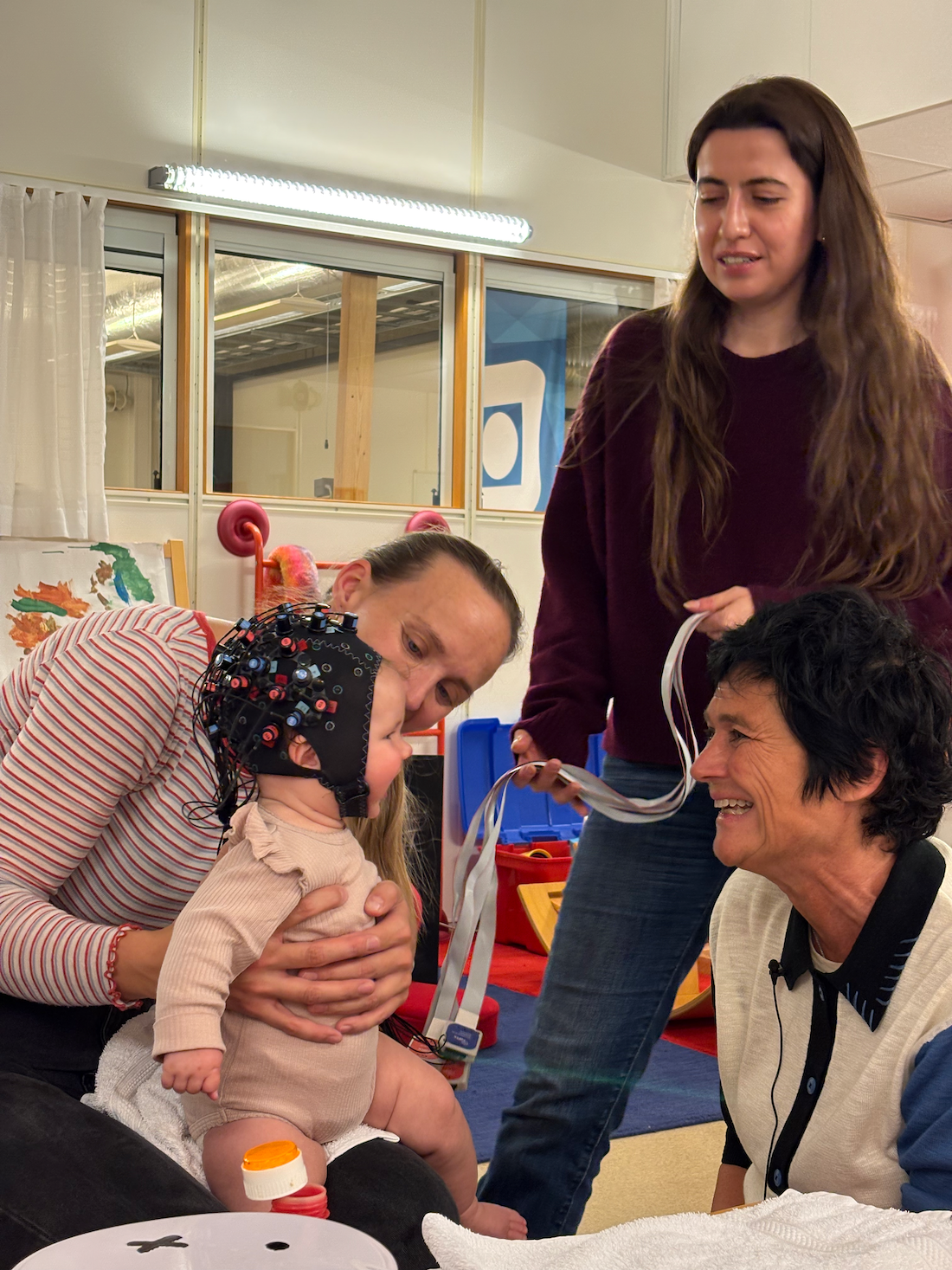
Baby Live is fitted with a special cap that enables researcher Audrey van der Meer to record what’s going on in her brain as she moves in different ways. Photo: Nancy Bazilchuk, NTNU
For years, the conventional wisdom had been that very young infants are only capable of reflexive movements like sucking, because their brains weren’t developed enough to control their bodies.
But as a young PhD candidate in Edinburgh, van der Meer became convinced that early infant movements were very deliberate.
Just how did she come by this epiphany? By watching her own young children, of course.
“I noticed that even the earliest arm movements are under visual control. So newborn babies have a genuine interest in their visual arms, and they will work to keep their arms in their field of view,” she said on the podcast.
Proving this, however, proved to be challenging. In the end, she was able to come up with a technique that showed without a doubt that babies were acting deliberately.
“We had this experiment where we pulled their arms away from their face in the direction of their toes by small weights. And we saw that the baby will fight those weights in order to keep their hand in their visual view. And the other hand that is not visual will be pulled down the more weights we added,” she said.
“That was the first evidence that movements made by very young newborn babies are already voluntary and intentional. So that was my aha moment.”
A move north and a big grant
An academic article about this research was published in 1995 in Science Magazine, one of the top academic journals in the world. At the same time, van der Meer and her husband and research partner Ruud van der Weel moved from the University of Edinburgh, where they both did their PhDs, to NTNU.
Newborns and young babies are much smarter than we tend to give them credit for, and they are actually born with a brain that is ready to learn from day one.
They won a big grant from the Research Council of Norway, with which they bought the special brain imaging equipment that they still use today.
While much of that research has focused on very young children, the brain imaging equipment has also enabled van der Meer and her colleagues to explore other questions. One such experiment was initiated when the research lab was contacted by Microsoft, which was working with a tablet product with a keyboard and a pen.
The company knew about the lab’s brain imagining equipment and wanted to know if the researchers could see if it was better to write by hand or type.
“Initially I was kind of skeptical, and I thought that it wouldn’t be possible even with our expensive system to see differences,” van der Meer said.
Movement involves the whole brain
It took some trials to figure out how to set up an experiment that would illuminate the difference between writing and typing.
The whole brain is active when you are writing by hand and forming those letters by hand or drawing, whereas only a fraction of the brain is active when you’re typing.
But they did. A 2020 paper about this research has been viewed nearly 330,000 times.
“What we see is that the whole brain is active when you are writing by hand and forming those letters by hand or drawing, whereas only a fraction of the brain is active when you’re typing. And that is because when you’re typing, you only use very simple finger movements that are actually exactly the same for every letter that you’re trying to type,” van der Meer said.
A subsequent study followed up on this research and looked at implications of using devices such as tablets in the classroom. The conclusion was that handwriting was superior in helping students read and write. This study has had roughly 265,000 views.
“When you’re writing by hand, you literally feel with your whole body and all of your senses that an A is produced completely different from a B, with a completely different underlying motor pattern. And it requires completely different muscles,” van der Meer said. “And that is probably the reason why young children who have learned to read and write on a tablet have difficulty with letters that are mirror images of each other, because they haven’t felt with their bodies that the underlying motor pattern is completely different.”
- You might also like: Why writing by hand makes kids smarter
Brain development and baby swimming
Van der Meer likes to say that movement is the language of the brain. Part of this is because movement allows a young baby to explore its world.
That holds true even when that movement is baby swimming, in part because it represents extra physical stimulation. In a 2022 article, van der Meer and her master’s student, Julie Borge Blystad, found some surprising advantages from this early exposure to physical activity.
“Compared to the traditionally raised Norwegian group of babies, in which babies spent up to 90% of their awake time flat on their backs, the baby swimmers were advanced in their motor skills, so they started crawling on average five weeks earlier, and they also showed brain development that was much better,” van der Meer said in the podcast.
Audrey van der Meer is one of the experts for the episode called “Movement” in the Netflix series on Babies from 2020.
News from the womb
Van der Meer is currently in Brazil, following up on a recent interesting find about babies and the way they cry.
By applying machine learning to recordings made by mothers of their newborns, Van der Meer and her colleagues have detected distinct patterns that reflect the language they would have heard while in the womb.
“We have found that Norwegian babies cry differently than French babies, Arabic babies, Italian babies, and that the Norwegian babies in a more singsong kind of manner, and that reminds of Norwegian or Scandinavian,” she said. “And we have reasoned or found that they need to have picked up these characteristics of their native language while they were still inside the womb.”
Van der Meer hasn’t published an academic article on this yet, since she’s still collecting data.
But if her findings hold true, these recordings could provide early clues about hearing in newborns.
“This has implications, of course, for babies born with a hearing deficit because if we are right, they would cry in a different way, not characteristic of their native language,” van der Meer said.
Ready to learn from Day One
When asked about her most important message for new parents, van der Meer was clear: don’t underestimate these tiny beings.
“Newborns and young babies are much smarter than we tend to give them credit for, and they are actually born with a brain that is ready to learn from day one,” she said on the podcast.
Even after nearly four decades of research on newborns and infants, van der Meer continues to marvel at how much a baby learns early on.
“I think it’s just fascinating to realize that when you hold a newborn baby, it can’t even hold up its own head. And then in the course of the first year, that same baby is running up and down the stairs. It’s uttering its first words, and it has developed a whole personality of its own. And I, as a developmental neuroscientist, I like to understand the underlying mechanisms that drive development,” she said.
Listen to the podcast, where Audrey’s work is featured in the first half of the episode:
Sources:
Jin Wang, Belde Mutaf-Yildiz, F.R. (Ruud) van der Weel, Audrey L.H. van der Meer,
Development of visual motion perception from infancy to early childhood in full-term and premature children: A longitudinal high-density EEG study,
Neuropsychologia, Volume 221, 2026, https://doi.org/10.1016/j.neuropsychologia.
Van der Weel F. R. (Ruud) , Van der Meer Audrey L. H.Handwriting but not typewriting leads to widespread brain connectivity: a high-density EEG study with implications for the classroom.Frontiers in Psychology, Volume 14,2023 https://doi.org/10.3389/fpsyg.2023.1219945
Julie Borge Blystad, Audrey L. H. van der Meer. Longitudinal study of infants receiving extra motor stimulation, full-term control infants, and infants born preterm: High-density EEG analyses of cortical activity in response to visual motion. Developmental Psychobiology, 2022 https://doi.org/10.1002/dev.2227
A.L.H. van der Meer, F.R. van der Weel and D.N. Lee. The Functional Significance of Arm Movements in Neonates Science, 3 Feb 1995, Vol 267, Issue 5198,pp. 693-695 DOI: 10.1126/science.7839147