
How healthcare can benefit from AI, without costing the world
AI is already widely used in hospitals and medical research. Can a new way of thinking unleash the technology’s green credentials?
In brief
What is Green Artificial Intelligence? Six areas that can make AI more environmentally-friendly:
- Cloud optimization tools: Improve data centres and cloud systems, reducing computing power and saving energy.
- Model efficiency tools: Simplify AI models so they can perform the same tasks more efficiently, while maintaining accuracy.
- Carbon footprinting tools: Models that enable researchers and developers to measure the environmental footprint of AI systems and their associated carbon emissions.
- Sustainability-focussed AI tools: AI technology designed to tackle the world’s environmental challenges.
- Open-source initiatives: Promote the sharing of software, standards, methods and ideas to ensure emergent AI technologies have access to best practice.
- Green AI research and research communities: Increase knowledge and understanding about the concept of Green AI, by building a dedicated research community.
Artificial Intelligence (AI) has had a transformative effect on healthcare. The technology has been tested and applied in almost every area, from disease diagnostics to AI-powered digital clinics.
The rationale always tracks back to efficiency: AI-technology will achieve more with less. In theory, greater efficiency contributes to sustainability.
But what about the environment cost? Will healthcare be picking up the bill later down the line?
These are the questions being asked in a new paper, Green Artificial Intelligence in Health Applications.
Green AI
Environmental costs should be integrated into AI development, argues the paper’s co-author, Alok Mishra, Professor in Data Management and Software Engineering at NTNU.
“AI is coming up all around the world. It can’t be stopped,” admits Mishra. “AI models require lots of energy and huge data centres. These data centres consume large amounts of electricity and use significant quantities of fresh water.”

Alok Mishra, Professor in Data Management and Software Engineering at NTNU. Photo: private
Mishra has previously proposed the need for ‘Green AI’; a holistic look at the technology’s impact on the environment.
His latest research examines the use of AI in health applications. It argues that the technology is “not working sustainably” and environmental consequence should be on equal footing with privacy, bias, fairness, transparency and other concerns about emergent AI-technology.
The environmental cost
Concerns about the environmental cost of AI are echoed by many. The International Energy Agency (IEA) estimates that data centres’ power consumption will double by 2030, reaching a level equivalent to Japan’s total electricity consumption.
Increased energy demand could lead to more carbon emissions and environmental degradation. This will affect quality of life and have health consequences for people around the world.
The IEA suggests, however, that AI can also be part of the solution. Fatih Birol, the agency’s Executive Director, spoke about “Energy for AI, and AI for Energy,” in the 2025 AI & Energy report. He points to the fact that AI could be used to operate power grids more efficiently, saving up to 175 gigawatts of transmission capacity in the process – enough to power Oslo for a year.
It is possible to develop AI sustainably. The technology can also be used for beneficial purposes. But unsustainable growth also points to a looming environmental cost.
The research asks the questions: What impact will this have on healthcare? And who will pay the price?
Healthcare an early adopter
Healthcare has been one of the technology’s most enthusiastic early adopters. Improvements in medical services and research have tangible benefits for people’s lives.
“These tools are very helpful for health professionals,” explains Mishra. “In no other area has the implementation of AI been as impactful as healthcare.
“For example, when doctors are dealing with thousands of pieces of information, they can use the technology to speed up analysis and assess the status of a particular patient or disease.”

“Personally, I’m optimistic about our energy prospects. But these are political questions more than scientific or medical ones,” says Åsmund Flobak, an oncologist at St Olav’s hospital. Photo: Anne Sliper Midling
Åsmund Flobak is an oncologist at the Cancer Clinic at St. Olav’s Hospital, professor at NTNU and senior research scientist at SINTEF. His field is among those that have adopted AI technology in healthcare.
“I’m involved in next-generation diagnostics for cancer patients, where we cultivate ‘living biopsies’ from patients to test drugs on the patients’ own cells,” explains Flobak. “Here we are using AI in image analysis to assess which of the cells are dying and which are not when exposed to different drugs.”
“In the Cancer Clinic we also routinely use AI-assisted drawing of what should be irradiated and what should be spared during cancer radiotherapy. We have started using auto-generated notes in patient consultations. AI will also soon come with tools to help us parse all data available for each patient,” says Flobak.
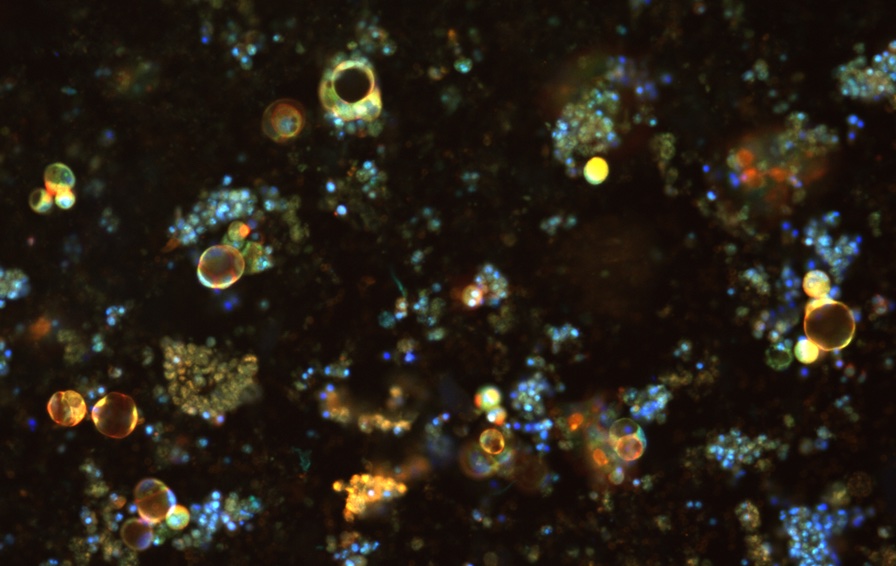
Mini-tumours grown in the laboratory. AI analyses the image, to help researchers understand how a drug works or to identify differences between patients. Photo: Christa Ringers, NTNU.
AI is increasingly used in a wide range of areas, including medical imaging, diagnostics, treatment planning, drug discovery, hospital management and telemedicine.
Flobak was asked whether, in his experience, environmental impact is considered when the technology is introduced?
“It is not something we discuss actively, no. This is something that should be sorted out at the policy level. The benefit to patients is difficult to turn down, for instance when using AI to ensure irradiation doses to healthy tissue are kept as low as possible.”
“Personally, I’m optimistic about our energy prospects. But these are political questions more than scientific or medical ones. In my daily life as a doctor, I prioritise every benefit I can give my patients, within the guidelines and regulations I work under.”
- Read more about Flobak’s research: Living longer with personalised chemotherapy – despite incurable cancer
Environmental impact
When offered the opportunity to accelerate life-saving research, environmental impact has not always been prioritised in healthcare, although sometimes it is considered.
Mishra’s research systematically reviewed 47 studies of AI in healthcare, where sustainability was a consideration. They found the results to be ‘siloed’ – well-intentioned initiatives, which did not always take the bigger picture into account.
The concept of Green AI is that AI applications cannot solely be implemented in a sustainable manner or, say, built on efficient models. It is not enough to simply be hosted by energy-optimised data centres or rely on the fact the technology will be used for good.
In order be truly ‘green’, AI development must take all aspects of its environmental impact into consideration.
This requires a life-cycle assessment, considering everything from manufacture to usage to recycling at the end of a product’s life. Mishra compares it to a kitchen appliance which has an energy rating, or an airline providing passengers with information about carbon emissions, and offering the chance to offset these through a donation.
It’s a tall ask for an industry which is typically shrouded in secrecy and not forthcoming about its energy use and data storage, acknowledges the professor.

The expansion of data centres, and the energy they consume, is at the heart of the discussion. These data centres consume large amounts of electricity and use significant quantities of fresh water,” explains Alok Mishra, professor at NTNU. Photo Geoffrey Moffett / Unsplash.
A paradigm shift
Mishra argues that a paradigm shift is necessary in order to address the environmental, ethical and operational challenges of AI.
“It is not just a political question anymore. Stakeholders and citizens are facing environmental consequences in daily life,” stresses the researcher.
He points to the environmental disasters which have hit parts of Asia and Europe this year.
“Landslides, melting glaciers, flash floods and heatwaves put pressure on health systems,” says Mishra. “Environmental consciousness therefore has to be at the core of AI development and application in healthcare.”
“AI use and its applications should be part of the picture, but they should also take into consideration sustainability issues. Is the answer to AI simply more AI? No, as researchers we want AI to be used in a sustainable manner so that it can provide more benefits to society.”
Reference:
Alzoubi YI, Mishra A. Green artificial intelligence in health applications. Artif Intell Med. 2026 Aug;178:103442. doi: 10.1016/j.artmed.2026.103442. Epub 2026 Apr 28. PMID: 42070542.