The AI train is moving at express speed. Tech giants are in the driver’s seat, while national governments and international institutions are several steps behind in developing roadmaps and guidelines.
The EU has taken several steps to address both the challenges and opportunities presented by artificial intelligence. European AI infrastructures are now being developed, including one for research data.
A virtual resource institute, RAISE (Resource for AI Science in Europe), was established by the European Commission last year, as part of its strategy for accelerating and managing the use of artificial intelligence in science.
In October 2025, RAISE launched three platforms: a central hub, a collaboration forum and an observatory that maps Europe’s AI ecosystem in science. The initiative is still in its pilot phase.
In November, the European Commission’s Joint Research Centre (JRC) launched its own platform, the JRC Scientific AI Hub.
The platform provides independent, research-based tools, analyses and insights designed to promote the safe and ethical use of artificial intelligence in research and public policy.
These initiatives form part of a broader European effort to develop trustworthy AI for science. The broader question is how Europe ought to design the institutions and practices needed to govern AI systems effectively. What will it take to create a European AI infrastructure that helps ensure science is grounded in accountability and trust?
Facts about RAISE
- RAISE functions as a virtual research institute and a platform connecting European universities, supercomputers and research communities.
- The initiative gives researchers access to computing power (including through the EU’s AI Gigafactories), curated datasets, training and research funding through Horizon Europe.
- The RAISE Pledging Initiative is a separate scheme under which organisations and stakeholders commit to providing infrastructure, grants, software or funding to strengthen European AI research.
Learn from the best
“Platforms and virtual institutions can connect people and resources, but they do not create trust in themselves. In science, trust has been built through practice,” says NTNU researcher Kyriaki Papageorgiou.
She believes Europe’s investment in AI for research can draw many important lessons from CERN, one of the world’s largest research centres for particle physics.
For more than 70 years, the European research centre has organised some of the world’s largest and most complex international scientific collaborations. CERN enjoys a strong reputation and a high level of trust.
The idea of a “CERN for AI” has become a prominent metaphor in discussions about a European AI research infrastructure.
Trust is key
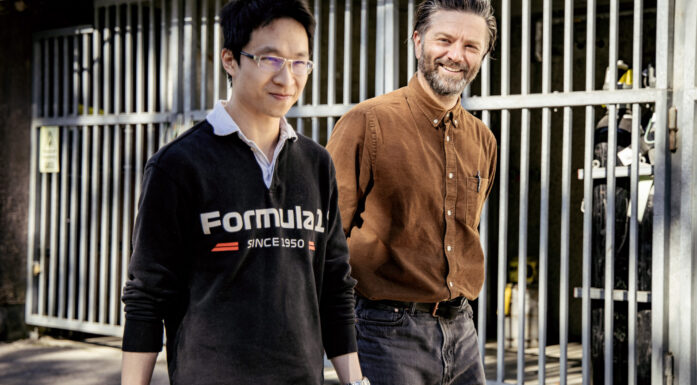
“We can learn a great deal from CERN, particularly about how trust can be built around complex scientific systems,” says Kyriaki Papageorgiou, a senior researcher at the Centre for Science and Society, Department of Interdisciplinary Studies of Culture at NTNU.

Kyriaki Papageorgiou is a senior researcher and Marie Curie Fellow.
Papageorgiou has investigated what enables CERN to enjoy such a high level of trust, and which lessons may be relevant as Europe develops its AI infrastructure. She carried out this analysis as part of her Marie Skłodowska-Curie-funded research project at NTNU.
CERN, known for bringing together talented researchers from around the world in some of the largest scientific collaborations in history, is often highlighted as a model for international research infrastructure.
Trust is central to what CERN has managed to achieve:
- Trust among thousands of researchers
- Trust in complex technical systems
- Trust in research findings
- Trust across national borders and political interests
Not a direct copy
Papageorgiou is not arguing that Europe should simply copy CERN. Rather, CERN highlights essential elements of scientific infrastructure that are easily overlooked:
- Visibility – so that systems can be observed
- Collective evaluation – so that findings can be challenged and verified
- Transparency about uncertainty – so that doubt is made visible rather than hidden
- The ability to stop – when risks or uncertainty make it necessary
Facts about CERN
- A European organisation that aims to support European collaboration in research in particle physics, nuclear physics and nuclear chemistry.
- CERN was founded in 1954 at the initiative of UNESCO, following negotiations between 12 European countries that became members, including Norway.
- The aim was to secure funding for research in nuclear and particle physics in Europe to enable the field to compete with equivalent research in the United States.
- Strengthening European and international collaboration was also an important objective.
- The research centre is located on the border between Switzerland and France, near Geneva, with infrastructure in both countries.
- A fundamental principle of CERN is that research should be open and accessible.
Source: Great Norwegian Encyclopedia (Store norske leksikon)
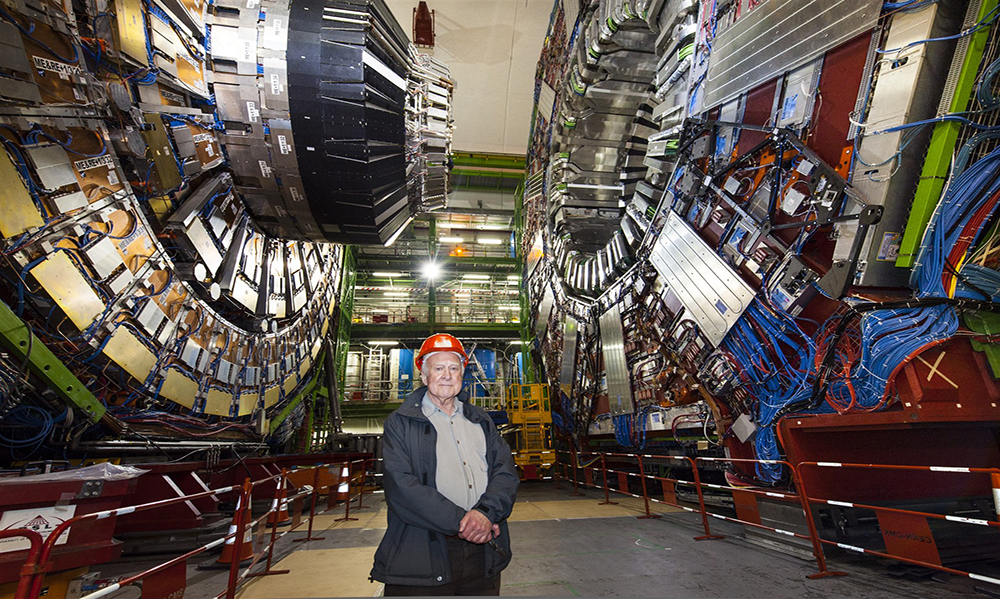
The Higgs boson is one of CERN’s most famous discoveries. Peter Higgs was a British theoretical physicist. He received the 2013 Nobel Prize in Physics together with François Englert for their theoretical work that led to the discovery of the Higgs boson. The discovery was confirmed in 2012 using the particle accelerator at CERN. Photo: Maximilien Brice, CERN.
Three key lessons
- Visibility
CERN makes complex systems visible. Although its particle accelerator is located deep underground, CERN has developed institutions, control rooms, exhibitions and observation practices that allow researchers and the public to gain insight into what is happening.
Kyriaki Papageorgiou points out that AI research lacks comparable mechanisms.
“Today, we have little insight into which models are being developed, what data are being used, which risks are being identified and what problems arise along the way,” explains Papageorgiou.
“RAISE should therefore develop a kind of ‘sensory apparatus’ for this: not a single instrument, but many. It requires contributions from people who can observe developments from different disciplinary perspectives, such as engineers, politicians or anthropologists. Together, they can monitor and analyse AI development on our behalf as it unfolds.”
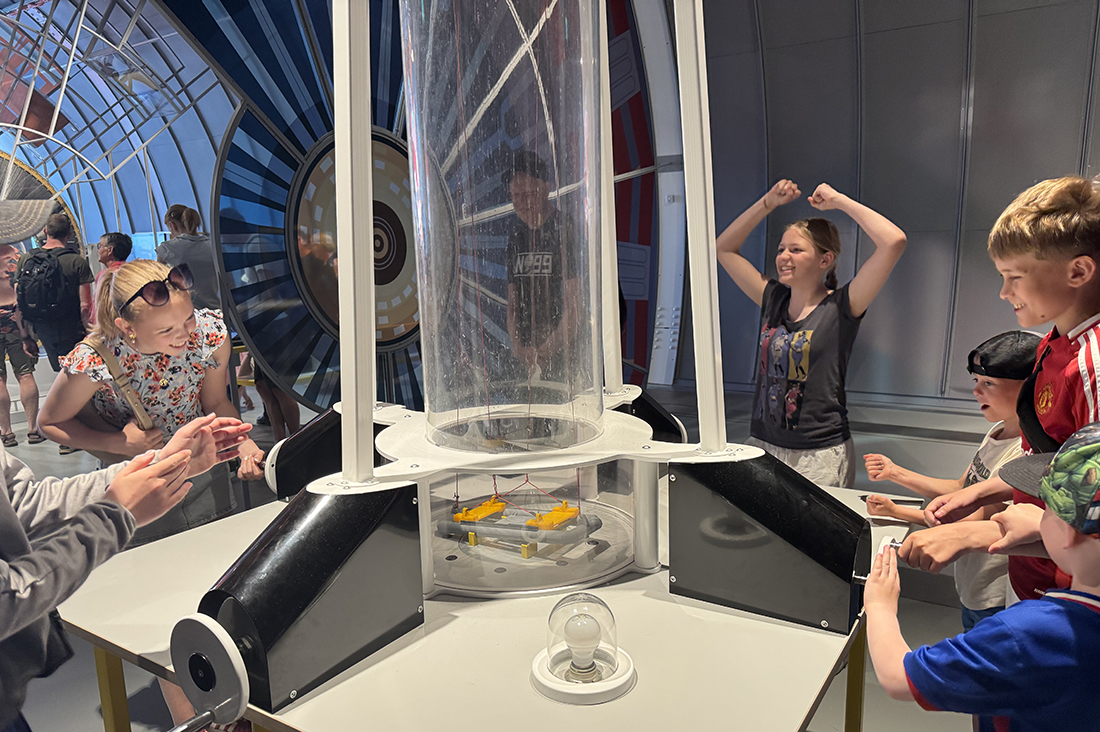
CERN also has extensive exhibition and outreach spaces where the research conducted at the centre is presented to both children and adults. Photo: Idun Haugan, NTNU.
- Collective evaluation
At CERN, no major findings are accepted without extensive scrutiny. Research findings must undergo peer review, multiple levels of checking and independent verification. The goal is not speed, but quality.
“Discoveries become credible because many people have had the opportunity to criticise, check and improve them,” says Papageorgiou.
“AI research needs similar mechanisms. Having control rooms and monitoring systems is not enough. There must also be procedures that make it possible to challenge interpretations and determine when a result is genuinely reliable.”
- Make uncertainty visible
In particle physics, considerable time is devoted to describing what is not known. Uncertainty is measured, documented and discussed.
“Researchers do not try to hide their doubts. They make them explicit. This is one of the most important aspects of quality assurance in CERN’s research,” Kyriaki Papageorgiou believes.
AI systems operate in the opposite way. They produce answers that often appear confident and authoritative, even when they are based on uncertain statistical patterns. This creates what researchers call an “illusion of understanding”, which conceals potential doubts and uncertainty in the underlying evidence.
Kyriaki Papageorgiou believes that future AI infrastructure must make uncertainty visible in the same way CERN does.
‘Dump the beam’
Researchers at CERN have been know to stop an experiment while it is in full progress. In the language of particle physicists, this is known as “dump the beam”.
CERN stops research experiments if something appears to be wrong. Researchers acknowledge uncertainty and doubt, and change course when the evidence calls for it. Measuring instruments are recalibrated, and systems that do not work are redesigned.
Papageorgiou believes this is the most important lesson for artificial intelligence: a trustworthy system must have the ability to stop, reflect and verify whether it is heading in the right direction.
An enormous experiment
Papageorgiou describes the current AI landscape as an enormous experiment conducted by a handful of technology companies, without sufficient transparency, shared oversight, collective evaluation or clear ways of measuring the consequences.
“Development is largely driven by competition to build larger models and achieve faster growth. As a result, many of the qualities that Europe itself says should characterise trustworthy AI are missing, including lawfulness, ethics, robustness and accountability,” says Papageorgiou.
But something can be done about this.
“Trust does not emerge from technology alone. It is created through the social, organisational and scientific practices that surround the technology. Europe has the opportunity to build that capacity, but not through a virtual institute alone,” Papageorgiou concludes.
Research:
Papageorgiou, Kyriaki. How CERN Earns Trust at Scale. Issues in Science and Technology 43, no. 1 (Fall 2026): 54–59. https://doi.org/10.58875/TLHM9740