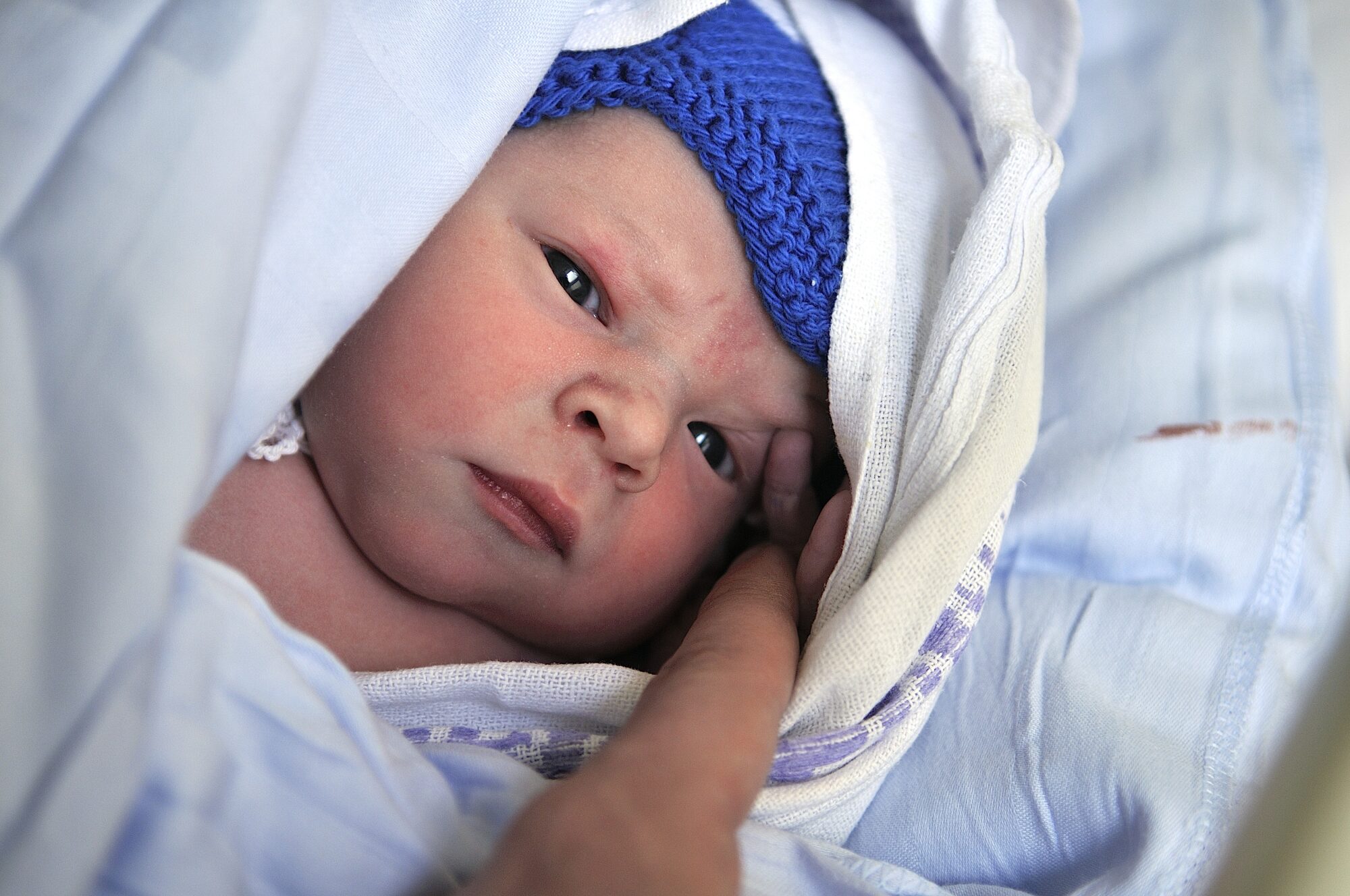
Centralizing Norwegian hospitals has reduced birth mortality
One million births in Norway over 17 years have a story to tell: Maternity wards with greater numbers of births have safer births.
In brief
Researchers at NTNU have investigated the effect of both the size of the maternity ward and travel time on the child's risk of dying in connection with childbirth.
The study used data from over a million births in Norway over a period of 17 years.
Longer travel time significantly increases the risk of giving birth on the way to the hospital, but there is little evidence that longer travel time increases the risk of death.
There is a clear correlation between the size of the maternity ward and mortality. The more births a maternity ward has, the less frequent the deaths become.
Some women only have to travel a short distance to the nearest maternity ward, while others have to cross fjords and mountains. Needless to say, these distances can cause great anxiety and uncertainty, especially when the birth is well on its way.
Researchers at NTNU have now investigated the effect of both the size of the maternity ward and travel time on a baby’s risk of dying in connection with childbirth. The study used data from more than one million births in Norway over a period of 17 years.
There were several clear findings:
- Longer travel times significantly increase the risk of giving birth on the way to hospital, but there is little to indicate that longer travel times increase the risk of death.
- There is a clear correlation between the size of the maternity ward and mortality. The more births a maternity ward has, the rarer the deaths.
- Smaller hospitals have more babies delivered by caesarean section
- There is a 55 per cent higher risk of the child dying shortly before or shortly after birth if the mother is expected to give birth in a hospital with 500 births a year compared to a hospital with 2000 births a year. The effect levelled off at 2000 births per year.
- There is roughly doubling in the risk of giving birth on the way to the hospital for every 30 minutes increase in travel time.
Fewer than one birth a week
“There may be other good arguments for maintaining a highly decentralized maternity service, but lower mortality associated with shorter travel times does not seem to be one of them. Our findings support Norway’s decision in recent decades to centralize hospitals to reduce childbirth-related mortality,” said Fredrik Carlsen. Carlsen is a professor of economics at NTNU, and a member of the research team behind new study.

Johan Håkon Bjørngaard. Photo: NTNU
Fewer children are born in Norway than before, and fewer people live in rural areas than before. The population base for maintaining birthplaces in our elongated country thus runs out of time by itself.
From 1967 to 2016, the number of birthing places in Norway was reduced from 182 to 48.
Norway now has 43 maternity services.
While birthing centres are required to maintain their professional competence, there is no lower limit to the number of births needed to retain a maternity service.
The smallest maternity institutions in Norway have fewer than one birth per week, according to Norway’s Medical Birth Registry.
“The smallest birthing places are basically for births with little risk. At the same time, our study shows that there is a greater propensity to use caesarean sections in small hospitals. This may suggest that obstetricians in larger hospitals have more training in using less invasive techniques such as forceps and vacuums,” said Andreas Asheim, a researcher at NTNU’s Department of Clinical and Molecular Medicine.
Mostly a political decision
When labour starts, women generally know where they should go to give birth. According to national guidelines (in Norwegian), pregnant women are offered follow-up by health personnel so that potentially risky births can be identified in advance.

There are currently 43 maternity clinics in Norway. All clinics must meet requirements to maintain their professional competence, but there is no lower limit on the number of births to maintain a maternity clinic. Photo: Shutterstock, NTB Scanpix
“Births that are believed to pose an extra risk to the mother or child are referred to one of the large hospitals. Women will give birth in a hospital where the professional services are best adapted to the needs of both the woman and the child. A prerequisite for ensuring safe follow-up of women in labour is a well-functioning system for identifying high-risk births. However, it’s not possible to identify all high-risk births in advance,” says Johan Håkon Bjørngaard, a professor at NTNU’s Department of Public Health and Nursing.
Women who have apparently uncomplicated pregnancies, and who live close to small hospitals, may thus face a weaker maternity service if they nevertheless have complications during childbirth, the research team believes.
“It is important that we have the knowledge to have the discussion about how best to organize maternity care. There is a trade-off between the risk of long travel times and the need for an adequately sized maternity ward. This is a complex, and ultimately a political decision. As researchers, we can only make sure that the consequences of the choices made are as clear as possible,” Bjørngaard said.
Designed the study in a unique way
Quality in maternity care is difficult to study because women who have high-risk births are referred to large hospitals. The statistics will thus show a higher incidence of birth complications at larger hospitals, even thought the size of the hospital isn’t really a factor in determining where it is safest to give birth.
“For the same reason, we might expect to find a higher risk with long travel distances, as the most high-risk births will be sent to large hospitals and thus have a longer travel distance,” says Bjørngaard.
To avoid this, the researchers took into account both the division of tasks and other differences between mothers who give birth in large and small hospitals.
The researchers have thus compared women according to which hospital they were supposed to give birth at in the first place – and not where they actually ended up.
How the study was conducted
1. Women who moved from one catchment area to another between pregnancies:
The woman could be compared to herself if during the first birth, she lived in a municipality in the catchment area of a large hospital but for her second birth, lived in a municipality in the catchment area of a small hospital (or vice versa). The woman was thus compared with herself.
2. Women who live in neighbouring municipalities, but in catchment areas of different hospitals, were compared.
Women who live close to each other probably have more in common than those who live far apart. The researchers assumed that which side of the municipal border the mother settled on was not associated with her risk of a complicated pregnancy.
Safe to give birth in Norway
The study included all births in Norway (approx. 1.1 million) from 1999 to 2016.
The researchers used data from two subgroups: 203464 births from women who had moved between pregnancies, and 460776 births from women who lived in neighbouring municipalities.
“It is important to emphasize that it is safe to give birth in Norway. There are few deaths, but we are facing major changes over where people choose to live. If we maintain many small maternity wards, it will be very important to ensure prenatal care so that everyone who needs the expertise that the large hospitals possess can get it when they need it,” Bjørngaard said.
Reference:
Asheim, Andreas; Nilsen, Sara Marie; Opdahl, Signe; Risnes, Kari; Balstad Magnussen, Elisabeth; Carlsen, Fredrik; Davies, Neil Martin; Bjørngaard, Johan Håkon. The Effects of Hospital Delivery Volume and Travel Time on Perinatal Mortality and Delivery in Transit: Causal Inference with Triangulation. Epidemiology 36(3):p 425-435, May 2025. | DOI: 10.1097/EDE.0000000000001840