Reinventing personalized fashion with a new sewing app
Wouldn’t it be great if you could just take a picture of yourself with your mobile phone and sew your own clothes – in exactly the right size and fit? The solution is on the way.
Today, the world is flooded with cheap, mass-produced fashion. Enormous amounts of clothes are thrown away, partly because they don’t fit. It happens on such a large scale that it has become an environmental problem. The Oslo-based company Fæbrik wants to do something about that.
Fæbrik’s business idea is to inspire people to sew and repair clothes themselves. The company sells patterns, surplus textiles and sewing supplies. Now SINTEF – a world-leading non-profit research foundation in Norway – has been brought on board.
Fæbrik recently launched the app Tæilor, which helps you achieve perfect fit on clothes you sew yourself. Maybe, thanks to technology, you’ll eventually be able to buy clothes tailored specifically to you from the major clothing manufacturers.
Personalized sewing patterns
The Tæilor app was created in collaboration with SINTEF and the product design and game company Agens. The way the app works is that users take four measurements of themselves, enter them into the app and adjust a digital body figure to make it resemble their own body shape. The app then creates a sewing pattern that the user prints out to make the garment.
For now, only the Penny skirt can be sewn this way, but Norwegian founder Ingrid Vik Lysne at Fæbrik promises that more garments will be coming soon.
To get the most accurate possible reproduction of a person’s body from a mere four measurements, Agens collaborated with pattern designers at Fæbrik. Using their expertise, Agens defines parametres to calculate and map the body’s measurements and shapes.
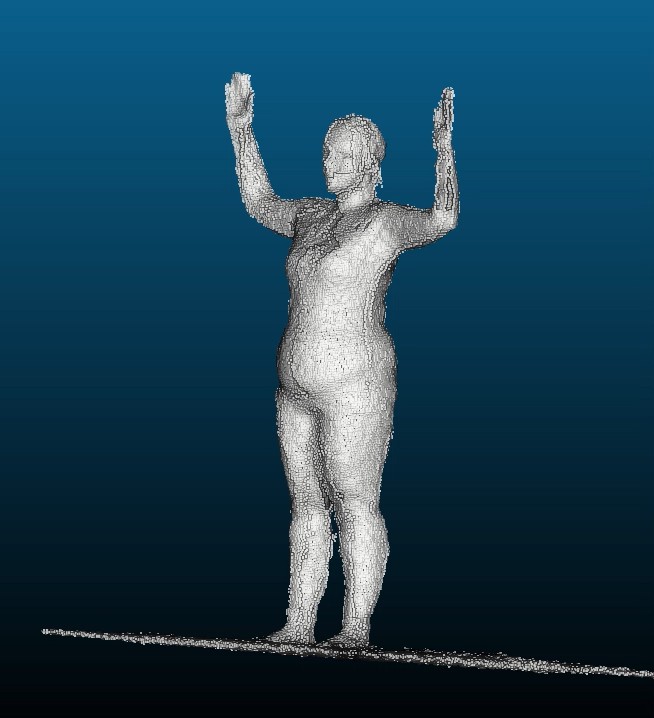
Point cloud that forms an digital image of a body. The data will be used for personalized sewing patterns. Data: SINTEF
Creating a digital model of the body
Marianne Bakken is a researcher at SINTEF Digital, and having sewed her own wedding dress, she clearly has more than a passing interest in sewing . She was fired up when she saw the Instagram post in which Ingrid at Fæbrik talked about the development of the Tæilor app.

Researcher Marianne Bakken at SINTEF.
“I thought, this requires research expertise,” Bakken says, “and so I got in touch since I work with sensors and algorithms to enable computers to understand the outside world, called computer vision.”
“For this project we set up six 3D sensors to scan a human body and create the most accurate model possible. The measurements generated millions of points that formed a three-dimensional point cloud recreating the body,” says Bakken.
Goal is to expand with more patterns
Scanning technology was not up to speed for the first version of Tæilor. However, Bakken is working with Agens and Fæbrik on an application to the Research Council of Norway for an IPN project (Innovation Project for the Industrial Sector). The goal is to develop 3D measurements and algorithms for any garment – completely automatically.
According to the researcher, the advantage of scanning is that it generates a correct digital representation of the person. You only need to do it once, and the avatar can be used to make all kinds of clothes.
“You don’t have to be an enthusiastic seamstress or tailor either, and with an avatar the garment can be sewn anywhere in the world. Of course, it’ll be even easier when you can do the scanning on your mobile phone. But that will probably still take a while,” says Bakken, who welcomes other partners to join the collaboration.
Facts:
Project name: Fæbtailor
Partners: Agens, Fæbrik, SINTEF
Project leader: Anders Kråkenes, Agens
Project leader SINTEF: Marianne Bakken
Duration: 2024-2025
Funded by: Oslo Municipality, Handelens Miljøfond