Bacteria survive washing and disinfection in food production plants
Can bacteria that survive washing and disinfection in food production facilities spread antimicrobial resistance?
Bacteria in food can make you seriously ill, which is why it is so important for the facilities that produce your food to ensure proper hygiene in their production lines.
A new doctoral thesis from NTNU has investigated how bacterial communities in the chicken and salmon industries change when disinfectants are used.
“These types of facilities can harbour bacteria that affect food safety. Some bacteria survive even the strictest hygiene regimens,” said Thorben O. Reiche.
Reiche is affiliated with the Department of Biotechnology and Food Science and recently defended his doctoral thesis, which is based on several research articles.
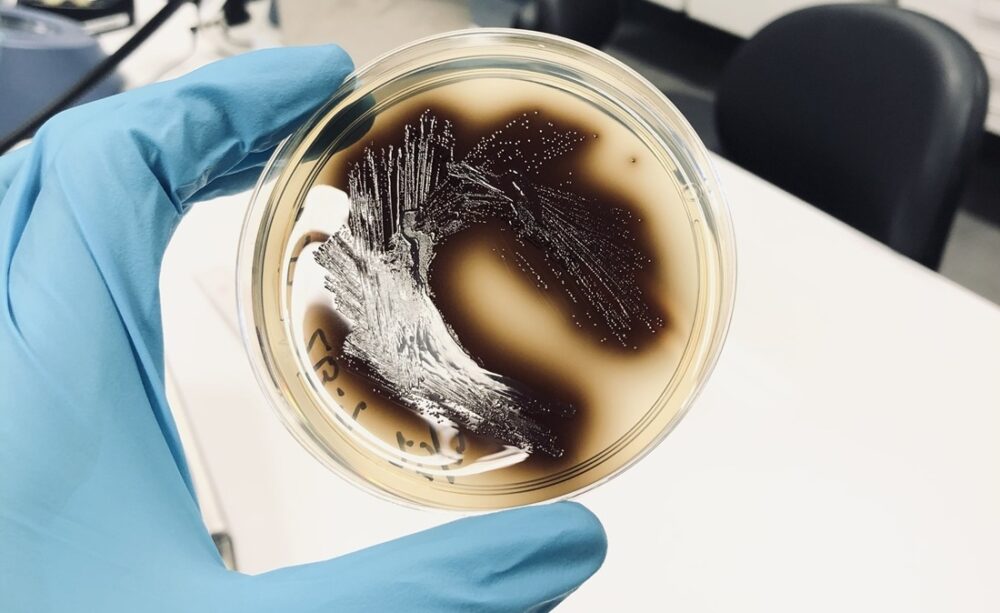
Bile Esculin Agar (BEA) is a smart medium for detecting Enterococcus, a tough gut bacterium that can withstand bile salts. When the bacterium breaks down a substance in the agar (esculin), the byproduct reacts with iron salts and produces the characteristic black colour seen here. This proves the presence of Enterococcus. Photo: Thorben O. Reiche, NTNU/SINTEF
Resistant bacteria
When bacteria become resistant to antibiotics, it is called antimicrobial resistance (AMR). AMR causes problems in many areas, including food production, and certain strains of bacteria can also be resilient to disinfection, making them difficult to eradicate.
“Research shows that bacteria that withstand certain types of disinfectants may also be resistant to antibiotics,” said Reiche.
This means that food industry research also plays an important role in combating AMR.
Investigations in Norway and Romania
In the recent study, researchers collected around 1000 bacterial samples and 100 DNA samples from production facilities for both chicken and salmon in Norway, and for chicken in Romania.
These samples were analyzed using high-throughput screening and modern sequencing technology.
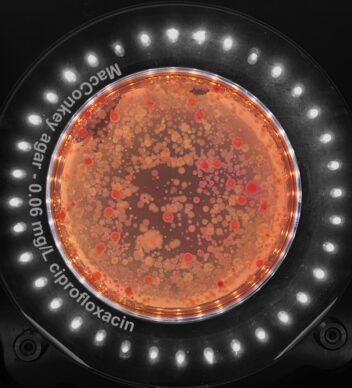
Vibrant red colonies on MacConkey agar: the ability to grow here indicates that the bacteria are resilient. The colour and growth help microbiologists identify common gut bacteria and test their resistance. Photo: Thorben O. Reiche, NTNU/SINTEF
“The results show that cleaning and disinfection are usually effective in reducing bacteria levels. But some areas still had a high prevalence of bacteria, including pathogenic bacteria,” explained Reiche.
Cleaning reduced bacteria levels by more than 90 per cent, but did not eradicate everything.
Some of the potentially pathogenic bacteria found after disinfection included Escherichia coli, Enterococcus faecalis, Acinetobacter baumannii and Pseudomonas aeruginosa. There were slightly higher levels of bacteria in Romania than in Norway after cleaning and disinfection.
Pseudomonas protects other bacteria
After disinfection, Pseudomonas bacteria often dominated. These bacteria are known to form a biofilm that can help more bacteria survive.
“This biofilm can also protect bacteria other than Pseudomonas itself, posing a potential risk to food safety,” added Reiche.
Pseudomonas is a large and diverse genus, but fortunately, the researchers found mostly harmless bacteria.
Found high-risk genes
However, the researchers found a wide range of genes that can confer resistance to antibiotics, some of which are considered high-risk. These were found within the facilities themselves, as well as in waste discharges and rest raw materials.
Living bacteria can of course spread resistance genes, but so it seems can dead bacteria. Even if we kill the bacteria, the genetic material can survive. Individual genes are harmless in themselves, but they can be absorbed by living bacterial cells.
“Waste discharges from the facilities contained the highest number of unique genes. These discharges end up in the ocean. This means that there is a risk of spreading AMR to marine environments,” said Reiche.
He concludes his doctoral thesis by stating that the production of salmon and chicken can contribute to the spread of antibiotic resistance both in the food chain and in the environment.
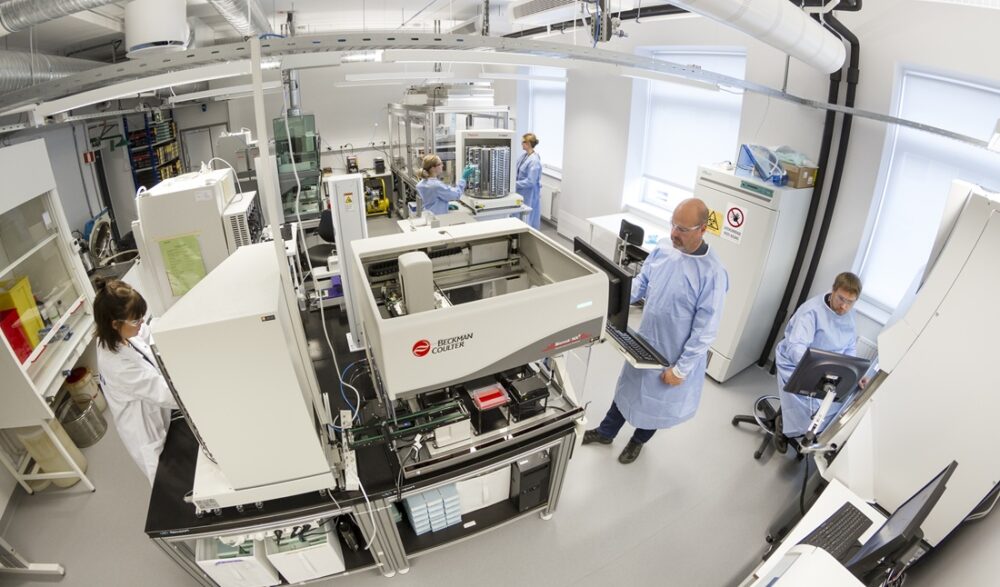
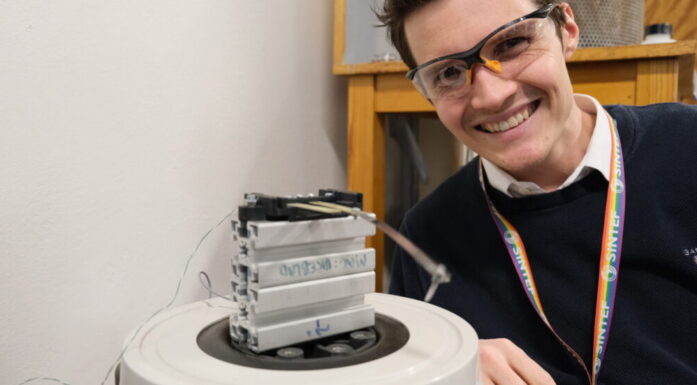
From the SINTEF laboratory. Photo: Thor Nielsen, SINTEF Industry
Low prevalence of clinical resistance
Clinical resistance is rare in Norway. We know this because it is monitored in both humans and livestock at the request of the Norwegian Institute of Public Health.
However, the prevalence and spread into the environment have largely gone under the radar. According to the researchers, we lack knowledge that is important for combating AMR in humans, animals and its spread in various environments.
Reiche’s supervisors were Professor Anita Nordeng Jakobsen and Associate Professor Sunniva Hoel from NTNU, and Senior Research Scientist Gunhild Hageskal from SINTEF. The doctoral thesis was affiliated with a collaborative project (DisinfectAMR) conducted by NTNU and SINTEF (2021–2025). The Research Council of Norway funded the work. Click here for a link to the project page at the Research Council of Norway.
References:
Reiche, Thorben Ogihara; Jakobsen, Anita Nordeng; Mares, Mihai; Hoel, Sunniva; Tøndervik, Anne; Heggeset, Tonje Marita Bjerkan. (2025) Antimicrobial resistance reservoirs in salmon and broiler processing environments, sidestreams, and waste discharges. Frontiers in Microbiology. https://doi.org/10.3389/fmicb.2025.1662113
Reiche, Thorben Ogihara; Hageskal, Gunhild; Mares, Mihai; Hoel, Sunniva; Tøndervik, Anne; Heggeset, Tonje Marita Bjerkan. (2025) Shifts in surface microbiota after cleaning and disinfection in broiler processing plants: incomplete biofilm eradication revealed by robotic high-throughput screening. Applied and Environmental Microbiology. https://doi.org/10.1128/aem.02401-24
Reiche, Thorben; Hageskal, Gunhild; Hoel, Sunniva; Tøndervik, Anne; Nærdal, Guro Kruge; Heggeset, Tonje Marita Bjerkan. (2024) Disinfection in a salmon processing plant: Impact on bacterial communities and efficacy towards foodborne bacteria and biofilms. International journal of food microbiology. https://doi.org/10.1016/j.ijfoodmicro.2024.110853
Thomassen, Gunn Merethe Bjørge; Reiche, Thorben; Hjørungnes, Martinus; Mehli, Lisbeth. (2023) High Disinfectant Tolerance in Pseudomonas spp. Biofilm Aids the Survival of Listeria monocytogenes. Microorganisms. https://www.inatur.no/fiske/50f6748de4b0b1d8643889d6/innlandsfiske-i-trondheim-bymarka-leinstrandmarka-og-malvikmarka-tofa