How Edvard Munch’s painting The Scream might look in 300 years’ time
Edvard Munch used materials that make his paintings vulnerable to the ravages of time. A new digital tool now shows how much The Scream may change over the next 300 years.
If your great-grandparents ever saw The Scream, they probably experienced a slightly different painting than the one we see today.
Yellow is affected by humidity
“Despite the conservators doing an excellent job of preserving the painting, we know that some of the yellow areas in the sky are sensitive to humidity and have faded over time. Munch also used two types of red pigments that are sensitive to light and slowly change over time, including in the sky and on the ground behind the screaming figure,” explained Irina-Mihaela Ciortan.
She is a postdoctoral fellow in computer science at NTNU in Gjøvik and has helped develop a digital tool that shows how The Scream may have changed from when it was painted to the present day – and 300 years into the future.

Irina-Mihaela Ciortan has helped develop the “Light Damage Estimator.” The new tool can assist both researchers and conservators who want to understand how to better preserve light-sensitive works of art. Photo: Mads Wang-Svendsen
To achieve this, she has made good use of much of the research that has already been done on the painting over the past 50 years. “Chemical analyses carried out using X-ray fluorescence have been particularly useful,” she said.
Munch also used two types of red pigments that are sensitive to light and slowly change over time, including in the sky and on the ground behind the screaming figure.
Identifying colours with X-rays
“This technique uses X-rays to identify the chemical composition of different materials and has enabled us to establish which pigments the paints Munch used are made of,” said Ciortan.
“For example, when mercury was discovered in the red brushstrokes in the sky, it became clear that Munch had painted with cinnabar – a mineral containing mercury. We have established a complete overview of the different pigments in the painting,” she said.
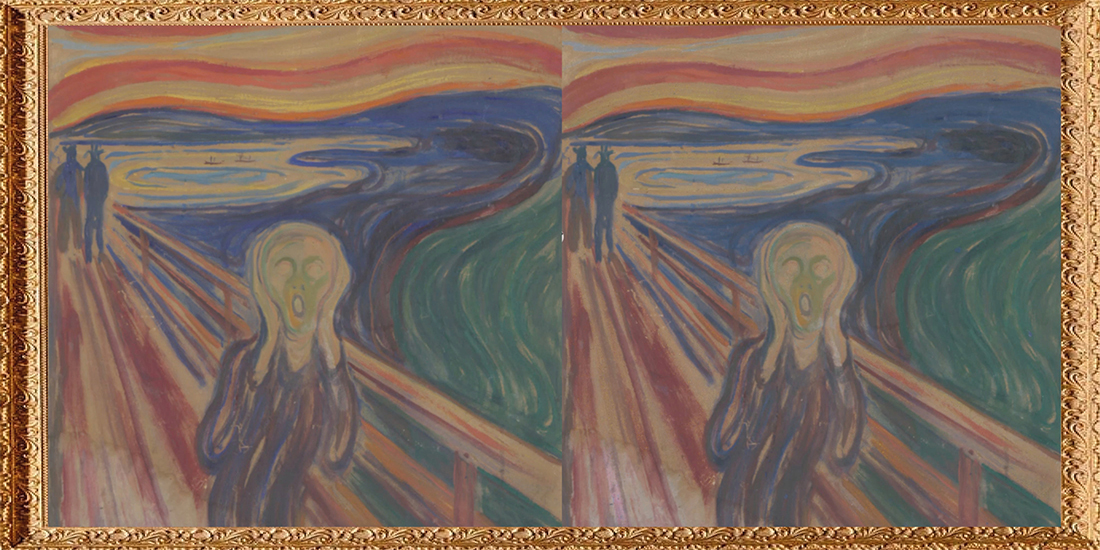
The arrow on the left shows “The Scream” as it might appear in 300 years. Some parts, like the greens, are very stable. Cadmium yellow and cinnabar are far more vulnerable. A new tool called the “Light Damage Estimator” also shows that one of the blues, ultramarine, will fade.
- You might also like: Piecing together tapestries from the Viking Oseberg ship
Accelerated ageing process
Using this technology, Ciortan’s Italian collaborators made a series of small samples based on The Scream. The samples were then subjected to an accelerated ageing process in a climate chamber.
They were left there for several days in varying humidity and light conditions, while all the changes were carefully monitored and documented.
The idea is that since the samples have the same properties as the original painting, changes in them can reflect both historical and future changes in The Scream.
A glimpse into the future
“After observing how the samples developed in the climate chamber, we calculated how long the relatively short time spent there corresponds to in actual years in the museum,” Ciortan said.
These calculations have now led to the creation of the Light Damage Estimator, a new digital tool that shows how The Scream could change over the next 300 years in different lighting conditions: 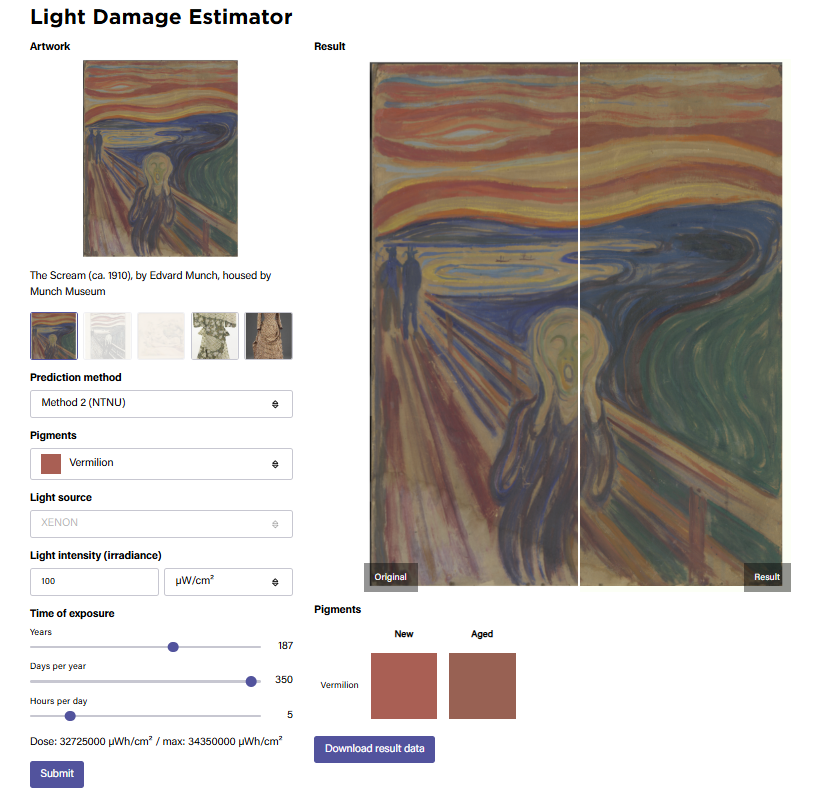
“You can choose different light sources and the number of hours of light exposure, and see for yourself how this affects the painting,” said Ciortan
She says that despite the researchers’ efforts to base their work on as much scientific source data as possible, there will always be elements of uncertainty when predicting changes 300 years into the future.
Two blue pigments that behave differently
While some pigments, such as the green ones, are very stable, others are far more vulnerable to environmental factors.
In addition to cadmium yellow and cinnabar red, deterioration has been observed in one of the blue pigments, according to the researcher.
“The Scream has two blue pigments – cobalt blue and ultramarine. Chemically speaking, cobalt is a much more stable pigment than ultramarine, which is known to change relatively quickly. The interesting thing here is that ultramarine behaves differently depending on which binder is used, and it seems that Munch used several different binders when painting The Scream,” said Ciortan. As a result, this blue pigment has faded in some areas and become darker in others.
- You might also like: A thousand-year-old cathedral surrenders its secrets, stone by stone
From The Scream to other works of art
The tool has been developed to help researchers and conservators understand how better to preserve light-sensitive works of art.
Currently, however, it can only be used on The Scream and a handful of other artworks that were studied in the EU project PERCEIVE. In addition, the tool is also limited to two of the most vulnerable pigments: cadmium yellow and cinnabar red.
However, through an extension of the project, researchers will now also explore the possibility of expanding its use to include more works of art.
“There is still a lot of work to be done before the tool can be used on any other paintings. If you wanted to upload another work of art, you would need to know which pigments and binders had been used and exactly how they are distributed across the painting to get a reasonably accurate result,” Ciortan said.
Help from AI
In other words, the tool doesn’t work automatically. She believes, however, that this stumbling block could be overcome in the future using artificial intelligence (AI).
“One day, perhaps, it will be possible to upload an image of a painting and let an AI model determine which pigments were used by comparing the colours with known paintings in the database,” said Ciortan.
As things currently stand, however, she thinks a tool like this would involve far too many elements of uncertainty to be of any real practical value for conservators.
“Until these challenges are resolved, it may be more useful to collaborate with museums that have similar data to what we used in our project. For example, extensive research has been done on Van Gogh’s paintings, producing the type of data needed to use our tool,” she said.