Preventing wildlife collisions in new ways
Wildlife fences and wildlife crossings are expensive – and they have mixed results. Now researchers have studied what is needed to prevent cars and trains from colliding with animals.
Wildlife collisions pose a significant challenge for traffic safety, animal welfare and the economy in Norway. New road and railway developments contribute to further fragmentation of animal habitats and increase the risk of traffic accidents.

Researcher Gunnhild Svaboe at SINTEF.
“Traditional measures like wildlife fences and wildlife crossings are expensive and have variable effectiveness. That is why we are exploring new and more flexible solutions to prevent collisions,” says Gunnhild Svaboe, a research scientist at SINTEF.
As part of the work in the WILDETECT project, she and her colleagues have mapped the actor landscape and what knowledge currently exists in order to develop new solutions for detecting and warning wildlife.
Fragmented responsibility among many actors
“The mapping shows that many different actors work directly or indirectly with wildlife collisions. These include the Norwegian Public Roads Administration, Bane NOR, car manufacturers, drone companies, municipalities and the Norwegian Directorate of Agriculture. But responsibilities, knowledge and data sources are fragmented among research, interest organizations, industry and public authorities,” says Svaboe.
Relevant sources of information include data on wildlife populations, registered collisions along roads and railways, vehicle data, sensors and user-based reporting solutions.
Historical data can be used to predict whether wildlife is in an area, while real-time data can be used for detection and warning. However, the level of detail, quality and availability of the data varies. In addition, the lack of standardization and systems for data sharing limits the potential for using the data to develop comprehensive solutions.
This is how the researchers mapped current practices:
The mapping consisted of three main activities:
- An initial search for relevant actors and ongoing initiatives.
- Interviews with key actors in transport, wildlife management, research and industry.
- A workshop with broad participation from the public sector, research environments and business.
Taken together, this information provided the researchers with a comprehensive picture of current practices, available data sources, technological opportunities, and important challenges related to the detection and warning of wildlife.
Greater prevention needed
“A consistent finding is that the current system is largely reactive, meaning that much of the activity involves handling collisions after the fact, rather than preventing them through early detection and precise warning,” says Svaboe.
Implementing effective preemptive measures on roads and railways comes with multiple challenges:
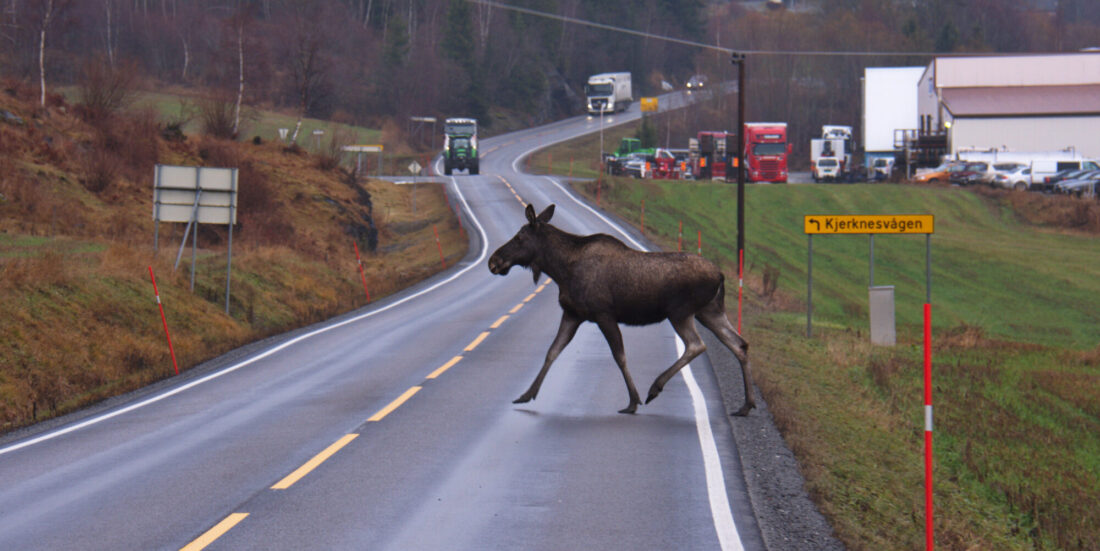
A train, for example, has a much longer braking distance than a car, and cannot swerve out of the way. When the train driver sees the moose, it is too late.
One technological method that has been tested on the railway is to use sounds to scare off wildlife before the train arrives. Human voices proved to be more effective than honking to scare away animals, according to a previous study (in Norwegian).
A car can both brake and turn. But when driving, you don’t have the same opportunities to contact the driver as you do on a train. Signage is the best preventive warning tool that we have today.
“A possible solution would be to send direct animal warnings to all cars in an area, for example. But that requires the cars and the road to be able to communicate with each other using data sharing,” says the researcher.
Facts about wildlife collisions and WILDETECT:
- 9 350 deer died due to collisions in the 2024/2025 hunting year (Statistics Norway, 2025).
- WILDETECT is a collaborative project that investigates how new solutions could improve traffic safety and reduce accidents. The Research Council of Norway has allocated 10 million kroner to the project.
- Partners are SINTEF (project leader), NINA (Norwegian Institute for Nature Research), Western Norway University of Applied Sciences and the Norwegian Public Roads Administration.
Animals get used to traffic and sounds
The survey also revealed challenges related to animal behaviour. For example, wildlife can gradually get used to sounds and/or light from traffic.
How animals react to a sound can also vary. Moose can react differently to a drone or a horn, for example. This makes it challenging to prioritize the most helpful measures for preventing wildlife collisions. What works today may not necessarily be effective in the long term.
At the same time, the researchers see significant potential in new technology, such as sensors, vehicle data, communication systems and drones. But this requires that the technology is used in a way that safeguards traffic safety, ethical considerations and animal welfare.
“An important step forward will be to establish more structured forms of cooperation and clear frameworks for data sharing. The goal is for available knowledge and technology to be better utilized in the effort to reduce wildlife collisions,” Svaboe says.
Report:
Deteksjon og varsling av vilt på veg og jernbane (Detection and warning of wildlife on roads and railways), in Norwegian.