Propelling the world’s giant ships into the future with new sail systems
Modern sails on large ships are becoming increasingly common to save fuel – and also the climate. Now a research team is looking at how to maximize their benefits, and that turns out to be more complicated than anticipated.
Huge ships, like container ships, bulk carriers and tankers, use large amounts of energy and are responsible for the corresponding climate emissions.
But new fuels, such as hydrogen and ammonia, are not yet that easy to apply. Zero-emission solutions like electrification are not readily available for the largest ships either. That is why many shipowners regard the world’s oldest “fuel” – sails – as the simplest solution.
These are the modern sail systems:
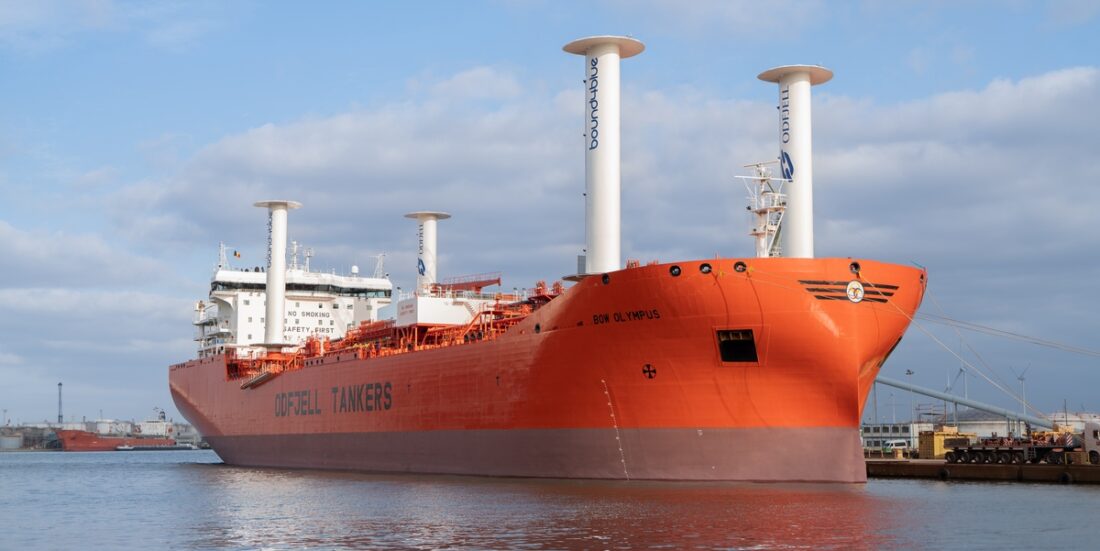
There are many different types of sail systems. The most common ones today are rotor sails, wing sails and suction sails.
A rotor sail is a large cylinder that is rotated by an engine. When the wind interacts with the rotor sail, it increases the speed on one side and decreases it on the other side. This creates a pressure difference, which results in a force (the Magnus effect) that contributes to the ship's propulsion.
A wing sail is similar in principle to an airplane wing. The shape of both the airplane wing and the wing sail are designed so that the wind speed is greater on one side than the other. This in turn creates a pressure difference, which gives the planes lift. On a ship, however, the wings are mounted vertically, so that the pressure propels the boat forward instead.
Wing sails can also be combined with a fan that sucks air in at the back. This creates an even greater pressure difference in the sail, or wing. This is called a suction sail.
The reSail project focuses mainly on wing sails and suction sails.

Research scientist Yannick Jooss at SINTEF.
“With fuel prices constantly rising and climate change impacts becoming increasingly evident, modern sails could be a good alternative,” says SINTEF researcher Yannick Jooss.
Jooss heads the reSail project, with the goal of optimizing the effect of the new sail systems, which in technical terms are called wind-assisted propulsion systems (WAPS).
The large variations in fuel savings and reduced emissions from modern ship sails form the background for the project. The researchers believe that the fuel variations are partly due to simplified assumptions about the wind conditions on ships.
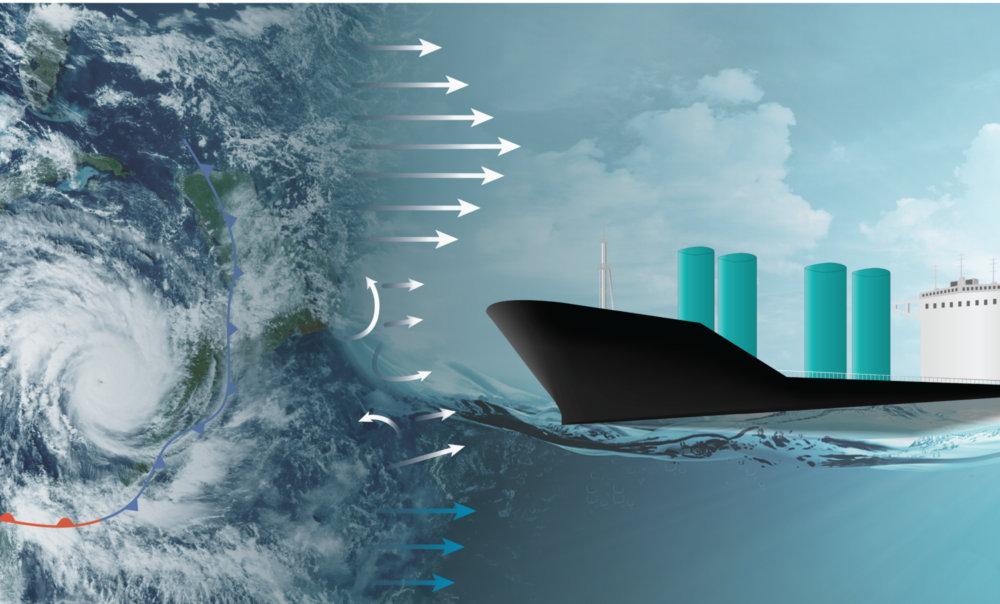
Modern sails on a ship exposed to complex wind conditions at sea. Illustration: SINTEF Energy AS
Modern sails are becoming increasingly common
More and more large ships are using modern sails. At the beginning of 2020, only nine large ships used sails. Today, they number 64, and according to SINTEF, many ships are now preparing to put the solutions into use.
“We’re seeing that the demand for these solutions has already increased. The systems can be easily installed on existing ships, and have the potential to contribute significantly to reducing emissions from the maritime sector,” says Jooss.
Gap between theory and practice
Many factors come into play for the advanced sail systems and the wind to perform optimally. For starters, the best possible understanding of realistic wind conditions is necessary, as well as how much energy the wind contains.
“This provides information that we can use to understand where the sails should be placed on the ship, how they can be regulated to make the best use of the wind and how all of that affects ship operations,” Jooss says.
Facts about large ships and fuel consumption:
Large ships (over 5 000 gross tonnage), such as container ships, bulk carriers and tankers, account for approximately 90 percent of CO₂ emissions from the maritime sector.
The goal, according to FuelEU Maritime, is to reduce emissions by six percent before 2030 and 80 percent before 2050.
Finding zero-emission solutions for such ships is particularly challenging. Modern sail systems offer one possible solution that has the potential to reduce emissions significantly.
Fuel and emissions savings are currently reported to be between two and 25 percent in ships with installed sails. These figures clearly illustrate the need for more study of such sail systems.
The project work so far has revealed that the interaction between modern sail solutions and the wind is more complicated than previously thought.
“We’ve looked more realistically at the wind conditions, and they deviate significantly from wind theory,” says Jooss.
The researchers have also previously investigated how complex wind conditions affect wind turbines, and this knowledge is now being put to use.
“Modern sailing systems encounter wind conditions that are equally complex. So we can gain a lot from a good understanding of them,” says Jooss.
Helped by the Doppler effect
As part of the project, the reSail research team has also taken wind measurements on the Bow Olympus ship, owned by the shipping company Odfjell. The ship recently had bound4blue sails installed.
The measurements were taken both before and after the installation.
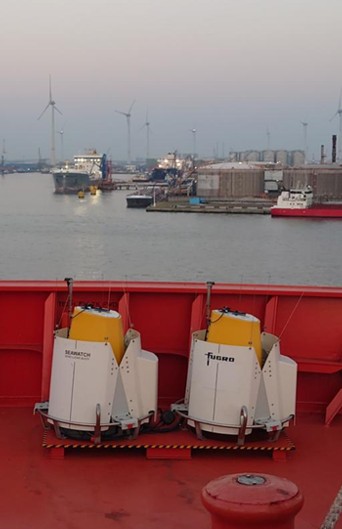
Wind-measuring equipment on the Odfjell ship Bow Olympus. Photo: Felix Kelberlau /Fugro
The measurements were taken with Fugro’s LiDAR system. LiDAR measures wind speed and direction by sending out laser beams that are reflected by dust and particles in the air. The reflected light returns with a different frequency, and this provides insight into the wind speed, relative to the ship (the Doppler effect).
Wind is complicated
The researchers found that the wind varies much more than previously thought, and that the ship and the sail system itself significantly affect the wind.
“If you just use the standard wind profile as is often done today, your measurements will be inaccurate.
Simplified assumptions and simulations are not good enough, because they do not take into account the complexity and variation in the wind.
“We’re finding that emissions can be reduced significantly with proper knowledge of wind conditions, sail system design, location, regulation and optimal operation of the ship. Just how much we’ll learn in the future,” says Jooss.
More new answers to come
In the future, the researchers will use the data from the wind measurements to find out:
- How to position the modern sails. These measurements will be carried out with model ships in NTNU’s wind tunnel, where the researchers can control the wind conditions and change the position of the sails to obtain realistic measurements.
- How to gain better control of the wind. If you can gauge the wind conditions before they reach the ship, you can move the sails to optimize their impact. This will also be tested in the lab.
- A holistic approach. Look at the overall ship operation using all the data collected in the project.
The researchers hope to help modern sails reach their implementation potential of 25 percent or more in fuel and emissions savings.
“Our goal is to make it more attractive to use modern sails on ships, and thus contribute to the necessary emissions reduction from the maritime sector,” says Jooss.
Facts about the project:
The research project reSail will promote the use of wind-assisted propulsion systems (WAPS).
The project started in 2024 and will last until 2028.
Partners are: SINTEF, NTNU, Odfjell Management, Fugro Norway, HD Hyundai Europe R&D GmbH and bound4blue.
reSail is an "Expertise and collaboration project" that is partially financed by the Research Council of Norway.