
A huge specially designed heat pump has saved a Norwegian agricultural cooperative millions
Energy use to produce concentrated livestock feed is being cut significantly, thanks to a first-of-its-kind heat pump solution. And a happy side effect is even higher feed quality.
There are some magical limits to how much energy we can get out of a heat pump. This story is about pushing the technical limits. It is about getting more energy out than you put in. And it’s how SINTEF – one of Europe’s largest applied research organizations, the renewable energy company Aneo, and the Norwegian agricultural cooperative Felleskjøpet together managed to shift the recovery of process heat from theoretical calculations in the researchers’ notebooks, to becoming an industrial electricity-saving project on a large scale.
Experts describe the project as a bold undertaking : No one has ever dared to combine the two systems in this way, and on such a large scale.
Norway’s biggest kitchen?
The characteristic storage silos can be found in Trondheim’s Skansen neighbourhood. Next to them you will find the animal feed factory. Large parts of the food supply for people living north of Dovre municipality depend on getting the concentrated feed made here to farmers in the region. The factory produces around 200 000 tonnes of feed each year and can justifiably be called one of Norway’s largest and most important kitchens.
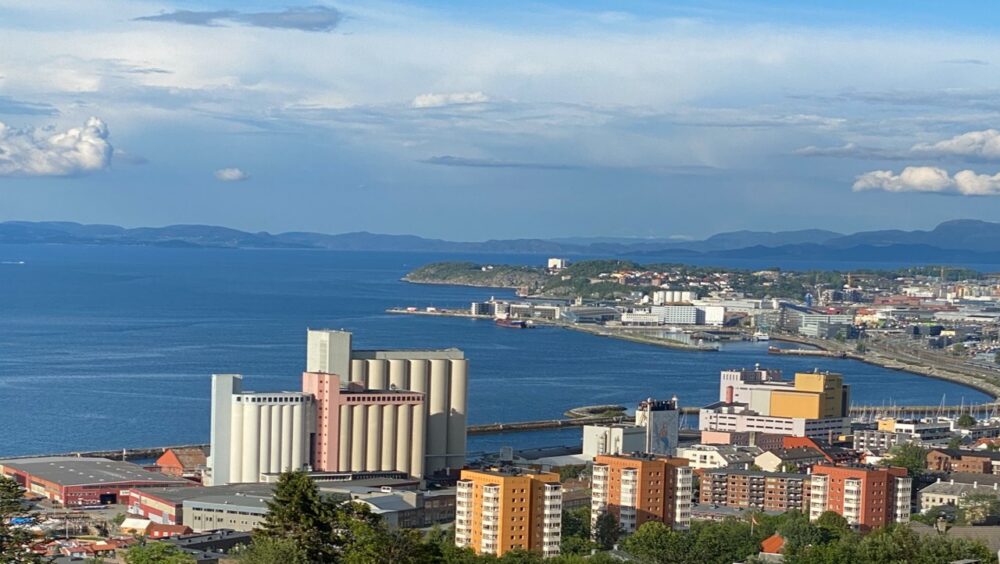
The Felleskjøpet buildings in Trondheim are among the largest buildings in Norway. Photo: Felleskjøpet
Now this facility has a heat pump – a really big one. To match the size of the need, we are not talking about the typical version that ordinary homes have mounted on their living room walls. This is a gigantic heat pump that is more reminiscent of the innards of the engine room of a large ship – with huge pipes, compressors, valves and connections.
Precision in every pellet
Felleskjøpet’s feed development is the gourmet department for livestock meals. But before chickens and cows can enjoy the fortified feed, it has to pass stringent quality controls. Norwegian animals are not served just any feed.
Vebjørn Nilsen is the technical manager at Felleskjøpet and explains what is involved.
“The raw materials go into a mixer where steam is injected. The temperature has to permeate the feed so that it is guaranteed to be above 81 degrees Celsius,” he says.
“No more than a one-degree deviation is allowed. If the mixture gets too hot, some nutrients are destroyed. And if the temperature is too low, bacteria can escape, and animals and humans could be exposed to Salmonella.
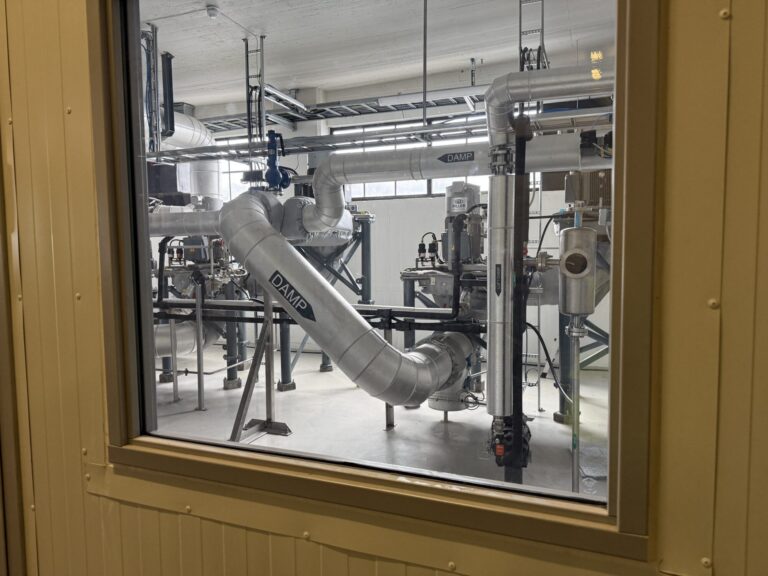
The Frigg heat pump extends across several rooms, and is now hidden by walls – both for safety and sound reduction. Photo: Hege Tunstad
Michael Bantle is the general manager of Aneo Industry, and puts the process in perspective.
“The production line here processes 20 tonnes of product per hour, and each batch has 15 seconds in the mixer to reach exactly the right temperature. At home, you spend 15 minutes baking a pizza,” he says.
The machine is designed to stop automatically if the temperature is wrong for just ten seconds.
Valuable steam was being lost right above the roof
After the steam treatment, the mixture is first pressed into long rods, which are then cut into even pieces. When the resulting pellets come out of the press, they are hot and moist, and need to be cooled. They then fall into a cooling tunnel where colder outside air absorbs the moisture and cools the pellets down to storage-ready temperature.
The pellets that emerge are not only perfectly sanitized. The precision heating has also resulted in more exact packaging of nutritious ingredients.
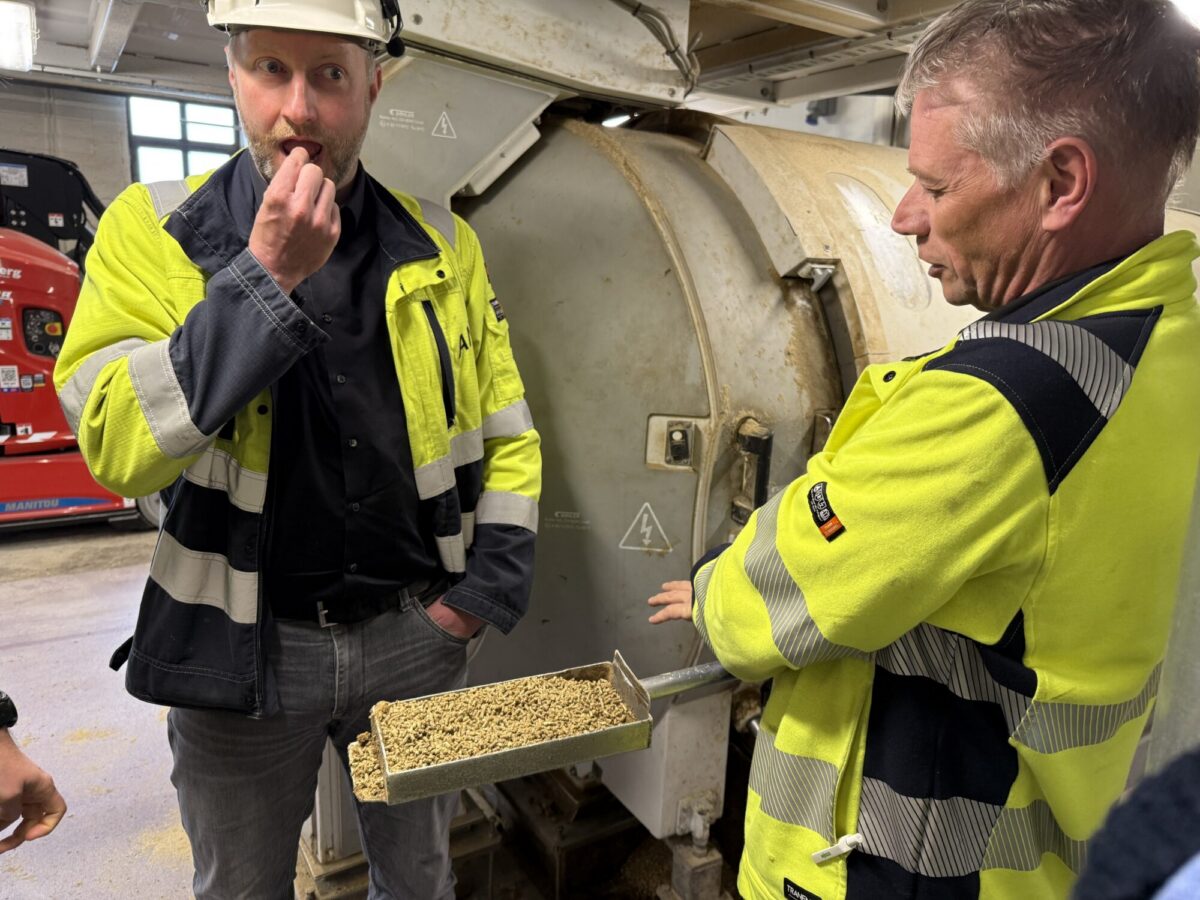
Michelin food, but not for humans. Christian Schlemminger considers tasting the feed that has just been pressed into pellets. Runar Myhren from Felleskjøpet is content to talk about the quality. Photo: Hege Tunstad
“We’re able to measure that the finished product quality is better,” says Nilsen. “This started out as an energy project and then also became a quality project.”
And the warm, humid air that remains after the production process? It has traditionally evaporated and disappeared straight up and out over the roof.
“It was like opening the door to the sauna to cool down the overheated people inside. A lot of heat is lost this way!”
Nilsen has walked around the factories and pondered waste heat in the industry for a long time.
“I’ve been thinking about this for more than 20 years, and it has been a long road to finding a solution that works. But now we’ve succeeded at directing the steam back into our process.
No one in the industry has done this before.
Stroke of genius in the 1980s
We have to take a step back in history, because in parallel with all this activity, SINTEF and NTNU have been developing heat pump technology with natural refrigerants for over forty years. Ole Marius Moen is a research scientist at SINTEF Energy and shares a bit of this technology history.
“Ever since the eighties, SINTEF and NTNU have had the conviction that we would not work with synthetic refrigerants,” says Moen.
This was an early decision, before the world had agreed that CFC gases were harmful to the ozone layer and had to be banned. What was a controversial position in the 1980s became the background for Trondheim to develop into the world hub for refrigeration technology with natural refrigerants that it has since become. And this thinking also evolved into the solution for Felleskjøpet’s heat recovery.
Michael Bantle and Christian Schlemminger worked for years as research scientists at SINTEF Energy, taking high-temperature heat pumps from theory to reality. In 2019, they showed that reaching 120 °C with natural refrigerants was possible. In 2021, they went even further and managed to get a heat pump to reach 180 °C. Then they switched sides and started in industry. Now they are at Aneo Industry.
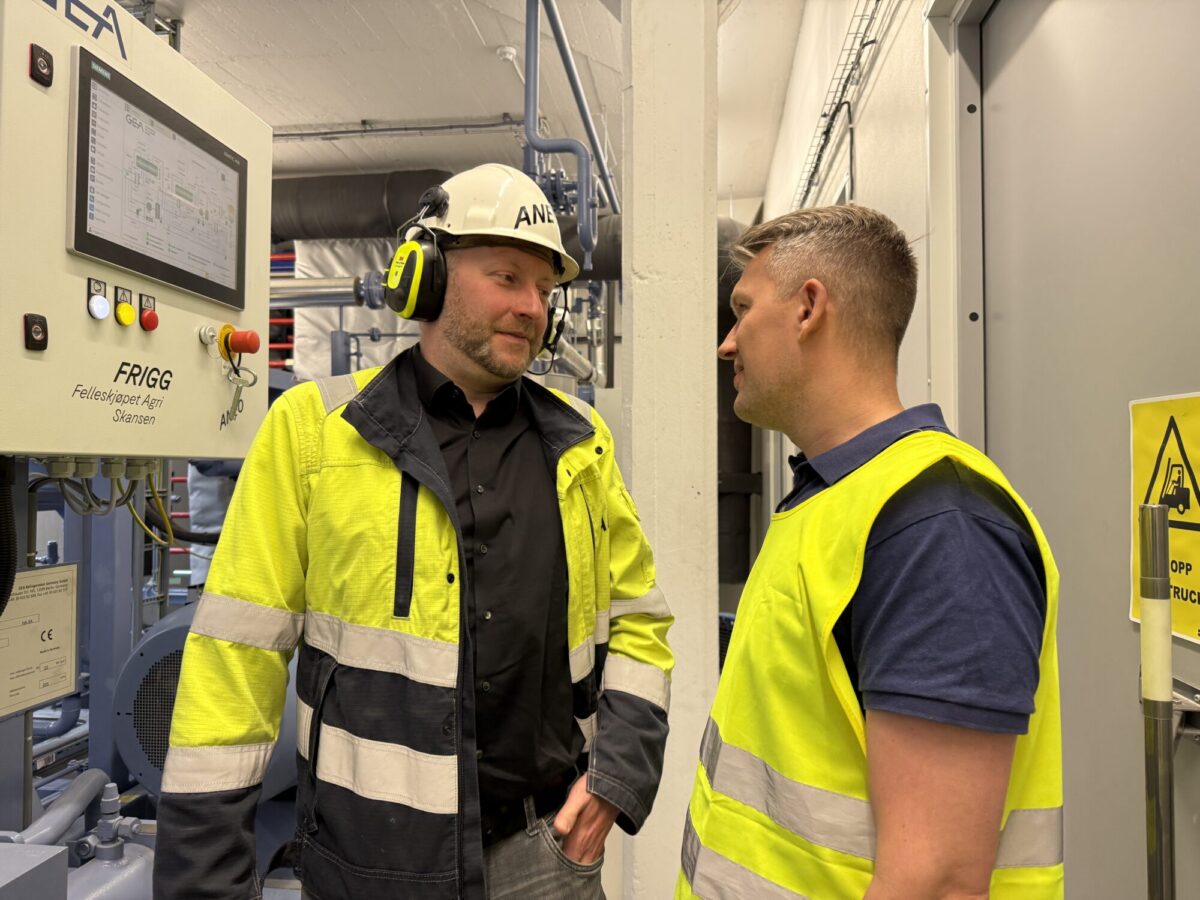
Christian Schlemminger from Aneo Industry and Ole Marius Moen from SINTEF Energy discuss the technology in the Frigg heat pump. Photo: Hege Tunstad
One kilowatt in – over three out
The genius of the resulting solution is that the waste heat becomes a raw material that goes back into the system, and at the same time explains how the process is so efficient. For every kilowatt of electricity that the heat pump – dubbed Frigg – uses, it delivers more than three kilowatts of heat back to the production line.
“When you buy a heat pump for your house, it has a COP factor (coefficient of performance) that tells you how much heat it can deliver compared to how much electricity you use. Typically, the COP factor is around 3.0,” says Moen.
“The greater the temperature difference between where you get the heat and where you are going to deliver it, the more energy it requires. With a temperature lift of 100 degrees, thermodynamics says that the maximum COP you can achieve is 4.0.
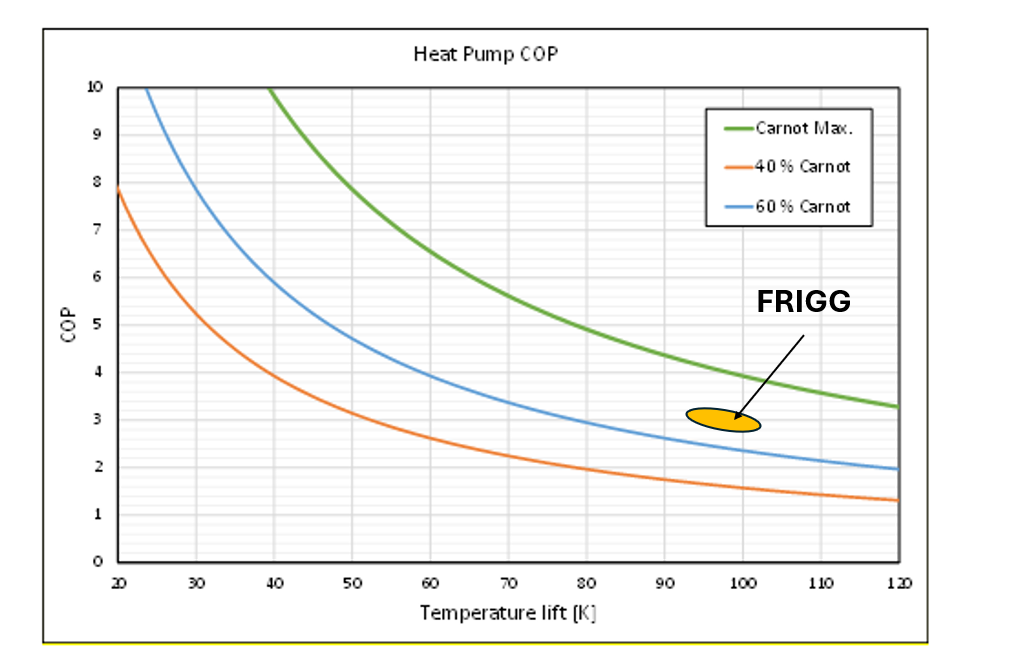
COP factor (coefficient of performance) as a function of temperature rise. Here, a condensing temperature of 120 degrees is assumed. The green graph shows the maximum COP that can be achieved, also known as Carnot COP. The orange and blue graphs show the COP that is typically achieved in industrial heat pumps. Frigg (yellow bubble) performs unusually well. Graphics: Ole-Marius Moen
Better result than anticipated
Bantle is now CEO of Aneo Industry. He calculated how well they thought the Frigg heat pump would manage to deliver.
“We guaranteed a COP of 2.5, but we’ve actually achieved over 3.0. We’re pushing thermodynamics to the limit here, and that is what makes it so fun,” he says.
Now Felleskjøpet is rolling out several more projects to continue on their energy-saving track. The project has received NOK 9.17 million in support from Enova through the “Piloting of new energy and climate technology” scheme.
How the giant Frigg heat pump works:
Frigg is a high-temperature heat pump in two coupled cycles. The raw material is hot, humid exhaust air (~65 °C) from the cooling tunnel where the pre-pressed pellets are cooled.
Frigg receives the waste heat and directs it through a heat exchanger, where the heat is transferred to a closed pipe system that transports it to the ammonia part of the heat pump.
When the ammonia evaporates inside the heat pump (ammonia has a boiling point of - 33 °C under normal pressure), it absorbs heat from the exhaust air. It also takes with it the energy that is released when the moisture in the air condenses into water.
The energy is extracted from the phase transition itself in the process, and this is a bit of the magic.
The ammonia gas is then compressed in two stages. The pressure rises, and the boiling point rises with it. When the ammonia condenses back into a liquid, it gives off heat at about 85 °C. But the process at the factory needs steam at an even higher temperature. Ammonia can't take us all the way there. Another refrigerant is needed to raise the temperature to new heights, and the solution was water vapour.
Ammonia is the natural refrigerant that is most widely used for industrial cooling and heating, and numerous fully functioning commercial solutions already exist for this.
When working with temperatures above 100 °C, water becomes an attractive working medium. What the researchers have done is to connect these two steps.
Pressure and temperature trickery
After the ammonia cycle has raised the temperature a little, the water vapour cycle takes over. Water boils at 100 °C under normal pressure, but if you increase the pressure, the boiling point rises. A special type of compressor takes the steam that has already been produced in the first cycle and compresses it further in several stages. Here too, the pressure rises, and the temperature with it, creating the steam that is delivered to the mixer in the factory.
It takes quite a lot of energy to break the bonds between water molecules and turn them into gas: To heat water from 0 °C to 99 °C, you need one amount of energy. To take the final step, from 99 °C liquid water to 100 °C steam, you actually need more than five times that amount. The temperature changes by only one degree, but the molecules have to be completely separated from each other, and that is hard work in the world of physics.
When this water vapour condenses back into water, about the same amount of energy is released again, and we can use it. The air humidity contains fully two-thirds of the available energy.
COP (coefficient of performance) indicates the heat delivered per kilowatt of electricity consumed. With a temperature rise of ~100 °C, the theoretical maximum (Carnot-COP) is 4.0. Frigg delivers COP 3.0 – 70% of Carnot, against the industry rule of thumb of 60%. The guaranteed COP level was 2.5. The result: 7.5 GWh saved per year, equivalent to the electricity consumption of approximately 500 households, and 1.2 MW of freed grid capacity.