Ultra-thin pipes solve space constraints on platforms
A redesigned heat exchanger can now replace one in every four offshore gas turbines, eliminating 25 percent of emissions without any loss of energy.

A redesigned heat exchanger can now replace one in every four offshore gas turbines, eliminating 25 percent of emissions without any loss of energy.
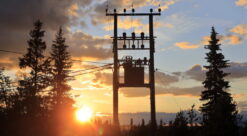
The age of the overhead lines that supply Norway’s electricity will no longer determine their priority for renewal. Instead, the probability of failure will serve as the primary criterion for prioritizing these lines.

Until now, it has been almost impossible to measure the energy density of hydrogen precisely, but a new sensor can register every single molecule. This could lay the foundation for correct accounting in the hydrogen economy.
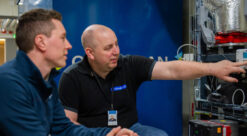
Installing just four percent of Europe’s commercial buildings with a Thermal Box from Norway — about the size of an American industrial refrigerator — would spare Europe the need to build seven nuclear power plants.
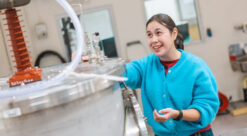
Many large circuit breakers are filled with sulphur hexafluoride (SF₆) – a greenhouse gas that is 24 300 times more powerful than CO₂. But an ingenious Norwegian solution could offer us a climate-friendly alternative.

Energy use to produce concentrated livestock feed is being cut significantly, thanks to a first-of-its-kind heat pump solution. And a happy side effect is even higher feed quality.

Implementing effective monitoring measures could yield much more energy from the cable network – all without digging a single new trench. Just a dream scenario? No, it is entirely possible, say researchers.
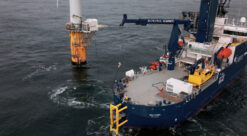
Connecting ships to charging stations is a bit of a hassle when you are out at sea. But with a new magnetic charging plug for boats – it is about as easy as putting a cup in a cup holder.
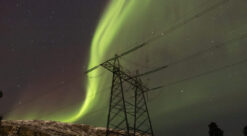
Scientists are working to understand how magnetic currents from the sun spread beneath the Earth’s crust when the northern lights dance across the sky. Their goal is to tame its “dark twin” and prevent damage to our power grid.
Many large circuit breakers are filled with sulphur hexafluoride (SF₆) – a greenhouse gas that is 24 300 times more powerful than CO₂. But an ingenious Norwegian solution could offer us a climate-friendly alternative.
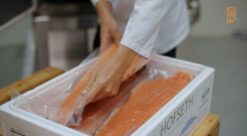
A small revolution is happening in the fishing industry. Freshly frozen fish can now be thawed in a new way, and that means you will have access to super-fresh food from the sea – even if you live thousands of miles away.
We can do a lot to save the climate by switching from coal to natural gas. And we can shelve concerns about the negative climate impact of methane emissions from gas production, say researchers.

Researchers with the Kavli Institute for Systems Neuroscience have found a pathway in the brain that the brain uses to plan to get from one place to another.
Nobel Laureates May-Britt and Edvard Moser have been elected to an American scientific society started by Benjamin Franklin.
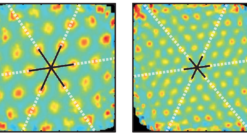
The brain’s GPS would be worthless if it simply contained maps of our surroundings that were not aligned to the real world. But we now know how this is done.
Edvard and May-Britt Moser, co-directors of the Kavli Institute for Systems Neuroscience at the Norwegian University of Science and Technology, have been selected for a EUR 750 000 award from the Körber Foundation.
NTNU neuroscientists elected to elite scientific association.

May-Britt and Edvard I. Moser have won the Nobel Prize for Physiology or Medicine 2014. This is part of their work.

Your brain has at least four different senses of location – and perhaps as many as 10. And each is different, according to new research from NTNU’s Kavli Institute for Systems Neuroscience.

Ice cold, hard and emotionless. Such is the psychopath – we think. Until we get a glimpse behind the mask.

Scientists are on the hunt for spare parts for our damaged or faltering brains. But is that a future we want?