What determines whether birds migrate or stay?
Some European shags migrate for the winter. Others stay. What factors cause such variation within the same species?
Should I stay or should I go? What determines whether birds migrate for the winter? This is one of the questions explored in a new doctoral thesis by Cassandra Ugland from NTNU’s Department of Biology
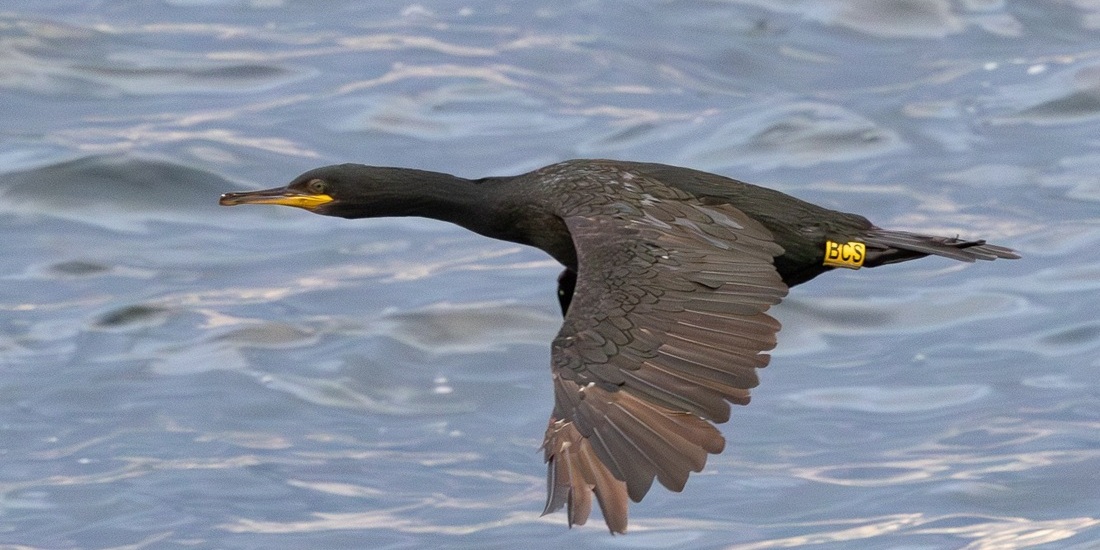
European shags are a species of cormorant, found from Northern Norway to Southern Europe. Cassandra Ugland studied a population that breeds on the Isle of May in Scotland. Photo: Snæþór Aðalsteinsson, NTNU
The climate is changing. This is leading to greater seasonal variation, which in turn may cause birds to adopt new strategies.
“Climate change is affecting the behaviour of bird species, causing some individuals to migrate away from their breeding grounds while others remain resident throughout the year,” says Ugland.
-
- You might also like: PFAs: found 180 times more ‘forever chemicals’ in birds
Studying European shags
One such species is the European shag (Gulosus aristotelis), found from Northern Norway to Southern Europe. Ugland studied a population that breeds on the Isle of May in Scotland. Around half of the population remains in roughly the same area throughout the winter, while the rest may migrate some distance northwards along the coast. Why do different shags adopt different strategies?
“To understand how individuals and populations adapt, we need to look at the interplay between several factors,” says Ugland.
These factors are:
- Natural selection
- Genetic variation
- How flexible their behaviour is. This is often referred to as “plasticity”.
“I investigated how these factors shape early-life expression of migration during the winter versus residence in the same area throughout the year,” explains Ugland.
To do this, Ugland examined large amounts of bird-ringing data (information collected when wild birds are safely caught, fitted with a uniquely coded, coloured leg ring, and then recorded and released). She used advanced models to analyse variation, selection and genetics during the birds’ first years of life.
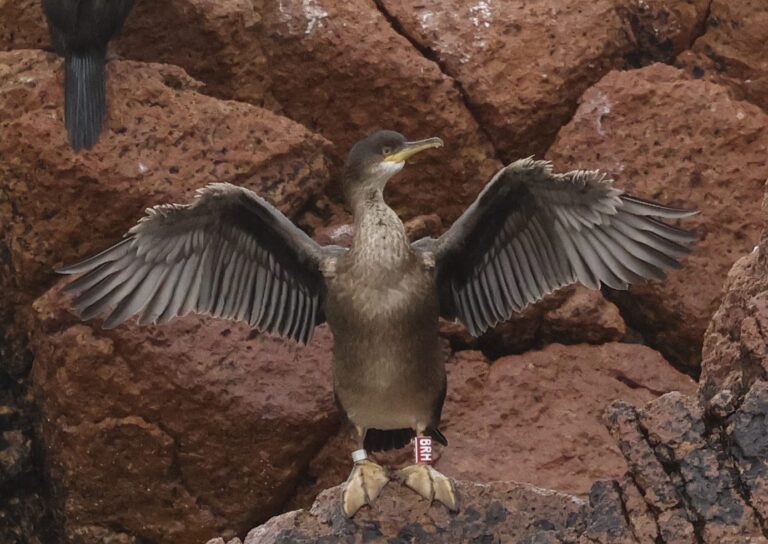
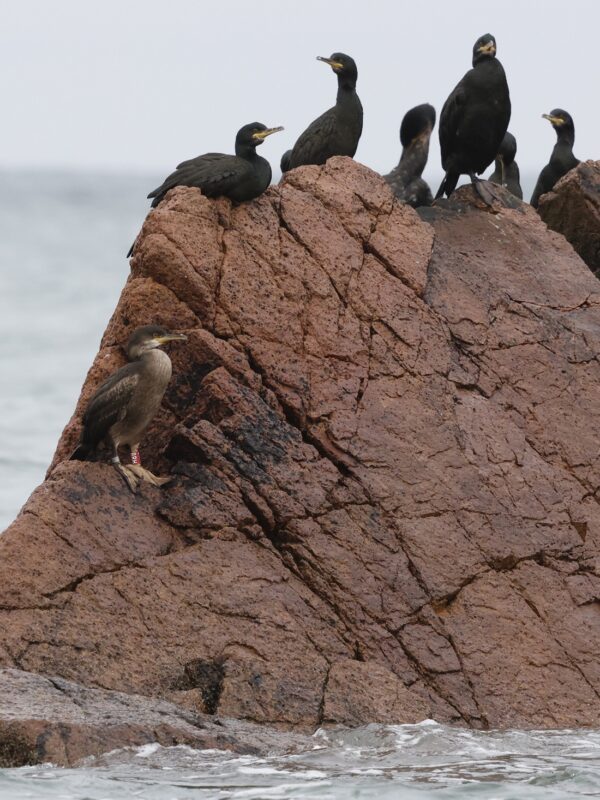
The choice each individual bird makes during its first winter appears to matter most. But other factors also play a role. Photo: Snæþór Aðalsteinsson, NTNU
Early experiences matter
“The results show considerable variation between individuals and from year to year. But we can see that early experiences are very important,” says Ugland.
The choice each individual bird makes during its first winter appears to matter most. But other factors also play a role.
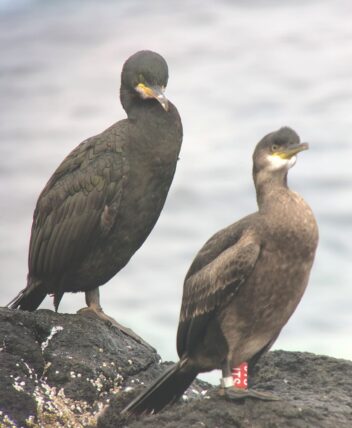
The proportion of birds that migrate is influenced by a complex interplay between the environment, the ability to change through learning and experience, and natural selection over time. Photo: Cassandra Ugland, NTNU
“Whether birds migrate or stay resident is largely determined early in life. This suggests that the environment individuals experience when they are young has a major influence on their long-term behaviour, although we still don’t know which environmental factors are most important.”
Consequently, more research is needed to uncover what these factors may be.
A complex interplay
“The extent of migration within the population can also be influenced by a complex interplay between the environment, the ability to change through learning and experience, and natural selection over time,” says Ugland.
Several factors need to be considered in conjunction, over both the short and long term, in order to understand how early-life conditions can affect birds’ behaviour and subsequent migration traits. This can also help researchers better understand what happens to the population as a whole.
Reference:
Ugland, C. R., Acker, P., Burthe, S. J., Fortuna, R., Gunn, C., Harris, M. P., Hewitt, J. H., Morley, T. I., Newell, M. A., Swann, R. L., Taylor, E. A., Wanless, S., Daunt, F., & Reid, J. M. (2026). Early-life stasis in partial seasonal migration is underpinned by among-cohort variation in migratory plasticity and selective disappearance. Journal of Animal Ecology, 95, 538–552. https://doi.org/10.1111/1365-2656.70215