“Almost as fascinating as the question of how life began”
NTNU researcher Foteini Oikonomou was particularly delighted when she learned that Francis Halzen had been awarded the Nobel Prize in Physics. Both are trying to find answers to some of the universe’s greatest mysteries.
“I’ve met several Nobel Prize winners, and they’ve all been very nice. But I would say Francis Halzen is special.”
Foteini Oikonomou’s office is in Trondheim, where she studies extreme events far beyond this galaxy. Like Halzen, she gets most of her neutrino data from the IceCube Observatory at the South Pole.
Although they are not part of the same research group, she knows this year’s Nobel laureate well.
“We work in the same research community and attend the same conferences,” explains Oikonomou. “We’re colleagues, and we often discuss our research. He’s very friendly, kind to everyone and he’s extremely supportive of young researchers. I think that’s why everyone is so happy for him. He really is a wonderful person.”
Faint flashes of light in the ice
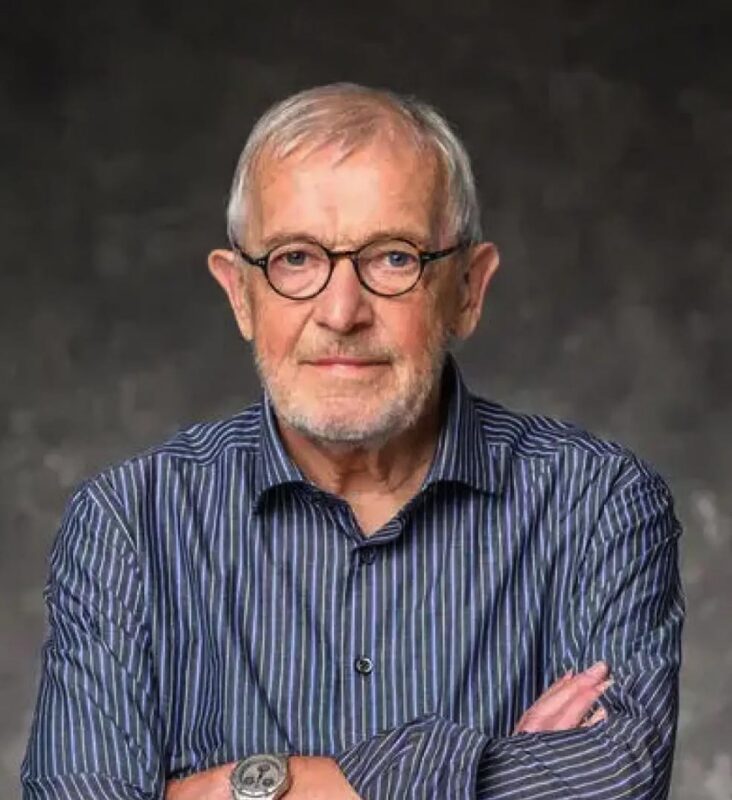
Nobel Prize laureate in Physics Francis Halzen. Photo: University of Wisconsin
Halzen received the Nobel Prize for his work searching for ‘neutrinos’ in ice.
“Neutrinos are sometimes called ghost particles because they are so difficult to detect. Most other particles have an electric charge and leave traces as they travel through a material. Neutrinos, on the other hand, are electrically neutral,” Oikonomou explains.
The idea of using a cubic kilometre of ice at the South Pole as an observatory to detect signals from neutrinos has opened up an entirely new way of studying space.
Although neutrinos are difficult to detect, occasionally they interact with matter in the ice. When this happens, electrically charged particles are produced, creating a faint flash of light. By detecting this light, researchers can calculate the neutrino’s energy and, in many cases, determine the direction it came from.
“Most of the neutrinos we detect come from the sun. Every second, around a trillion of these solar neutrinos pass through your hand.”
- You may also like: Unravelling the origin of mysterious radiation
Searching for the sources
The neutrinos studied by Francis Halzen and the IceCube Collaboration are particles with much higher energies than those originating from the Sun. Many come from sources far beyond our own galaxy.
Researchers believe that many of them originate in extremely energetic environments in distant parts of the cosmos, including regions surrounding supermassive black holes.
“My work involves simulating these extreme sources,” says Oikonomou.
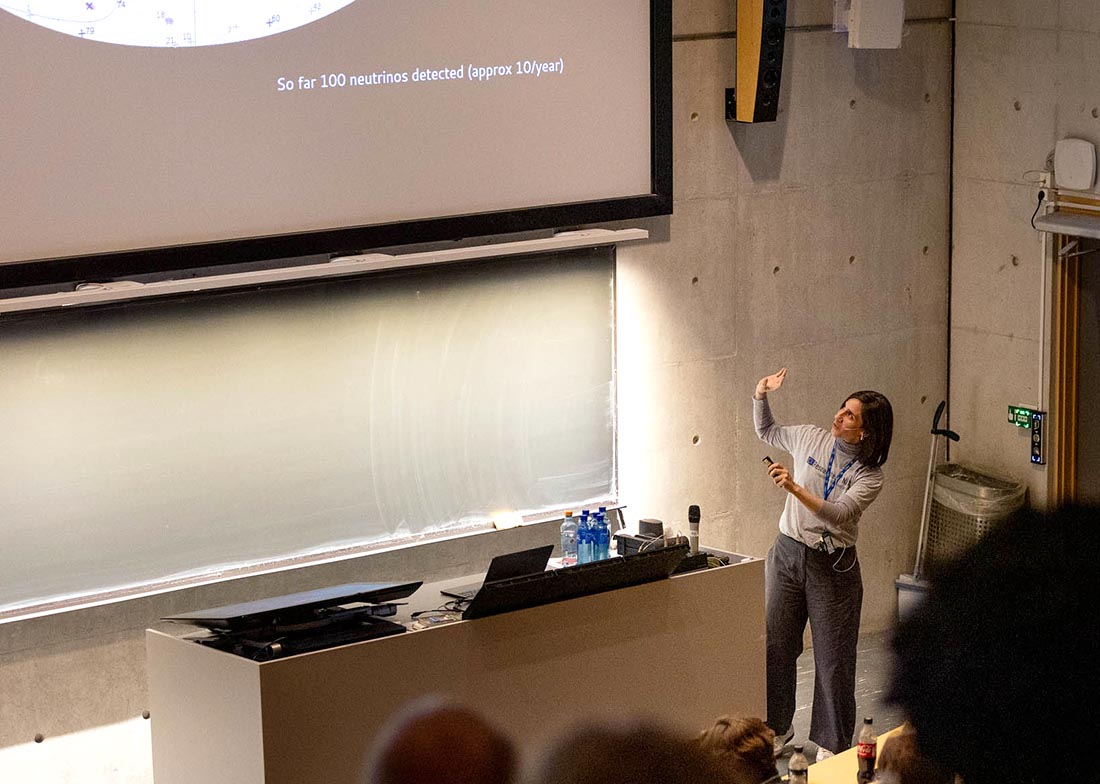
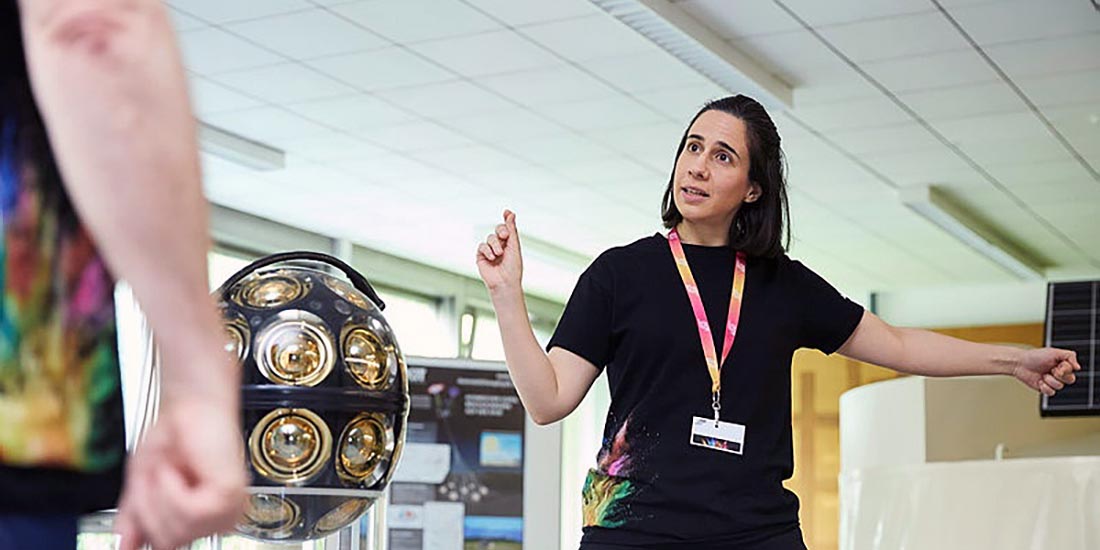
Foteini Oikonomou hosting a lecture about neutrinos to upper secondary school students. The occasion was Researchers’ Night, an event held as part of the Norwegian Research Days. Photo: Aleksander Stokke Båtnes, NTNU
Together with NTNU colleague and professor Michael Kachelriess, she works in high-energy astroparticle physics.
“It’s about using not only light to study the universe, but also other messengers – other particles. We combine particle physics and astrophysics.”
Oikonomou’s research also encompasses cosmic rays.
“Cosmic rays consist of protons and atomic nuclei. These are the highest-energy particles we have ever detected. They can reach energies millions of times higher than those we can produce in particle accelerators on Earth.”
- You may also like: The brain’s searchlight
Extremely violent environments
The mystery facing people working in high-energy astroparticle physics is ‘what is the universe’s most extreme particle accelerator?’
“Most of our theories involve supermassive black holes. Not what lies inside the black hole itself, but the regions surrounding it. These are extremely violent environments. There are jets travelling at close to the speed of light, along with other highly energetic processes. We know about these from astronomy.”
Oikonomou now hopes that this year’s Nobel Prize will inspire enthusiasm among young people and attract more of them to the field.
“That would make me happy. These were the questions that inspired me to pursue a PhD. For me, it’s almost as fascinating as the question of how life began: How does the universe work, and why does it produce such extraordinary energies?”