Seafood should not have to fly
A small revolution is happening in the fishing industry. Freshly frozen fish can now be thawed in a new way, and that means you will have access to super-fresh food from the sea – even if you live thousands of miles away.
As a child living in Northern Norway, I was often at the fish market. Grandpa would grunt and wrinkle his nose as he poked the fish and leaned forward to smell it. “When was this caught?” he’d ask the person who was standing at the ready with a sharp knife and an apron glistening with fish scales.
If the answer was more than two days ago, buying it was out of the question. Nothing is in more of a hurry than a dead fish.
“This is exactly what we have been working on!” says Anders Haugland, founder and CTO of Icefresh. He previously worked on concepts for defrosting fish as a researcher at SINTEF.
“People who are going to eat fish want it as fresh as possible, and we have to find ways to give it to them – even if they are a long way from the Norwegian coast, where the fish begins its journey. Often on the other side of the globe.”
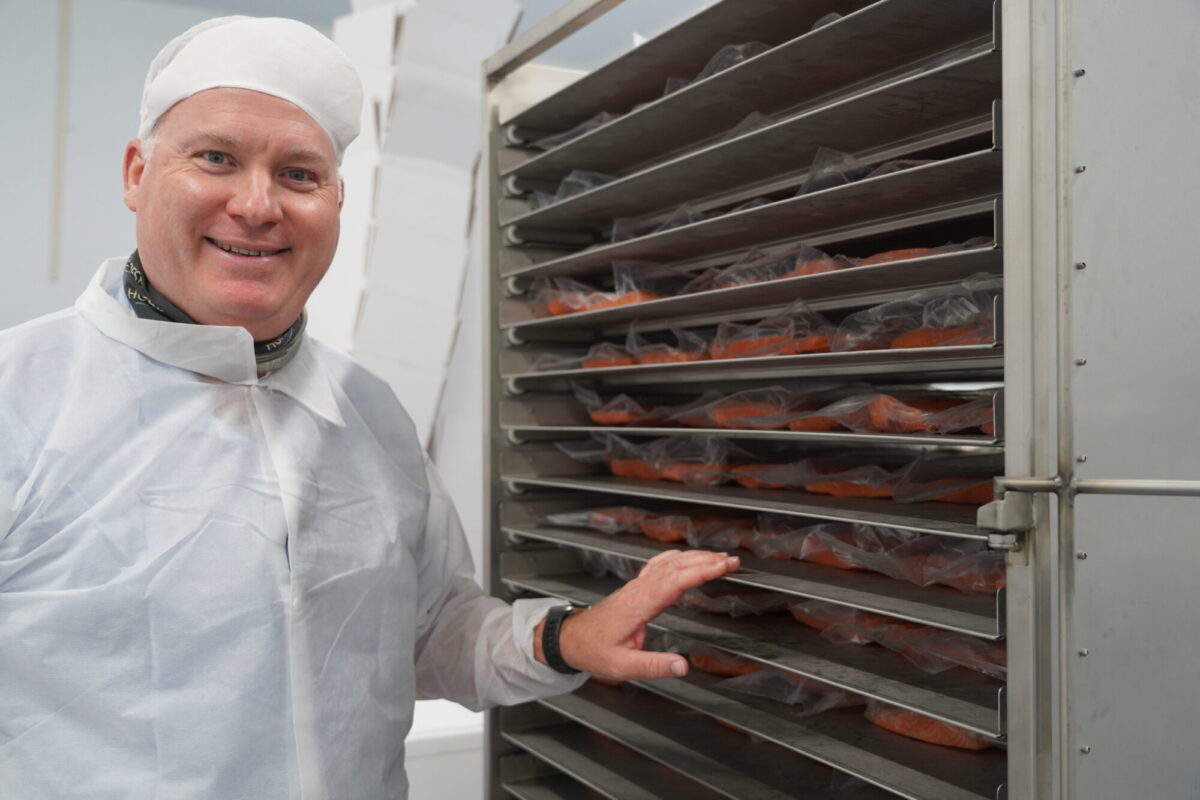
Anders Haugland is a former SINTEF researcher. He now works for Icefresh, which has set itself the goal of delivering salmon with super-fresh quality – even if it has been frozen. Photo: Hofseth
The current method is to load the fish onto a plane, and hope for the best in getting it to the customer’s dinner table as quickly as possible. The countdown begins as soon as the fish are out of the water.
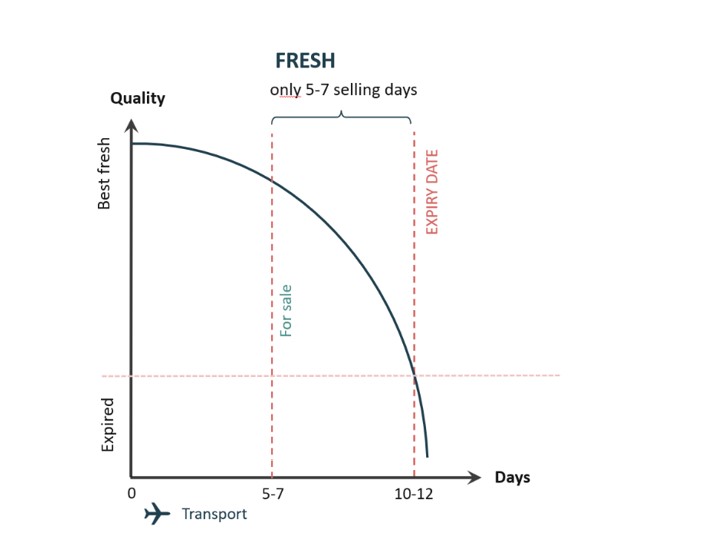
The freshness window. How long does a fresh fish remain edible? Anywhere from 7-14 days depending on the type of fish and the cold chain. More than half of the time is often lost in transport. If you are lucky, you can keep it in the fridge for a few days before it starts smelling “fishy” as it spoils. Ill: Hofseth
That scenario is how the process used to be – a race against the clock. But that’s not the only reason to make changes to the fish’s travel route to distant destinations. The researchers you will hear about have been working for a couple of decades to solve the crucial puzzle:
How can we ensure that the fish quality is super-fresh when it reaches the customer, and at the same time avoid a lot of food waste, climate emissions, and uncertainty around demand?

Trond Andresen. Senior research scientist at SINTEF Energy. Photo: Private
“Thawing fish might seem simple, but it actually involves advanced interactions between heat, air flow and raw material quality,” says Trond Andresen, a senior research scientist at SINTEF.
“This is precisely where SINTEF’s strength lies,” he says. “We can combine food technology with our in-depth expertise in heat transport and flow science. The adaptive process we are developing will allow the system to find the best way to thaw, regardless of the type of fish, the cut and packaging. I find it inspiring to see how theory and computer models can be turned into practical solutions that both improve quality and save energy and emissions.”
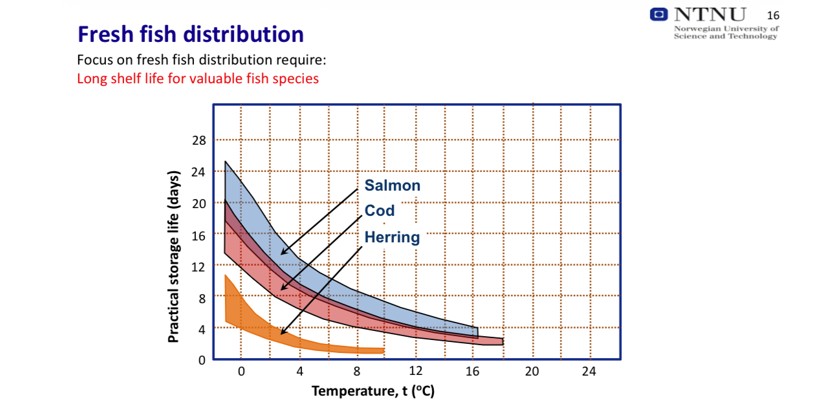
The number of days a fish fillet stays fresh in the chiller cabinet depends on both the type of fish and the temperature. Illustration: Trygve Eikevik, NTNU
And although that might sound feasible, there was no shortcut as to how it could be done in practice, so frozen fish could “become fresh again.”
The clock starts ticking the second the fish leaves the sea
The first piece of the puzzle is Anders Haugland, the researcher who went into depth on how we can thaw frozen fish in a way that actually makes it taste as fresh as when it came off the fishing boat.
“The overarching idea is that if we can have the fish as close as possible to the customer before the ‘freshness window’ expires, then it will be a win for everyone. To achieve that we have to stop time, in a way. And we do that with a freezer. But the challenge arises when you have to thaw the fish.
Freezing fish is good, old knowledge. But everyone knows that as soon as the fish has thawed on the kitchen counter, it is something completely different from a dock-fresh delicacy. So what the researchers did was look for a way to thaw the fish that allows it to retain all its fresh qualities.
“It’s possible to freeze something and then thaw it to optimal quality quite a while afterwards,” says Haugland. “This is done every day by people who work with in vitro fertilization.”
Our challenge was to be able to create a system that can accomplish the same thing with fish fillets.
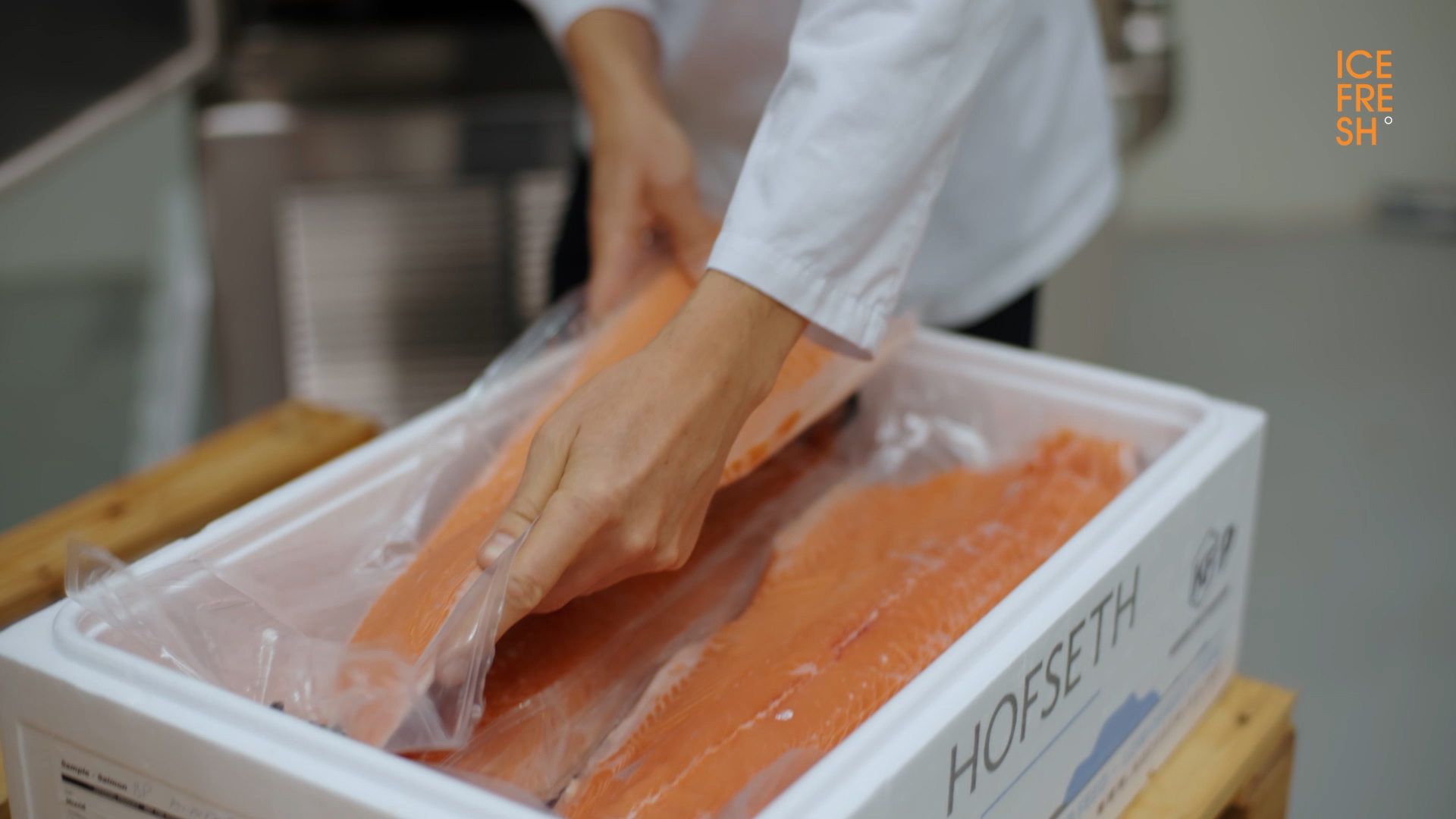
Many years and a lot of research later, the solution has arrived. The fish thaws on trays, in cabinets, with carefully calibrated air flow and temperatures. It may look a bit like an industrial bread oven, but it works the opposite way.
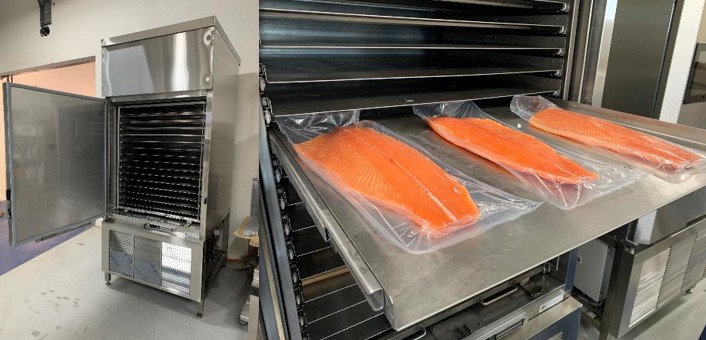
An IceFresh defrosting cabinet. This is a self-learning “machine park.” The machine automatically adjusts itself to the energy flow between the fish and the equipment, and this ensures faster and more energy-efficient thawing. All new learning is stored and used to improve the algorithms for all machines – this way the entire machine park becomes smarter over time – and the energy consumption is as low as possible without compromising the quality of the fish. Photo: Hofseth
“We figured out the actual process of thawing fish in a good way a while ago. But it’s not enough to thaw it well, we also have to put this into use and reach the customer. A good product is useless without a place in the value chain for the raw material,” says Haugland.
He laughs a little because it took a few attempts to figure out how the thawing cabinets could be useful.
Facts about Icefresh:
- Reduced food waste: The fish is stored frozen and only thawed “when needed” close to the retailer, which greatly reduces waste and supports additional sales in stores.
- Quality and food safety: When the fish is frozen at its very best, the quality is sealed, the nutrients are preserved, and oxidation is prevented right up until the time of consumption.
- Real positive environmental impact: Switching from air freight to sea transport reduces the carbon footprint from transport by over 90 percent.
The trip to China – thawing trouble on two wheels
“Around 2010, the big idea was: We have the technology, we’ve managed to create a functioning thawing device in Norway – we can solve this! But Norway and the local market were too small – or maybe just too complicated? The solution was to turn the tables: Buy the very best, super-quality salmon, freeze it, and send it straight to China!”
Haugland says that the plan was to set up “thawing hubs” in China, and the salmon was launched as Icefresh via the online store Alibaba. The concept was as fresh as it was optimistic: Customers ordered online, and the freshly thawed fish would be delivered to their door by bike couriers on scooters, equipped with electric cooler bags. Brilliant, right? A kind of Foodora for fish. It might have worked out well.
But then, in the middle of this salmon dream, geopolitics threw a spoke in the wheel of the project. Liu Xiaobo received the Nobel Peace Prize, and suddenly Norway and Norwegians were about as popular in China as a smelly old salmon.
“As if that weren’t enough, it turned out that the high-tech bike operators were small, family-run companies with less than optimal coolers, to put it nicely.
So the online competition to sell fresh fish became a “race to the bottom” on price – regardless of quality. The thawing team had to find new markets. And more partners. The options looked pretty slim for a while, but on Christmas Eve 2021, Roger Hofseth signed a napkin agreement with the company – one that could perhaps be described as a small Christmas miracle for all of them.
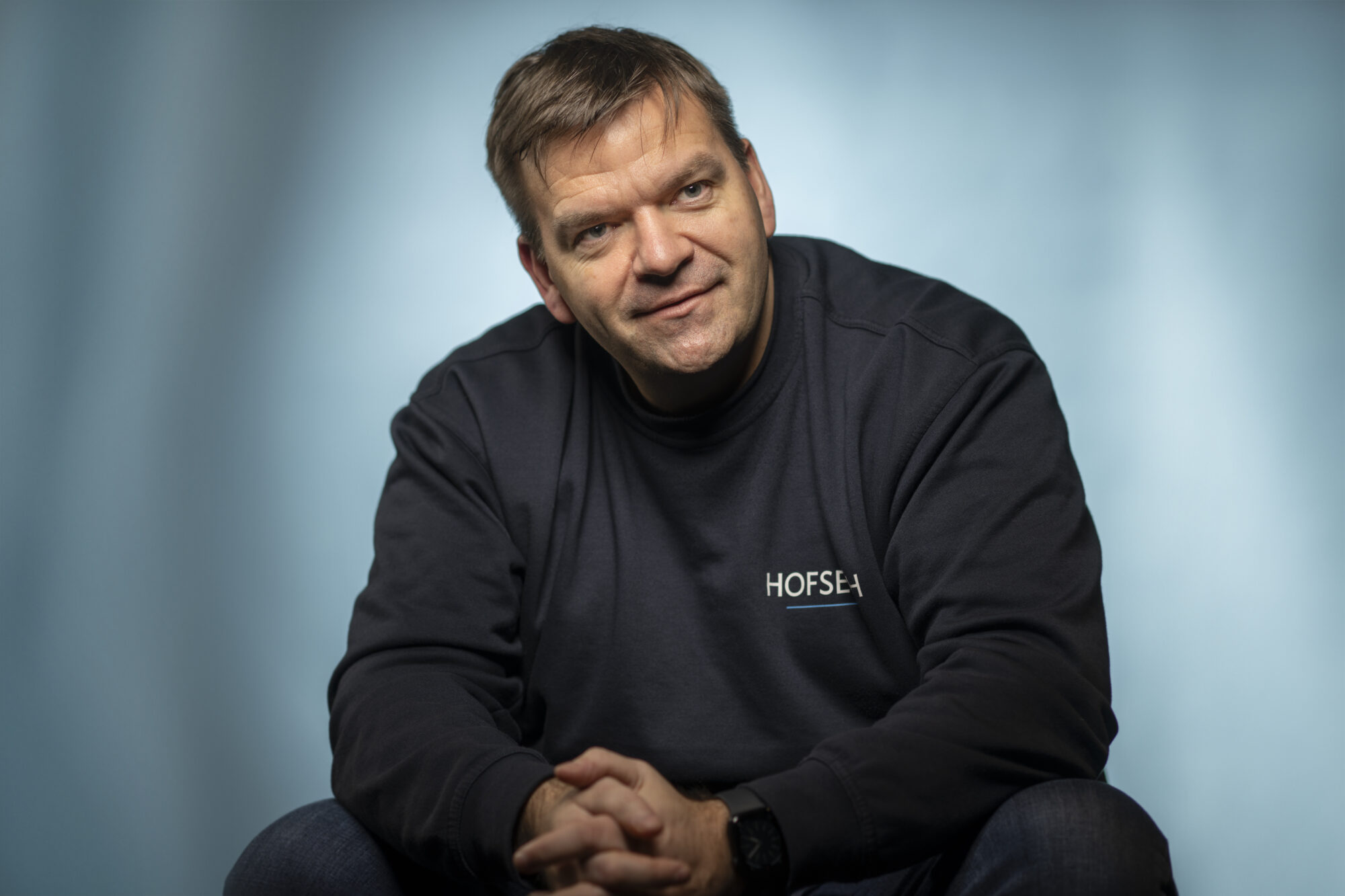
Industry builder from the Sunnmøre district in Møre og Romsdal county, Norway: “Today, a lot of fish loses both quality and value on its way to the markets, and far too much is thrown away. It is neither sustainable nor sensible”, says CEO Roger Hofseth. Photo: Tony Hall
Good enough for the fresh product counter
Who is the new partner in this project? The seafood group Hofseth may not be as well-known as Salmar and Lerøy to most of us, but it sells salmon and trout worth several hundred million euros annually to its main market in the USA. Roger Hofseth says that IceFresh is a crucial addition to optimizing the value chain.
“Up until now, we have focused on frozen products, and had therefore already cut out air freight,” he says. “IceFresh gives us a fantastic opportunity, because we can now sell the “refreshed” products in the fresh produce counter with the good fresh quality that we created in Sunnmøre. The technology offers so many advantages that we’re convinced that the entire industry will follow suit,” he says.
The American dream: everything is bigger over there
“We built some cabinets at Rustfrie Bergh in Dokka municipality and took one across the pond to show that it worked,” says Haugland.
First the team went to a trade fair in Boston, where they experienced more learning than success. The next stop was Florida, where the team had made contact with one of the larger food chains.
“We sent out 230 000 portions of thawed salmon, and the same amount of fresh. Then the users – the chefs and customers – were asked about the quality.
“We were prepared for the introduction of new technology and routines in the value chains for fish at the grocery chains to be challenging. And even though we could show major improvements, the interest in demonstrating solutions that would change established working methods on a commercial scale was limited,” Haugland said.
But a few months later, another exciting supplier came on the scene. They wanted a comprehensive full-scale test, which was carried out in late summer 2024.
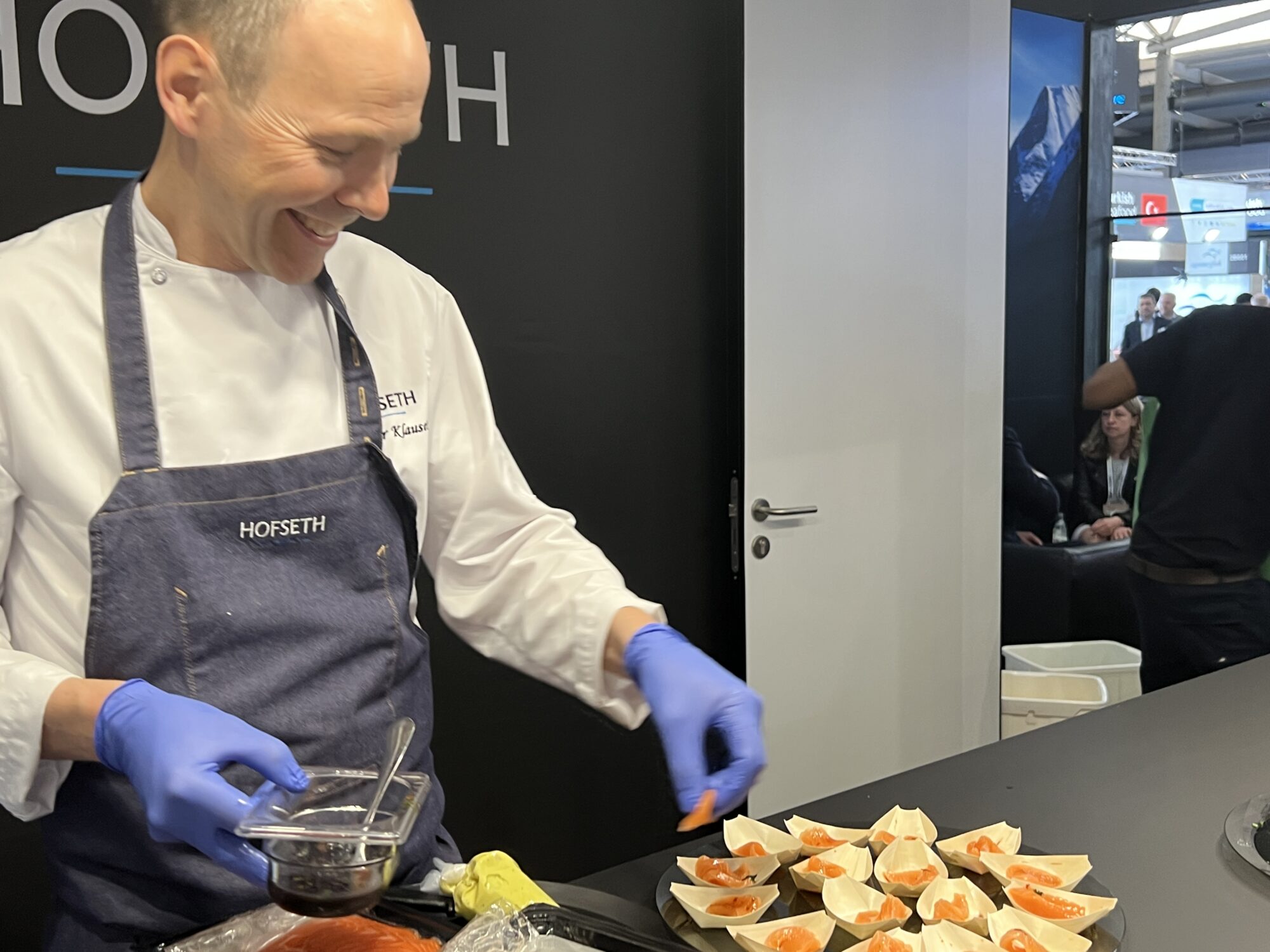 Chef Mindor Klauset serving freshly thawed salmon. Photo: Hofseth
We sent out 230 000 portions of thawed salmon, and the same amount of fresh. Then the end users – the chefs and customers – were asked about the quality. The result was a resounding success, which confirmed the logistical gain: by buying, freezing and transporting the salmon by boat, high-quality fish could be thawed at the earliest two days before it is available for the customer.
This timing ensures a freshness that even a picky grandfather from Northern Norway would accept, and it prevents food waste.
Go big or go home
The large customer found the existing cabinets too cumbersome, so they issued an ultimatum. They wanted a thawing plant ready to go in Chicago before Christmas 2024.
Since neither the technology nor the financing for the future thawing tunnels were in place, the plant had to start with the classic, smaller thawing cabinets. Six of these cabinets were immediately shipped by container, and the hunt for an operational partner began.
After rebuilding and approving the premises, and recruiting people to run the thawing operations, they managed to make the very first delivery of freshly thawed salmon on 23 December 2024. Another little Christmas miracle for the thawing team.
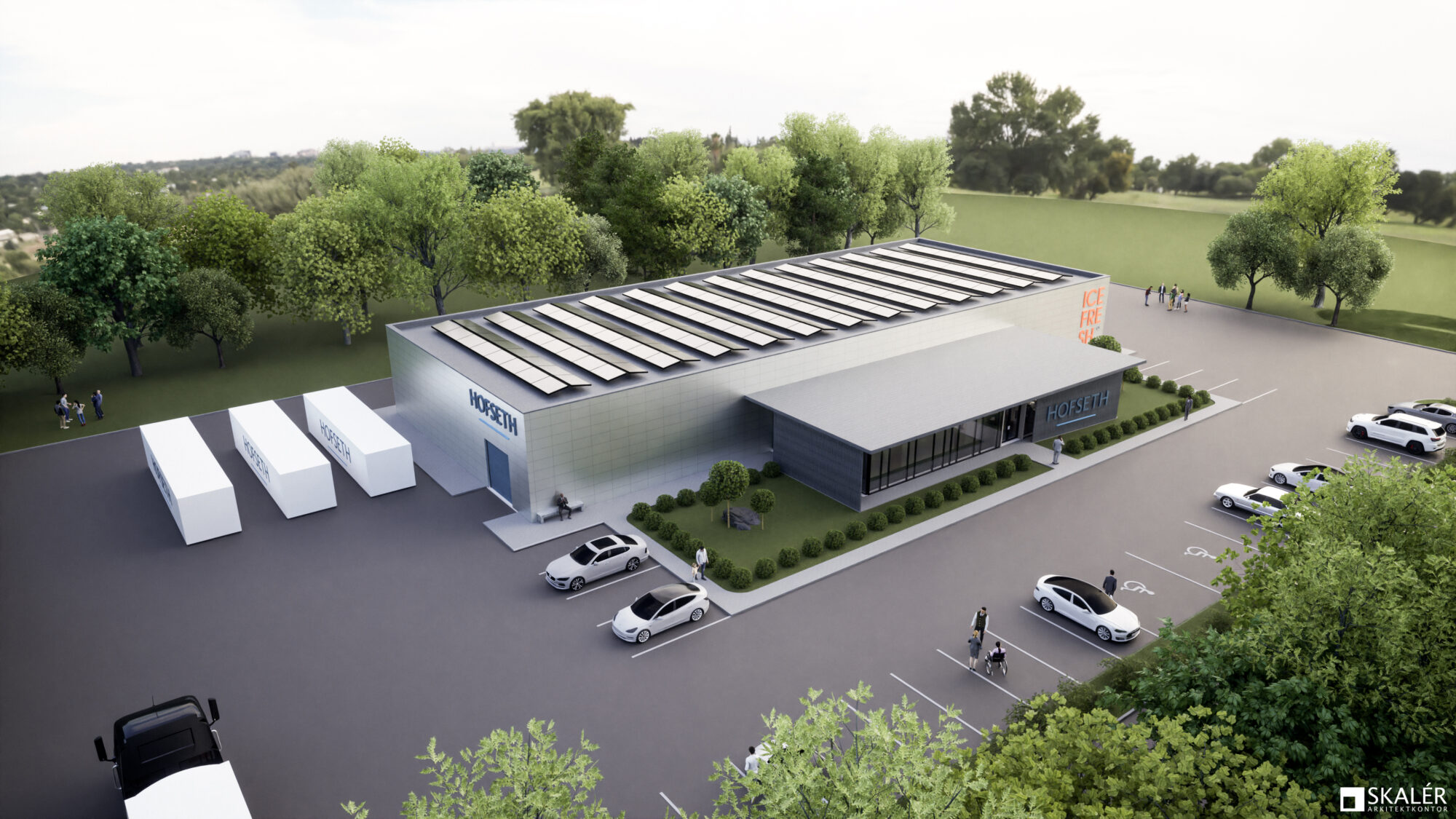
Thawing factory in Los Angeles, to be expanded during 2026. Seafood producer Hofseth, the IceFresh company, supplier MMC First Process, SINTEF Energy and SINTEF Ocean, collaborated closely to develop the concept.
Now things were moving fast. During this process, it had become clear that extensive research and development would be required to set up tunnel-based thawing plants.
SINTEF became more closely linked to the project at that point, establishing an IPN (Innovation Project for the Industrial Sector). The thawing team had now became a powerful consortium consisting of IceFresh, MMC First Process, Hofseth International and SINTEF.
The players joined forces to develop thawing tunnels, and through the project, which was named REFRESHING, it secured support from the Research Council of Norway. Now they could combine their expertise in seafood processing, food science, thermodynamics, fluid flow and system optimization.
In other words, everything you need to obtain the taste of fresh salmon from frozen fillets.
“The goal is to develop groundbreaking technology for the large-scale thawing of fish, which safeguards all aspects of the fish’s quality combined with maximum energy efficiency and productivity in the thawing process,” says Andresen.
From small cabinets to large tunnels
“It’s one thing to create several large thawing cabinets, but quite another to create large systems that can thaw 250 000 portions a day and that will provide the same quality. At the same time, having such a large system to work with gives us more data and a better opportunity to create even more benefits.
A thawing plant will open in Miami in 2026, and the one already established in Los Angeles will be upgraded to the tunnel solution as the first full-scale pilot system, financed by Innovation Norway and equity.
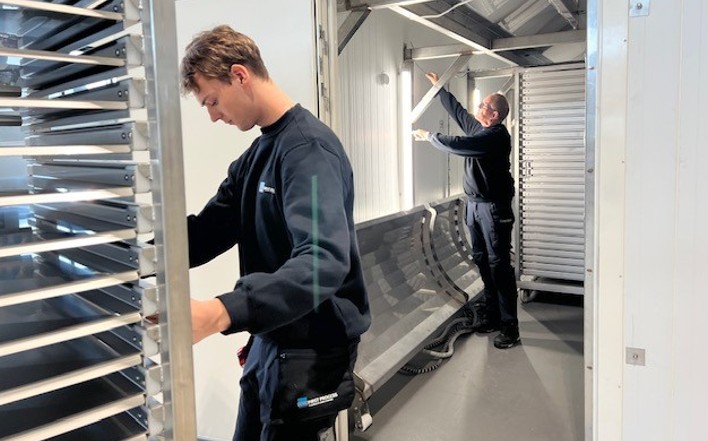
Thawing hub under construction at MMC First Process. Photo: Hofseth
Thawing hub under construction at MMC First Process. Photo: Hofseth
Time to get salmon out to sea again?
Despite the progress, achieving coherence in the value chain is still a challenge. One of the great paradoxes of Norwegian exports is that salmon is flown to its destinations. Every single day, planes loaded with hundreds of tons of fish take off from Gardermoen and other airports. To the USA. To Asia. And to markets that are so far away from the fish’s origin that it is almost absurd to think about.
If all this fish were instead frozen, transported by freighter and then thawed, we would save six million tonnes of CO₂ emissions a year. That is three times the annual emissions from Mongstad, Norway’s largest oil refinery.
“The benefits of shipping fish this way are so great that this change is bound to happen no matter what,” says Hofseth. “When we stop flying fish, the footprint of the seafood industry will be dramatically reduced.”
He says the project now has to build capacity quickly, so that large volumes can be realized in the markets. “A lot is happening in a short amount of time, and the expertise and the thawing capacity have to be shared with the entire industry,” he says.
“Seafood currently accounts for only two percent of the world’s protein intake. When more of the leading players start using thawing hubs, the quality will increase – and along with it people’s seafood consumption. Cheaper products, less waste, a smaller footprint and better quality are win-wins for everyone.
He paints a picture of thawing hubs around the world, which he believes will make airfreighting fish something we’ll come to read about in history books, and fresh fish something that everyone has access to. From then on, it will only be your own cooking skills that will determine whether the salmon turns into a delicious gourmet meal or not.
- Read more about the REFRESHING project here.