Norway’s thermal energy solution: Powering Europe without the nuclear price tag
Installing just four percent of Europe’s commercial buildings with a Thermal Box from Norway — about the size of an American industrial refrigerator — would spare Europe the need to build seven nuclear power plants.
The Thermal Box can store excess energy from the sun, wind or other renewable energy sources in a phase change material, and it is now appearing in more and more places in Norway and Europe. The technology developed by the SINTEF spin-off Cartesian Energy was recently selected by Amazon out of 550 climate technology company applicants from around the world.
“We see the opportunity to deploy Thermal Box at many locations worldwide, especially across our European fulfilment network, over the next years — and this could represent a critical piece of technology in our broader sustainability programme,” says Brad Swartz, the EU Customer Fulfilment Principal Program Manager at Amazon.
The problem no one had solved
Phase change materials are not new physics. Materials that melt and solidify release enormous amounts of energy in the transition (think of an ice pack on a broken ankle). Pack enough of this material into an insulated box and you have a thermal battery with extraordinary energy density. It can solidify and melt thousands of times in a row, without anything being replaced or losing power.
The problem was that no one had managed to make it reliable and commercially viable. It’s not enough to have a box that can melt and solidify, you also need to be able to monitor how much energy is stored and available. Alexis Sevault, the founder of Cartesian, calls it “Schrödinger’s vat”, in a play on the thought experiment called Schrödinger’s cat.
“You can’t know how much of the material has melted without disturbing the system. We can’t measure inside the box without influencing it, so we had to find a new solution. That resulted in an ultrasonic sensor system,” he says.
Without this insight and control, Cartesian would just have a complicated heat tank, not an efficient battery. Cartesian’s patent on the ultrasonic sensor system earned the company the Nordic Innovation Award in 2025.
“I think Amazon started to notice us when we received that award,” says Sevault.
It turned out that Amazon had hired an external company to seek out technology that could contribute to their goal of net zero emissions. Cartesian was selected for Amazon’s sustainability accelerator program and was named this year’s winner.

This year’s winners: Amazon and Cartesian in Paris. From left: Brad Swartz at Amazon, Alexis Sevault and Frode Iglebæk. Photo: Cartesian
Thirty boxes are now ordered and under construction, and will be delivered to three different countries over the summer.
Complex math
Amazon’s warehouses in England have insufficient cooling capacity, and they will be the recipients of one of the Thermal Box deliveries. The solution could have been more cooling machines, with increased electricity costs as a result. But instead, wherever Thermal Boxes are being installed, cooling units won’t have to turn on and off as often, the need for maintenance will be reduced and the machines will last longer. Excess energy from the solar panels on the roof, which would otherwise go to waste, can be stored and provide cooling when buildings need it most.
The result is that cooling capacity increases by 38 percent, without a corresponding increase in electricity consumption, according to Cartesian’s director Frode Iglebæk. The investment is repaid in five years, and with an expected lifespan of 25 years for each Thermal Box, the rest is pure profit for Amazon.
Saves seven nuclear power plants
The calculation does not only apply to Amazon. Sevault explains the math for the entire European market:
“We have conducted investigations and can conservatively say that at least four percent of Europe’s commercial buildings could install one of our boxes without any support, adaptation or downtime. If they all installed a Thermal Box, we could release seven gigawatts of energy. That’s equivalent to the power generated by seven conventional nuclear reactors, without stopping operations for a single minute.”
Inge Gran, Director of SINTEF Energy, places the invention into a broader context.
“A heat exchanger is one of the key components in the energy system, but it’s not very spectacular on its own. There are no moving parts, and yet it’s extremely difficult to design them. We can go to the moon and make superconductors, but we haven’t been able to build a heat exchanger that effectively utilizes the energy in thermal power plants. Alexis and his colleagues have contributed something quite extraordinary with their research.
The solution, developed after ten years at SINTEF and two patented methods, solved both problems at once: a new generation of extruded aluminium heat exchanger, designed to withstand thousands of phase changes in the biowax without losing its shape, and a method for measuring energy levels with ultrasonic sensors. The box thus always knows how much energy it has left, making it controllable like a battery, but without the environmental downsides of battery chemistry, the use of rare metals or degradation.
The idea was born when Sevault started working on thermal storage in phase change materials. His research eventually ended up on the table of SINTEF TTO, which commercializes ideas from SINTEF researchers. The Thermal Box prototype was installed in NTNU and SINTEF’s zero-emission laboratory building, known as the ZEB laboratory, in 2021, and has been there without fail since.
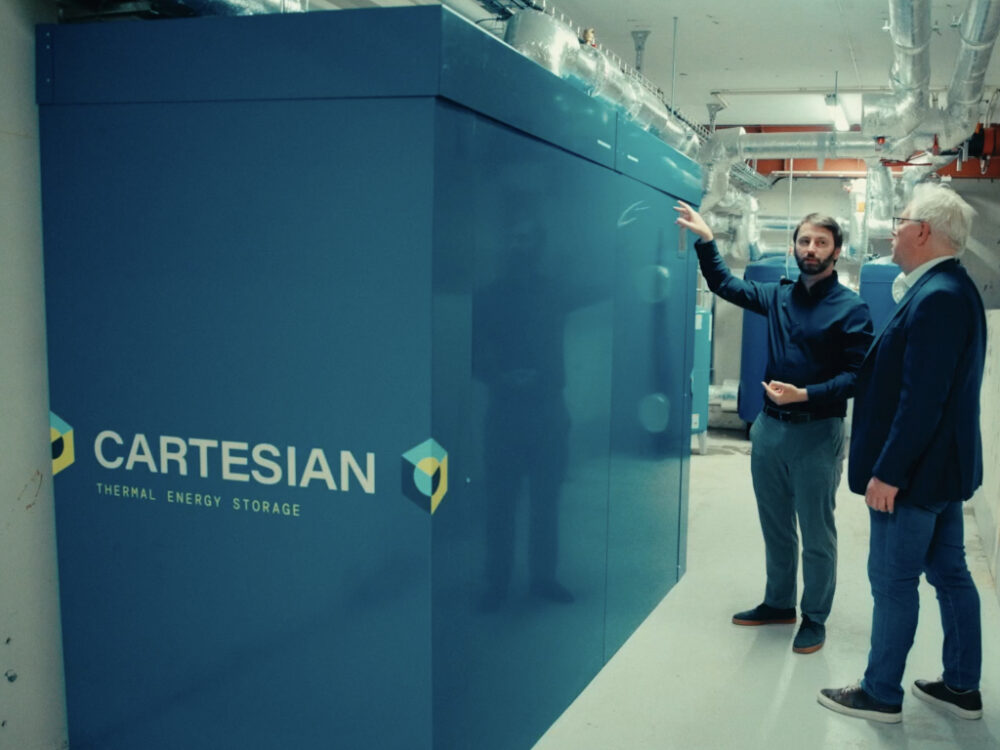
Successful entrepreneurs: Alexis Sevault and Frode Iglebæk in front of the Thermal Box that has attracted Amazon’s interest. Photo: Cartesian
The Thermal Box charges when energy is cheap and delivers when it is expensive, thereby cutting costly energy consumption peaks that an increasing number of European countries are now pricing separately. The Thermal Box is compatible with over 180 different phase change materials in an operating temperature range from -20°C to 120°C degrees, and it can be installed indoors or outdoors, in new buildings or in existing ones.
“We talk about offshore wind and nuclear power as if they’re the only solutions,” says Sevault. “But there are solutions that already work today, and that can be integrated into existing systems without disrupting operations.”