Research shows that allowing natural vegetation to grow back in mountainous areas and on steep slopes and moving production to more fertile areas will both reduce climate emissions and increase biodiversity.
Geologic reservoirs that trapped petroleum for millions of years are now being repurposed to store the greenhouse gas carbon dioxide. New research is improving how we monitor this storage and verify how much CO₂ these reservoirs have stored.
The first-ever audited account of the actual amounts of CO2 stored underground by CCS projects globally has been released. It was created by a new international consortium of scientists and industrial partners, including NTNU.
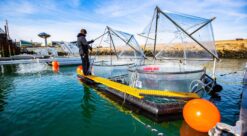
The oceans have to play a role in helping humanity remove carbon dioxide from the atmosphere to curb dangerous climate warming. But are we ready to scale up the technologies that will do the job?
The transport of dense gases and liquids is becoming increasingly relevant in relation to carbon capture. New research is helping us understand more about how this can be done most efficiently.
He’s been called the father of carbon capture and storage in Norway – but Erik Lindeberg isn’t resting on his laurels. At 76, he’s still crusading to make sure this technology is put to use as quickly and comprehensively as possible, to help the world avoid the worst consequences of global warming.
Companies can’t simply walk away from old oil and gas wells. They have to be capped in a way that protects the environment and prevents leaks. A new approach to today’s solution could be better for the environment and cheaper, too.
Europe is well on its way to achieving its ambitious climate goals of a 55 per cent reduction in emissions in 2030 and “net zero” in 2050. But proposed policies must be implemented quickly and effectively.
What should power the future’s shipping fleets? How can we change the way we build buildings so that they’re truly climate neutral? If we’re going to actively alter the planet’s climate, how should we study this?
Direct Air Capture (DAC) technologies offer new opportunities for getting closer to our climate change mitigation targets. However, we still have a long way to go before DAC can be fully rolled out as a mitigation measure.
Norwegian oil and gas companies are now plugging and abandoning production wells using an artificial ‘lava’. So far, the results have been excellent. Recent laboratory results indicate that the same method can be used to seal subsurface CO2 storage reservoirs.
The ZEB Laboratory has been utilised both as an office building and a sustainable construction laboratory for about two years. It was designed to be the world’s most ambitious ‘climate-adapted building’ and up to now it has been a great success.
Climate researchers have long known that large animals, like moose, could play a role in how much the Earth will warm due to climate change. But the question is, how much? New research shows the answer can be a lot.
There are plans in Årdal to build a waste incineration plant based on a new technology that captures and stores CO2, thus removing the greenhouse gas from the atmosphere.
At last it is now possible to capture CO2 at industrial scales without state subsidy, and countries across the world should be persuading private industry to identify storage sites that will make a real difference.
The view that natural gas can act as an eco-friendly bridge in the transition from our use of coal to renewable energy has experienced a renaissance in the wake of the European war. Thus, the time is right to review the data behind the politics.
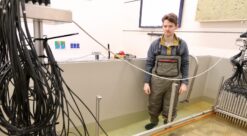
NTNU Associate Professor Jason Hearst has been awarded an ERC Starting Grant from the European Research Council (ERC). He will investigate how turbulence affects the ocean’s ability to absorb CO2.
Code red for humanity, says the IPCC. Fortunately, there’s still a lot we can do, but we have no time to lose, says NTNU climate researcher Edgar Hertwich.
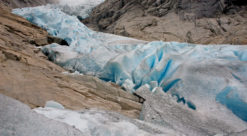
A new report from the Intergovernmental Panel on Climate Change (IPCC) describes with unnerving detail just what can happen if nations fail to limit greenhouse gas emissions. But rapid international action will keep the worst consequences at bay, the panel said.
Everyone knows there’s just too much carbon dioxide in the atmosphere — and we’re heating up the planet at an unprecedented pace. In the third episode of NTNU’s new English-language podcast, 63 Degrees North, we’ll hear what Norwegian researchers are doing to help address this problem.
More biofuels are needed to counteract climate change. But producing them shouldn’t diminish food production or wilderness areas. The solution may be to grow more grass on recently abandoned cropland.
The capture and storage of CO2, also known as CCS, from our waste is essential because this refuse is responsible for a large proportion or our cities’ greenhouse gas emissions. Moreover, the technology represents a relatively inexpensive abatement cost.
The Privacy Statement is about how this website collects and uses visitor information. The statement contains information that you are entitled to when collecting information from our website, and general information about how we treat personal data.The legal owner of the website is the processing officer for the processing of personal data. It is voluntary for those who visit the web sites to provide personal information regarding services such as receiving newsletters and using the sharing and tip services. The treatment basis is the consent of the individual, unless otherwise specified.
1. Web analytics and cookies (cookies)
As an important part of the effort to create a user-friendly website, we look at the user pattern of those who visit the site. To analyze the information, we use the Google Analytics analysis tool.Google Analytics uses cookies (small text files that the site stores on the user's computer), which registers the users' IP address and provides information about the individual user's online movements. Examples of what the statistics give us answers to are; how many people visit different pages, how long the visit lasts, what websites users come from and what browsers are used. None of the cookies allow us to link information about your use of the site to you as an individual.The information collected by Google Analytics is stored on Google servers in the U.S.. The information received is subject to the Google Privacy Policy.An IP address is defined as a personal information because it can be traced back to a particular hardware and thus to an individual. We use Google Analytics's tracking code to anonymize the IP address before the information is stored and processed by Google. Thus, the stored IP address can not be used to identify the individual user.
2. Search
If the webpage has search function, it stores information about what keywords users use in Google Analytics. The purpose of the storage is to improve our information service. The search usage pattern is stored in aggregate form. Only the keyword is saved and they can not be linked to other information about the users, such as the IP addresses.
3. Share / Tips service
The "Share with others" feature can be used to forward links to the site by email, or to share the content of social networking. Tips for tips are not logged with us, but only used to add the tips to the community. However, we can not guarantee that the online community does not log this information. All such services should therefore be used wisely. If you use the email feature, we only use the provided email addresses to resend the message without any form of storage.
4. Newsletter
The website can send out newsletters by email if you have registered to receive this. In order for us to be able to send e-mail, you must register an e-mail address. Mailchimp is the data processor for the newsletter. The e-mail address is stored in a separate database, not shared with others and deleted when you unsubscribe. The e-mail address will also be deleted if we receive feedback that it is not active.
5. Registration, form
The website may have a form for registration, contact form or other form. These forms are available to the public to perform the tasks they are supposed to do.Registration form is for visitors to sign up or register.Contact form is for visitors to easily send a message to the website's contact person.We ask for the name of the sender and contact information for this. Personal information we receive is not used for purposes other than responding to the inquiry.The form is sent as email via Mailgun as a third party solution. The entire submission will be stored at Mailgun for 24 hours. Between 24 hours and 30 days, only mailheader is stored before the submission is deleted after 30 days. The reason for this storage is to confirm whether emails are sent from the website and forwarded to the correct recipient.Once the email is received by the recipient, it is up to the recipient to determine the data processing needs of the email.
6. Page and service functionality
Cookies are used in the operation and presentation of data from websites. Such cookies may contain language code information for languages selected by the user. There may be cookies with information supporting the load balancing of the system, ensuring all users the best possible experience. For services that require login or search, cookies can be used to ensure that the service presents data to the right recipient.