
Gold particles and sunlight can help purify water
Fresh water is under threat on many fronts. Researchers are working hard to solve this problem. One solution uses sunlight and bismutite.
Industrial waste, dyes and chemicals all potentially pollute our waters. This is a problem we have to address, but how can water be cleansed of these pollutants in a sustainable manner?
Jibin Antony, a PhD research fellow at NTNU’s Department of Chemical Engineering believes the solution may lie in using something of which we have in great abundance: sunlight.
“We need technologies that are green, affordable and efficient. The sun provides us with an enormous amount of energy, completely free of charge. The challenge is finding materials that can use sunlight to break down pollutants in water,” Antony said.
He is studying a process called photocatalysis. Photocatalysts are special materials that start a chemical reaction when exposed to light. The reaction can break down harmful substances in water.
- You might also like: Solving a dirty problem with sunlight and oil
Using bismutite
The material Antony has ended up focusing on is called bismutite. This is a mineral that naturally occurs as bismuth carbonate oxide, and can be found in certain places in Norway.
Bismutite can be used as a photocatalyst, but it only works effectively when exposed to ultraviolet light – a very small portion of sunlight. In order to make bismutite more effective in normal sunlight, Antony has tested three different methods:
- The first was to combine bismutite with silica to form silicon dioxide (SiO2).
“Silica helps the pollutants adhere better to the material while also creating small structural defects that serve to accelerate the process,” he said.
- The second method was to cover bismutite with ‘plasmonic’ gold nanoparticles in various shapes. Plasmonic metal particles can absorb and scatter light at specific wavelengths. The elongated nanoparticles in particular produced a significant improvement.
“They work almost like antennas for sunlight. The effect on the photocatalysis was very clear,” added Antony.
- Finally, Antony tried a chemical treatment in which bismutite was etched using an alkaline solution.
This method alone did not produce significant results, but it can enhance the effects of the other methods.
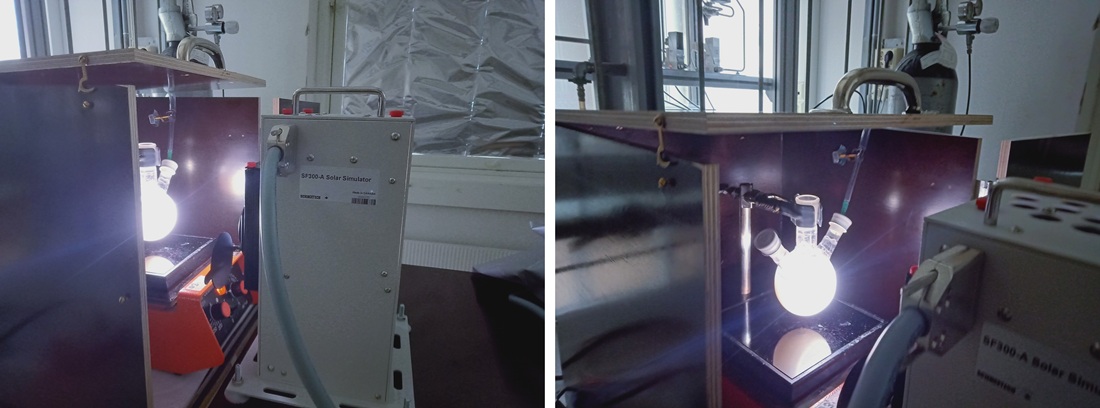
The experimental setup. Photo: NTNU
Making bismutite more effective
Collectively, the experiments showed that it is possible to make materials like bismutite much more effective in normal sunlight.

Jibin Antony. Photo: NTNU
“This is a step towards affordable, solar-powered systems that can purify water without the use of harmful chemicals,” said Antony.
The goal is that, sometime in the future, a technology can be developed that helps create cleaner rivers, lakes and drinking water, using one of nature’s most abundant resources.
“We can’t solve every environmental problem with just one method, but if we can use sunlight and smart chemistry to purify water, we will have taken an important step in the right direction,” concluded Antony.
References:
Antony, J., Gonzalez, S.V., Bandyopadhyay, S., Yang, J. and Rønning, M., 2023. Silica-modified bismutite nanoparticles for enhanced adsorption and faster solar photocatalytic degradation of methylene blue. Catalysis Today, 413, p.113986. https://doi.org/10.1016/j.cattod.2022.12.017
Antony, J., Bandyopadhyay, S., Yang, J. and Rønning, M., 2023. Optimizing the shape anisotropy of gold nanoparticles for enhanced light harvesting and photocatalytic applications. Photochemical & Photobiological Sciences, 22(4), pp.773-781. https://doi.org/10.1007/s43630-022-00351-8