Patients are much more demanding than ever before
Pablo Picasso’s painting ‘Science and Charity’ from 1897 depicts a meek and compliant patient lying placidly in bed between the doctor and the nurse. Picasso would hardly recognize the modern-day patient.
Opinions expressed in Viewpoints are the author’s own.
Patients in the past were expected to be patient, grateful, passive and docile – but many of today’s patients are assertive, demanding, impatient and insistent. Why have things changed?
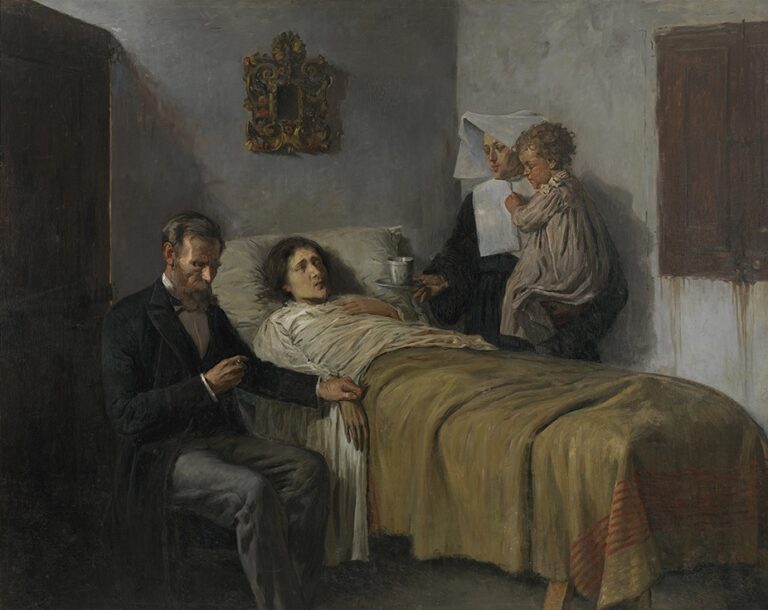
Pablo Picasso’s “Ciencia y caridad”. The painting is displayed at the Museo Picasso de Barcelona.
One of the most significant changes is that the treatment and care of the sick have shifted from the local community and family to the welfare state and professional healthcare services.
With institutionalization, the ‘sick role’ shifted from being relational and close-knit to becoming an individual right within an impersonal system.
Rights without responsibilities and obligations
The American sociologist Talcott Parsons was one of the first people to systematically study the ‘sick role’. He described it as a socially accepted set of behaviours and expectations for individuals who were ill or disabled. Parsons highlighted four key characteristics of the sick role.
- Firstly, the sick role is not considered the individual’s fault, since being ill is usually beyond a person’s control.
- Secondly, illness exempts the sick person from obligations such as work, school and caring for others.
- Thirdly, the sick role comes with responsibilities: the sick person has a duty to try to regain their health or to help ensure that it does not worsen.
- Fourthly, Parsons argued that the sick role also entails an obligation to cooperate with health professionals and follow their recommendations.
An important change since Parsons described the sick role in the 1950s is that the relevance of rights has become stronger, while the significance of responsibility and obligations has diminished. This is, of course, closely connected to the institutionalization of the welfare services.
- You might also like: Psychiatric treatment no guarantee of a return to work
Part of common discourse
Another important change that has influenced the sick role is that illness has become much more common in public discourse and everyday language.
People are more open about illness, and it is talked about more. Furthermore, words associated with illness are used much more frequently and widely than before. Today, expressions like ‘that car is sick’, ‘the food was insanely good’ or ‘the concert was absolutely mental’ are commonly used.
The normalization of illness in public discourse and everyday language has undoubtedly influenced the sick role. It is more widely recognized and accepted, and carries less stigma. This is related to the fact that far more people currently receive diagnoses than before.
More illnesses – more roles
When some ‘old folks’ were interviewed in the newspaper Indlandsposten (13.09.1916), they responded: “No, we didn’t know anything about illness back then; we didn’t have doctors or medicine or anything like that, and you know, people were healthy.” These days, however, there are many doctors, many different types of medication – and a whole host of diagnoses.
There are 55,000 diagnostic codes in the WHO classification system (ICD-11). This means that many different types of health conditions can be assigned a diagnosis – and the statistics show that a large number of people take sick leave. Therefore, the sick role has become far more common.
In addition, there is a big difference between having a dementia diagnosis, a cancer diagnosis and being diagnosed as on the autism spectrum. As a result, sick roles also differ. It is no wonder that people become confused and feel misunderstood.
The sick role is also influenced by its social function.
Function of the sick role
The sick role exempts individuals from obligations, such as work, and grants rights, including the right to medical attention and sick pay. In addition, it has a moral function: it explains and justifies not contributing to society or taking responsibility for others (such as family).
The sick role is shaped by how its various functions are perceived and change over time. For example, parents may push for a child to receive an ADHD diagnosis in order to gain access to services and support, while the individual in question may later struggle to get a job in the police or military as a direct result of having received the diagnosis.
An important change can be seen in the explanatory power of the sick role. Previously, it provided an explanation for why the individual could not contribute to the family or society. Nowadays, however, it increasingly serves as an explanation for why someone is not performing as expected. This, of course, is related to a general trend of individualization in society.
The significance of diagnoses and medical attention has also changed. Whereas people in the past sought to avoid the sick role, today it brings increased attention. One Norwegian pundit observed that “it seems like every other influencer either has ADHD or is being assessed for it.” This shift is related to connected to the sick role as an identity marker.
- You might also like: This form of therapy can save enormous amounts of money by getting people with mental health problems back to work more quickly
Illness as identity
Whereas illness used to negatively affect a person’s identity by preventing them from performing their job, diagnoses are increasingly becoming part of the identity of more and more people. People identify themselves as ‘epileptic’, ‘diabetic’, or a ‘cancer survivor’.
Society previously assigned the sick role, but individuals are now more active in shaping their own sick role.
The sick role is not like other roles
The sick role has thus changed in four notable ways:
- Responsibility and care for the sick have shifted from close family relationships to welfare-based institutions.
- The rights associated with the sick role have received increased attention, while the obligations have faded into the background.
- The explanatory power of the sick role has changed: from explaining a lack of contribution to society to explaining a lack of personal performance.
- These are all related to the increase in the number of diagnoses and the sick role’s function in shaping identity. Therefore, being sick today is more complex and demanding than ever.
This feature article was first published in Dagens Medisin on 4 February 2026.