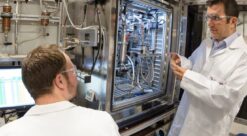
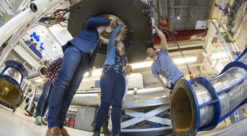
Most people know that metals are made from ore, but how do we make gold from gravel? That’s the process we must understand to be able to make the metal industry climate friendly. Here are some alternatives for CO2-free metal production.
It is difficult to recycle artificial turf and there are no obvious deposit-return systems for these plastics on the market. But researchers are now looking to find a solution to the problem.
A team of Norwegian researchers has succeeded in producing hydrogen using a far more efficient method than is currently in use. The technology was ready as early as in 2017. The team has also demonstrated that the process can be scaled up for commercial application.
Very soon, there will be enormous numbers of used EV batteries available, but we have yet to work out how we will be organising the reuse of this massive resource.
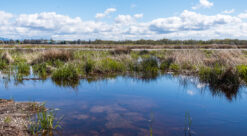
At the boundary between the land and sea, there exists an ecosystem that has been overlooked by Norwegians for so long that it was only recently given an official name. But studies are revealing that it has some very desirable properties.
The Earth’s oceans are crisscrossed with roughly 1.2 million km of fibre optic telecommunication cables — enough to girdle the planet 30 times. Researchers have now succeeded in using fibre in a submarine cable as a passive listening system, enabling them to listen to and monitor whales.
As part of a six-year research project, researchers have succeeded in developing a membrane that captures CO2 in an entirely innovative way. Their work has resulted in an article published in the prestigious research periodical Science Magazine.
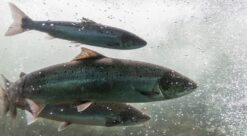
When hydroelectric power plants suddenly switch off the water, we risk killing fish fry and other living organisms in rivers. The regulations need to change, say scientists and anglers.
Heating with oil in homes and commercial buildings is now banned in Norway. The storage tanks are supposed to be removed from buildings, but many people choose not to get rid of these environmental time bombs.
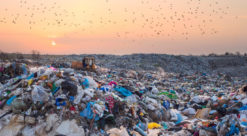
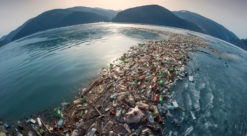
Using non-recyclable plastic waste as an alternative to coal may prevent huge volumes of plastic from being discarded into the oceans – and will also reduce CO2 emissions. This is the conclusion of a recently completed pilot project headed by SINTEF in Vietnam.
The idea behind batteries is to make the planet greener, but they all start their lives as energy-demanding environmental liabilities. Research scientists at SINTEF have succeeded in making batteries cheaper and simpler using a process that requires much less energy consumption.
Norwegian mountains are full of time capsules. Thousands of years of human and ecological history are preserved in remnant patches of ice. Now this treasure trove of information threatens to melt away, unless we take action.
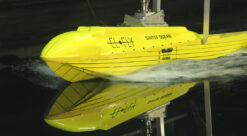
With this seaplane you will be able to take off from Trondheim Fjord or Flesland Airport in Bergen, Norway, and land in the Geiranger Fjord one hour later.
Electrification of the Norwegian continental shelf is a long-standing political issue. Now research scientists believe this can be done using fuel cells installed on the platforms. This will reduce CO2 emissions and remove the need to lay new subsea cables.
High energy prices highlight the importance of the thousands of kilometres of insulated pipe networks and equipment in industrial plants. However, corrosion under the pipes’ insulation is hard to detect and can have severe consequences. New surveillance technology being developed by SINTEF can help combat this looming threat.
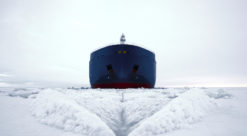
More than 600 fishing vessels sail the icy waters of the Arctic. But just over two dozen big tankers are the worst offenders when it comes to air pollution in this vulnerable region.
Capping production of new plastics will help cut their release to the environment — and brings other benefits, from boosting the value of plastics to helping tackle climate change.
Many buildings with solar cells produce more electricity than they consume themselves, but current legislation prevents surplus power from being sold to neighbouring consumers. A pilot project in Trondheim will be the first in the world to test a system that makes this possible.
How Norwegian scientists and engineers harnessed the country’s wild waterfalls by developing super efficient turbines — and how advances in turbine technology being developed now may be the future in a zero-carbon world.
The climate will benefit if we shift to using aluminium in more and more construction. Buyers need to look past the procurement costs and consider the total life cycle costs instead.
The Intergovernmental Panel on Climate Change (IPCC) has released its third Working Group report on how humankind can mitigate the ecosystem and societal effects of climate change. Much can be done, but the challenges remain enormous, the report confirms.
While former Prime Minister Jens Stoltenberg steered Norway according to the logic of economics, today’s politicians seem to lack a basic understanding of markets. The result is a policy that amplifies energy scarcity and drives up energy prices – without policymakers recognizing this unintended consequence.
The Privacy Statement is about how this website collects and uses visitor information. The statement contains information that you are entitled to when collecting information from our website, and general information about how we treat personal data.The legal owner of the website is the processing officer for the processing of personal data. It is voluntary for those who visit the web sites to provide personal information regarding services such as receiving newsletters and using the sharing and tip services. The treatment basis is the consent of the individual, unless otherwise specified.
1. Web analytics and cookies (cookies)
As an important part of the effort to create a user-friendly website, we look at the user pattern of those who visit the site. To analyze the information, we use the Google Analytics analysis tool.Google Analytics uses cookies (small text files that the site stores on the user's computer), which registers the users' IP address and provides information about the individual user's online movements. Examples of what the statistics give us answers to are; how many people visit different pages, how long the visit lasts, what websites users come from and what browsers are used. None of the cookies allow us to link information about your use of the site to you as an individual.The information collected by Google Analytics is stored on Google servers in the U.S.. The information received is subject to the Google Privacy Policy.An IP address is defined as a personal information because it can be traced back to a particular hardware and thus to an individual. We use Google Analytics's tracking code to anonymize the IP address before the information is stored and processed by Google. Thus, the stored IP address can not be used to identify the individual user.
2. Search
If the webpage has search function, it stores information about what keywords users use in Google Analytics. The purpose of the storage is to improve our information service. The search usage pattern is stored in aggregate form. Only the keyword is saved and they can not be linked to other information about the users, such as the IP addresses.
3. Share / Tips service
The "Share with others" feature can be used to forward links to the site by email, or to share the content of social networking. Tips for tips are not logged with us, but only used to add the tips to the community. However, we can not guarantee that the online community does not log this information. All such services should therefore be used wisely. If you use the email feature, we only use the provided email addresses to resend the message without any form of storage.
4. Newsletter
The website can send out newsletters by email if you have registered to receive this. In order for us to be able to send e-mail, you must register an e-mail address. Mailchimp is the data processor for the newsletter. The e-mail address is stored in a separate database, not shared with others and deleted when you unsubscribe. The e-mail address will also be deleted if we receive feedback that it is not active.
5. Registration, form
The website may have a form for registration, contact form or other form. These forms are available to the public to perform the tasks they are supposed to do.Registration form is for visitors to sign up or register.Contact form is for visitors to easily send a message to the website's contact person.We ask for the name of the sender and contact information for this. Personal information we receive is not used for purposes other than responding to the inquiry.The form is sent as email via Mailgun as a third party solution. The entire submission will be stored at Mailgun for 24 hours. Between 24 hours and 30 days, only mailheader is stored before the submission is deleted after 30 days. The reason for this storage is to confirm whether emails are sent from the website and forwarded to the correct recipient.Once the email is received by the recipient, it is up to the recipient to determine the data processing needs of the email.
6. Page and service functionality
Cookies are used in the operation and presentation of data from websites. Such cookies may contain language code information for languages selected by the user. There may be cookies with information supporting the load balancing of the system, ensuring all users the best possible experience. For services that require login or search, cookies can be used to ensure that the service presents data to the right recipient.