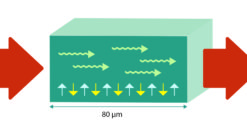
Components are falling into place for the technology of the future. They can provide smaller, faster and cheaper electronics with minimal energy consumption.
Norwegian research scientists are contributing to the development of the world’s hottest geothermal well in a non-volcanic area. The goal is to exploit the inexhaustible supply of heat from the interior of the Earth, and this calls for equipment that can withstand the most extreme conditions.
As a child, Professor Myrheim wondered what the far side of the Moon looked like. Trondheim’s Starmus festival will welcome a trio who has actually been on the moon, and the astrophysicist is excited to hear their lecture. “Perhaps it’s the magic of childhood that lingers on,” he says.
This year’s winners of the Stephen Hawking Medal for Science Communication 2017 were announced yesterday at a press conference in New York. The winner of the science communicator award is astrophysicist Neil deGrasse Tyson. The medal itself will be awarded on 20 June during the Starmus Science Festival in Trondheim.
Many of the speakers at the Starmus Festival are superstars in their fields of expertise. But few have as many fans as Brian Cox, the researcher who also feels at home in popular culture.
Imagine a dog owner with a reflective vest and a black dog without one. In the dark we can see how the dog owner moves, but not the dog. That’s how black holes work, too.
He was the very first person to walk in space. A rescue team on skis brought him to safety after an emergency landing in the Siberian forest. Now, Alexei Leonov is coming to Trondheim.
By controlling a mix of clay, water and salt, Norwegian and Brazilian researchers have created nanostructures that might help boost oil production, expand the lifespan of certain foods or that could be used in cosmetics or drugs.
The Privacy Statement is about how this website collects and uses visitor information. The statement contains information that you are entitled to when collecting information from our website, and general information about how we treat personal data.The legal owner of the website is the processing officer for the processing of personal data. It is voluntary for those who visit the web sites to provide personal information regarding services such as receiving newsletters and using the sharing and tip services. The treatment basis is the consent of the individual, unless otherwise specified.
1. Web analytics and cookies (cookies)
As an important part of the effort to create a user-friendly website, we look at the user pattern of those who visit the site. To analyze the information, we use the Google Analytics analysis tool.Google Analytics uses cookies (small text files that the site stores on the user's computer), which registers the users' IP address and provides information about the individual user's online movements. Examples of what the statistics give us answers to are; how many people visit different pages, how long the visit lasts, what websites users come from and what browsers are used. None of the cookies allow us to link information about your use of the site to you as an individual.The information collected by Google Analytics is stored on Google servers in the U.S.. The information received is subject to the Google Privacy Policy.An IP address is defined as a personal information because it can be traced back to a particular hardware and thus to an individual. We use Google Analytics's tracking code to anonymize the IP address before the information is stored and processed by Google. Thus, the stored IP address can not be used to identify the individual user.
2. Search
If the webpage has search function, it stores information about what keywords users use in Google Analytics. The purpose of the storage is to improve our information service. The search usage pattern is stored in aggregate form. Only the keyword is saved and they can not be linked to other information about the users, such as the IP addresses.
3. Share / Tips service
The "Share with others" feature can be used to forward links to the site by email, or to share the content of social networking. Tips for tips are not logged with us, but only used to add the tips to the community. However, we can not guarantee that the online community does not log this information. All such services should therefore be used wisely. If you use the email feature, we only use the provided email addresses to resend the message without any form of storage.
4. Newsletter
The website can send out newsletters by email if you have registered to receive this. In order for us to be able to send e-mail, you must register an e-mail address. Mailchimp is the data processor for the newsletter. The e-mail address is stored in a separate database, not shared with others and deleted when you unsubscribe. The e-mail address will also be deleted if we receive feedback that it is not active.
5. Registration, form
The website may have a form for registration, contact form or other form. These forms are available to the public to perform the tasks they are supposed to do.Registration form is for visitors to sign up or register.Contact form is for visitors to easily send a message to the website's contact person.We ask for the name of the sender and contact information for this. Personal information we receive is not used for purposes other than responding to the inquiry.The form is sent as email via Mailgun as a third party solution. The entire submission will be stored at Mailgun for 24 hours. Between 24 hours and 30 days, only mailheader is stored before the submission is deleted after 30 days. The reason for this storage is to confirm whether emails are sent from the website and forwarded to the correct recipient.Once the email is received by the recipient, it is up to the recipient to determine the data processing needs of the email.
6. Page and service functionality
Cookies are used in the operation and presentation of data from websites. Such cookies may contain language code information for languages selected by the user. There may be cookies with information supporting the load balancing of the system, ensuring all users the best possible experience. For services that require login or search, cookies can be used to ensure that the service presents data to the right recipient.