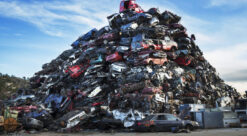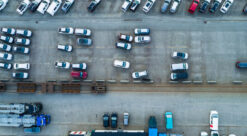
Cars are too wide and parking spaces too narrow
SINTEF is recommending that parking spaces should be made wider – because passenger cars are getting bigger, and the number of civil actions relating to parking is on the increase.

SINTEF is recommending that parking spaces should be made wider – because passenger cars are getting bigger, and the number of civil actions relating to parking is on the increase.
It is essential to speed up electrification of the Norwegian heavy transport sector. We believe that this is possible in spite of full capacity utilisation in the electricity grid. Here are our three recommendations.
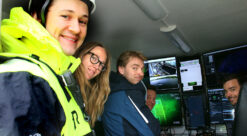
NTNU’s largest laboratory – the Trondheim fjord – is something of an Eldorado for researchers developing underwater robots. A charging station has been installed on the seabed, and to ensure the robots can find the shortest route to the charging station, they train in the fjord.
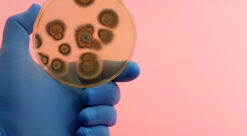
SINTEF researchers have been testing different types of water distribution cabinets. Cabinets that combine the distribution of both domestic tap water and water for floor heating, are now shown to represent an unnecessary risk of Legionnaires’ disease.
How can we decarbonize large-scale power generation and aviation as quickly as possible? The European Research Council has awarded a substantial grant to a team of researchers who will explore this.
Every organism needs to breathe – including cells that we use in in vitro microphysiological systems. We now have promising results with a material that enhances the quality of our experiments.
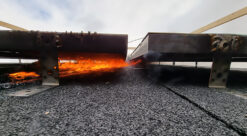
Solar panels installed on roofs and facades increase the fire risk. However, research shows that small changes in construction can make a big difference.

Researchers have concluded that many people are suffering unnecessarily and that treatment provision offered to patients is failing at many levels.
Recent data on people’s habits in the workplace are giving us reason to look into whether the use of artificial intelligence (AI) may be hampering collaboration and knowledge sharing.
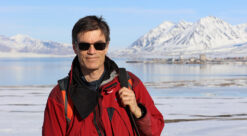
NTNU Amos is an expansive ocean research and innovation community that’s composed of both highly honed specialist expertise and an incredibly broad scope of knowledge. It also adheres to a popular Norwegian football strategy: Develop talents by allowing them to do what they do best – and playing to each other’s strengths.
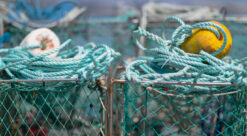
The aquaculture sector can now download a set of guidelines containing 25 ideas about the circular use of plastics.
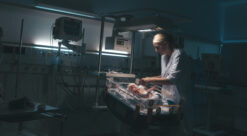
Ultrasound technology from NTNU makes it possible to monitor cerebral blood flow in newborn babies, helping prevent brain damage in premature and sick infants who require surgery.
The Nyhavna industrial area in Trondheim, which is being developed into a new mixed-use neighbourhood, has seen significant maritime technology research and innovation. NTNU Nyhavna for autonomous vessels is now officially opened.
Norway is often seen as a shining example of how a country can make its transportation greener by encouraging consumers to purchase electric cars. But Norway’s approach isn’t for everyone — and it may be hampering the country’s efforts to make its transport solutions truly climate friendly.
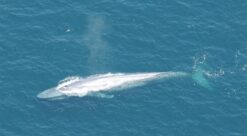
Nineteenth-century Norwegian technology helped bring large whale populations to the brink of extinction. Can 21st-century technology help save them?
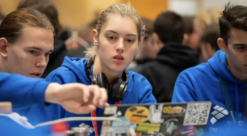
The need for cyber security expertise is steadily increasing. This summer’s cyber attacks against 12 Norwegian ministries and the Storting were a stark reminder of this. According to an NTNU researcher, hacking in organized forms is the solution.
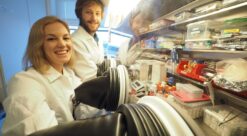
Researchers at NTNU are searching for materials that could be used to make Li-ion batteries with a higher energy density.
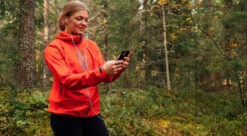
Apps and games make us exercise more often, play more, run further, learn better and work smarter. Meet the innovators who make you do the things you should be doing but that you maybe don’t want to.
Unless we acquire greater knowledge about what happens at the atomic and molecular scale during materials recycling, progress towards a truly circular economy will grind to a halt.
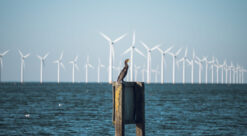
Norwegian researchers are currently developing wind turbines that can adapt their blade rotation speeds to prevent bird strikes.
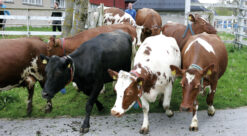
Researchers have developed a new method of detecting a metabolic disease that affects dairy cows after calving. The aim is to determine whether cows are at risk of contracting the disease before they actually become sick.
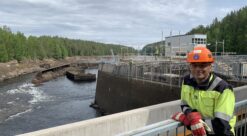
SINTEF researcher Marcell Szabo-Meszaros is the man behind the international study ‘Hydropower and Fish – a Roadmap for Best Practice Management’, which offers guidelines on fish population protection in rivers to companies carrying out hydropower developments.
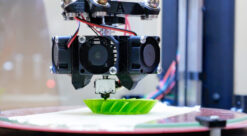
In recent years, 3D printing has exploded in popularity, and may open a new era of faster and more climate-friendly manufacturing. But is it really the manufacturing method of the future?
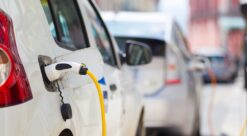
Solid-state batteries may be the perfect solution for electric cars of the future. Researchers in Norway are making these batteries better.