Young people’s attitudes toward democracy are formed outside of school
The backgrounds of 14-year-olds in Norway have a significant impact on their attitudes and knowledge regarding democracy and citizenship.


The backgrounds of 14-year-olds in Norway have a significant impact on their attitudes and knowledge regarding democracy and citizenship.

Apprentices in private, independent companies are more likely to fail their final exams, change contracts and not complete their training than apprentices who have contracts through a training agency.

Elderly Norwegians are encouraged to stay in their homes where they can receive home care services. The idea is that living at home will give them the most control over their everyday lives. Research suggests the opposite is true.

Is artificial intelligence displacing young workers at the start of their careers? So far, the answer appears to be no. But that could change in the future.

What exactly are antiferroelectric materials, and what does it mean that they can also be polar? The answers may open up new possibilities in technology.

Urban planning is not what it used to be. Researchers now want to use social networks and sensor data to make cities easier to navigate – and preferably on foot.

The turn of the 20th century has been referred to as the homosexual breakthrough in Europe. A recent study has analyzed literary texts in which Norwegian nature plays an important role in conveying this perspective.

Some people are more sensitive to low-frequency noise, such as from ventilation systems, heat pumps, wind turbines and transformers. Why is that?

Spending less time in an office and more time in the great outdoors with animals can benefit patients and therapists alike.

A small fish and a human, hundreds of millions of years apart, build the sensing brain by the same underlying logic. The finding suggests there may be rules a vertebrate brain follows.

Researchers have taken over 120,000 images of salmon lice larvae in seawater and used them to train AI models. The models were much faster and more accurate than experienced biologists at identifying the parasites that feed on the skin and blood of salmonids.
If the current stage of AI development frees us from thinking, who will decide what the next stage will be?

Your body absorbs alcohol much more rapidly after bariatric surgery. Patients need to know this when they choose the kind of surgery they will have.

A 100-year-old equation and a fibre-optic cable off the coast of Svalbard led researchers to discover they could detect swimming whales — even if they were completely silent. The discovery broadens the tools that biologists could someday use to detect and monitor these marine giants.

Modern large-scale warfare imposes extreme psychological stress on soldiers at the front. Ukrainian soldiers are being trained in Norway to help better protect them from this trauma.

More than 70 per cent of the Earth is covered by oceans. An increasing amount of critical infrastructure is being installed on the seabed. Sabotage and accidents increase the need for inspection and monitoring. These measures are currently very expensive, but the hope is that they can soon be carried out by robots that are permanently stationed on the seabed.

Why do some Norwegian hospitals treat infants’ eye disease more often than others?

The Kavli Prize 2026 has been awarded to researchers who have provided us with groundbreaking knowledge in their fields.
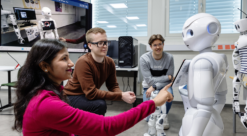
Pepper the friendly, humanoid robot both looks and behaves much like a human being. But is that enough?

People who are resilient to psychological stress are similar to each other – not in terms of appearance, but in the brain’s response to stressful stimuli.

There are 55 species of gulls in the world, but less than half have been observed in Norway. Here you can learn a little about the most common gulls in the land of the Vikings.
There is no shortcut to improving technical skills in football. Natural talent is not enough to be among the very best.

Do you occasionally hear a low buzzing or humming sound that doesn’t have a clear source? Then you’re among the estimated 2-4 per cent of the world’s population who hear this. Scientists have been trying to figure out for decades where this sound comes from.

How can Norway provide new renewable energy sources to meet future needs while still protecting its natural environment, and the plants and animals that live there?