The 11 March 2011 Tohoku-Oki earthquake was the largest and most destructive in the history of Japan. Japanese researchers — and Norwegian partners — are hard at work trying to understand just what made it so devastating.
Researchers measured the stress hormone cortisol in 112 toddlers from 85 different childcare centres in six municipalities, approximately five months after they started attending. Children with the longest childcare days (8-9 hours) showed an increase in cortisol during the day.
You’ve heard it a thousand times, that little catchphrase with the magic number encouraging you to eat “five a day” of fruits and vegetables for better health. But it turns out that the real magic number is eight, according to a new comprehensive study just published in the International Journal of Epidemiology.
The way to shorten one’s time in purgatory was to obtain indulgences. But they had to be purchased, so only people who were well off could afford them.
Help is not just a phone call away if you have an accident in the Arctic. That’s why the far northern Norwegian archipelago of Svalbard is establishing an educational and research centre for Arctic safety.
You might think that polar bears— and the potential for attack— are the biggest danger on the Norwegian island archipelago of Svalbard. But avalanches kill far more people on Svalbard than polar bears ever have.
Surgeons often take a blood vessel from your leg to graft onto your heart during a coronary bypass surgery. The practice can lead to scarring in many patients, which in turn can cause another heart attack. A new technique under development may help prevent this problem.
When the unthinkable happens and the unpredictable takes over, crises cannot be handled by the book. What should the police have actually done during the 2011 attack on the Norwegian island of Utøya?
One of the world’s leading membrane manufacturers has signed a licensing agreement with NTNU on a new technology that allows for environmentally friendly CO2 capture.
Online weight loss forums protect participants from public fat shaming, and offer them a place to speak out without being confronted by normal-weight individuals, medical science or the authorities.
As the world struggles to make progress to limit climate change, researchers are finding ways to adapt to warmer winter temperatures — by developing environmentally friendly ways of producing artificial snow.
Visualizing oil reservoirs or tectonic plates under the seafloor requires lots of computing power and the imagination to envision what the data are showing you. That’s Martin Landrø’s work world. But he’s also fascinated by how teachers from a century ago taught their students about the Earth and the way it moves around the sun.
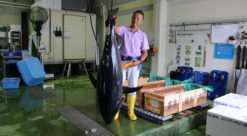
The Japanese eat one in ten of the world’s fish, and 80 per cent of the planet’s prized —and critically threatened — Bluefin tuna. Tuna aquaculture pioneered at Kindai University in Japan offers hope for both fish lovers and the fish.
An enzyme found in many bacteria, including the bacterium that gives us strep throat, has given mankind a cheap and effective tool with which to edit our own genes. This technology, called CRISPR, is also being used to understand how the immune system responds to a viral attack.
Pregnant women increase their chances of vitamin B12 deficiency if they don’t consume enough meat, milk or eggs. This vitamin is found only in animal products. A deficiency of the vitamin during pregnancy could have dramatic consequences for the foetus.
Scientists and policymakers rely on complex computer simulations called Integrated Assessment Models to figure out how to address climate change. But these models need tinkering to make them more accurate.
The Privacy Statement is about how this website collects and uses visitor information. The statement contains information that you are entitled to when collecting information from our website, and general information about how we treat personal data.The legal owner of the website is the processing officer for the processing of personal data. It is voluntary for those who visit the web sites to provide personal information regarding services such as receiving newsletters and using the sharing and tip services. The treatment basis is the consent of the individual, unless otherwise specified.
1. Web analytics and cookies (cookies)
As an important part of the effort to create a user-friendly website, we look at the user pattern of those who visit the site. To analyze the information, we use the Google Analytics analysis tool.Google Analytics uses cookies (small text files that the site stores on the user's computer), which registers the users' IP address and provides information about the individual user's online movements. Examples of what the statistics give us answers to are; how many people visit different pages, how long the visit lasts, what websites users come from and what browsers are used. None of the cookies allow us to link information about your use of the site to you as an individual.The information collected by Google Analytics is stored on Google servers in the U.S.. The information received is subject to the Google Privacy Policy.An IP address is defined as a personal information because it can be traced back to a particular hardware and thus to an individual. We use Google Analytics's tracking code to anonymize the IP address before the information is stored and processed by Google. Thus, the stored IP address can not be used to identify the individual user.
2. Search
If the webpage has search function, it stores information about what keywords users use in Google Analytics. The purpose of the storage is to improve our information service. The search usage pattern is stored in aggregate form. Only the keyword is saved and they can not be linked to other information about the users, such as the IP addresses.
3. Share / Tips service
The "Share with others" feature can be used to forward links to the site by email, or to share the content of social networking. Tips for tips are not logged with us, but only used to add the tips to the community. However, we can not guarantee that the online community does not log this information. All such services should therefore be used wisely. If you use the email feature, we only use the provided email addresses to resend the message without any form of storage.
4. Newsletter
The website can send out newsletters by email if you have registered to receive this. In order for us to be able to send e-mail, you must register an e-mail address. Mailchimp is the data processor for the newsletter. The e-mail address is stored in a separate database, not shared with others and deleted when you unsubscribe. The e-mail address will also be deleted if we receive feedback that it is not active.
5. Registration, form
The website may have a form for registration, contact form or other form. These forms are available to the public to perform the tasks they are supposed to do.Registration form is for visitors to sign up or register.Contact form is for visitors to easily send a message to the website's contact person.We ask for the name of the sender and contact information for this. Personal information we receive is not used for purposes other than responding to the inquiry.The form is sent as email via Mailgun as a third party solution. The entire submission will be stored at Mailgun for 24 hours. Between 24 hours and 30 days, only mailheader is stored before the submission is deleted after 30 days. The reason for this storage is to confirm whether emails are sent from the website and forwarded to the correct recipient.Once the email is received by the recipient, it is up to the recipient to determine the data processing needs of the email.
6. Page and service functionality
Cookies are used in the operation and presentation of data from websites. Such cookies may contain language code information for languages selected by the user. There may be cookies with information supporting the load balancing of the system, ensuring all users the best possible experience. For services that require login or search, cookies can be used to ensure that the service presents data to the right recipient.