Solar energy is good news for planet Earth – but solar panels are not as climate-friendly as they should be. Researcher Martin Bellmann is using what he calls the ‘black gold’ waste materials from solar panel manufacture to make new panels.
Waste slags from the metallurgy industries often contain valuable materials, but in very small concentrations. This means that large areas of valuable land are used to accommodate reservoirs filled with what is sometimes toxic waste. We now want to use hydrogen to convert this waste into a resource.
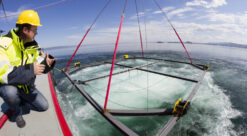
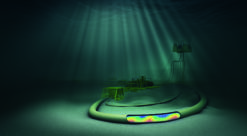
During the next three years, a team of researchers will be developing a system designed to protect floating solar farms in the harshest ocean environments.
Not only are they high above us – they also offer us great benefits. From SINTEF’s new solar panel laboratory, you can see all across the city of Trondheim. Here, conditions are optimal for research into solar panel performance at Nordic latitudes.
Norway has developed subsea technologies that you may never have heard of to ensure the safe operation of Norwegian oil and gas installations. Our experts are ready and waiting to assist in the Baltic Sea.
Most people know that metals are made from ore, but how do we make gold from gravel? That’s the process we must understand to be able to make the metal industry climate friendly. Here are some alternatives for CO2-free metal production.
A team of Norwegian researchers has succeeded in producing hydrogen using a far more efficient method than is currently in use. The technology was ready as early as in 2017. The team has also demonstrated that the process can be scaled up for commercial application.
Researchers have discovered a new method of activating enzymes that may make it possible to repair proteins that have been damaged as a result of hereditary diseases, such as some types of skin cancer.
Very soon, there will be enormous numbers of used EV batteries available, but we have yet to work out how we will be organising the reuse of this massive resource.
Lung cancer is one of the most dangerous forms of cancer. Treatments are available, but they are demanding on patients and less than 30 percent survive. But mRNA technology is offering new hope for higher survival rates because treatments target the malignant cells in an entirely new way.
As part of a six-year research project, researchers have succeeded in developing a membrane that captures CO2 in an entirely innovative way. Their work has resulted in an article published in the prestigious research periodical Science Magazine.
The idea behind batteries is to make the planet greener, but they all start their lives as energy-demanding environmental liabilities. Research scientists at SINTEF have succeeded in making batteries cheaper and simpler using a process that requires much less energy consumption.
Electrification of the Norwegian continental shelf is a long-standing political issue. Now research scientists believe this can be done using fuel cells installed on the platforms. This will reduce CO2 emissions and remove the need to lay new subsea cables.
The climate will benefit if we shift to using aluminium in more and more construction. Buyers need to look past the procurement costs and consider the total life cycle costs instead.
The world is crying out for rare minerals for the manufacture of electric cars, wind turbines and other technologies that we simply need more of. But how can we guarantee access to these resources without threatening the natural world and mankind as we know it?
These research scientists are studying Nature’s own nanomaterials – applying tools and methods that are normally used for something quite different. Their work has provided us with knowledge that may revolutionise everything from medical treatments to building constructions.
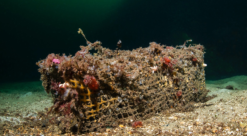
Ghost fishing and plastic waste from the fisheries industry is becoming a major environmental problem. Can we address the issue by using degradable plastics? Scientists at a new research centre are aiming to find the answers and develop the systems we need.
For more than 100 years, we’ve known that some metal alloys become stronger by being kept at room temperature. But we haven’t understood all the details – until now.
Ten cubic kilometres of concrete, equivalent to the volume of Mount Everest, are used in construction projects every year, resulting in huge volumes of emissions. But a new eco-friendly cement may help to reduce our global climate footprint.
The new vaccines designed to combat the Covid-19 virus have been developed in record time, causing some people to be sceptical of taking them. Should we be worried about side effects? Norwegian SciTech News has been talking to two research scientists about this issue.
The answer is that both can cause torsion, meaning the climbing rope or cable will start to twist. Up until now, no-one could explain why this happened. However, two enthusiastic researchers, who happen to be rock climbers, made it their business to solve the mystery.
Pfizer has recently announced that it is ready with a Covid-19 vaccine that is 90 percent effective. The vaccine is a so-called mRNA vaccine that has been developed jointly by Pfizer and BioNTech. But what is mRNA technology, and how does it work?
Future offshore oil and gas fields are most likely to be “satellite developments” that are less expensive and emit less greenhouse gases than other fields because they do not require new production platforms. An innovative Norwegian computational tool called “Slug Capturing 2” is now enabling the design of longer pipelines that will allow many more fields to be developed as satellites.
The Privacy Statement is about how this website collects and uses visitor information. The statement contains information that you are entitled to when collecting information from our website, and general information about how we treat personal data.The legal owner of the website is the processing officer for the processing of personal data. It is voluntary for those who visit the web sites to provide personal information regarding services such as receiving newsletters and using the sharing and tip services. The treatment basis is the consent of the individual, unless otherwise specified.
1. Web analytics and cookies (cookies)
As an important part of the effort to create a user-friendly website, we look at the user pattern of those who visit the site. To analyze the information, we use the Google Analytics analysis tool.Google Analytics uses cookies (small text files that the site stores on the user's computer), which registers the users' IP address and provides information about the individual user's online movements. Examples of what the statistics give us answers to are; how many people visit different pages, how long the visit lasts, what websites users come from and what browsers are used. None of the cookies allow us to link information about your use of the site to you as an individual.The information collected by Google Analytics is stored on Google servers in the U.S.. The information received is subject to the Google Privacy Policy.An IP address is defined as a personal information because it can be traced back to a particular hardware and thus to an individual. We use Google Analytics's tracking code to anonymize the IP address before the information is stored and processed by Google. Thus, the stored IP address can not be used to identify the individual user.
2. Search
If the webpage has search function, it stores information about what keywords users use in Google Analytics. The purpose of the storage is to improve our information service. The search usage pattern is stored in aggregate form. Only the keyword is saved and they can not be linked to other information about the users, such as the IP addresses.
3. Share / Tips service
The "Share with others" feature can be used to forward links to the site by email, or to share the content of social networking. Tips for tips are not logged with us, but only used to add the tips to the community. However, we can not guarantee that the online community does not log this information. All such services should therefore be used wisely. If you use the email feature, we only use the provided email addresses to resend the message without any form of storage.
4. Newsletter
The website can send out newsletters by email if you have registered to receive this. In order for us to be able to send e-mail, you must register an e-mail address. Mailchimp is the data processor for the newsletter. The e-mail address is stored in a separate database, not shared with others and deleted when you unsubscribe. The e-mail address will also be deleted if we receive feedback that it is not active.
5. Registration, form
The website may have a form for registration, contact form or other form. These forms are available to the public to perform the tasks they are supposed to do.Registration form is for visitors to sign up or register.Contact form is for visitors to easily send a message to the website's contact person.We ask for the name of the sender and contact information for this. Personal information we receive is not used for purposes other than responding to the inquiry.The form is sent as email via Mailgun as a third party solution. The entire submission will be stored at Mailgun for 24 hours. Between 24 hours and 30 days, only mailheader is stored before the submission is deleted after 30 days. The reason for this storage is to confirm whether emails are sent from the website and forwarded to the correct recipient.Once the email is received by the recipient, it is up to the recipient to determine the data processing needs of the email.
6. Page and service functionality
Cookies are used in the operation and presentation of data from websites. Such cookies may contain language code information for languages selected by the user. There may be cookies with information supporting the load balancing of the system, ensuring all users the best possible experience. For services that require login or search, cookies can be used to ensure that the service presents data to the right recipient.