Rape myths such as ‘scantily clad’ and ‘being promiscuous’ can influence sentencing in Norwegian courtrooms. In court cases where victims are described in a prejudiced manner, defendants typically receive prison sentences that are 16 months shorter than in cases without such descriptions.
The Norwegian-developed sensor node detects where transmission lines have available space. It also means that grid companies could avoid building new, expensive and controversial power lines.
World-famous treasures crafted from walrus ivory are on their way to Norway, including chess pieces from the Isle of Lewis in Scotland. Were they originally from Norway? And why did the walrus trade disappear?
The transport of dense gases and liquids is becoming increasingly relevant in relation to carbon capture. New research is helping us understand more about how this can be done most efficiently.
Firefighters do hard physical work while being exposed to great heat strain. Now we know more about what happens to their body temperature during a smoke dive.
They won’t feature at this year’s World Championships in Trondheim, but NTNU researchers believe the world’s fastest and most flexible cross-country skis will be ready for the 2027 World Championships in Falun.
SINTEF experts on microchip technology are working on a method to detect biomarkers in our breath and to miniaturize a monitoring device. The project can help to discover symptoms of COPD earlier and change the lives of millions of people suffering from this disease.
“It would be boring if you could never have a party! The challenge is to do it in a way that the cost is in a reasonable proportion to the benefit to society,” says researcher Denis Becker about the 2025 World Ski Championships in Trondheim.
Nanomedicines save lives, but they don’t reach the market or the patient’s body fast enough. Researchers have now come up with a recipe to accelerate and improve the process.
New technology aims to enable us to always do even more. A researcher has issued a warning about what this ‘efficiency hysteria’ is doing to us and our workplaces.
These man-made toxic substances are often referred to as ‘forever chemicals’. There are thousands of different variants, and researchers are finding more and more of them.
Will we be able to trust text and images in the future? Deepfake is being used not just for innocent fun, but also to influence voters in the world’s most powerful countries.
Despite decades of innovation, more than a billion people in sub-Saharan Africa still don’t have access to clean cooking. Low-tech, affordable cookers exist, yet firewood remains the go-to fuel. Why?
A recent study shows that a new programme can increase ‘grit’ and self-efficacy in adolescents. Approximately 16,000 young people will soon have access to this programme each year.
How can we increase our understanding and commitment to environmentally friendly architecture? There is much evidence to suggest that visualisation using AR can help us.
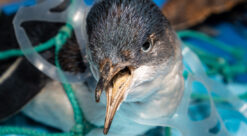
Ropes and fishing gear used in the fisheries and aquaculture industries are a major source of microplastics in the ocean and littering along the coastline. A multidisciplinary international research team has now drawn up a plan that will help to reduce pollution.
Patients with multiple sclerosis (MS) and Parkinson’s can get better if they train at a high intensity, because high-intensity exercise activates the nervous system and helps to boost strength. Researchers are now developing an app to make training at home more effective, using a mobile phone as a personal trainer.
Rather than simply tracking an animal’s real-time location, grid cells coordinate to perform rapid, rhythmic sweeps into the space ahead of the animal.
Fish welfare: Using a digital eye and artificial intelligence, scientists have found a way of monitoring the breathing of salmon. The method can reveal whether or not the fish are stressed.
If electric vehicles were lighter, they would also be more energy-efficient. Not surprisingly, this is a problem researchers are working on – using aluminium.
The Privacy Statement is about how this website collects and uses visitor information. The statement contains information that you are entitled to when collecting information from our website, and general information about how we treat personal data.The legal owner of the website is the processing officer for the processing of personal data. It is voluntary for those who visit the web sites to provide personal information regarding services such as receiving newsletters and using the sharing and tip services. The treatment basis is the consent of the individual, unless otherwise specified.
1. Web analytics and cookies (cookies)
As an important part of the effort to create a user-friendly website, we look at the user pattern of those who visit the site. To analyze the information, we use the Google Analytics analysis tool.Google Analytics uses cookies (small text files that the site stores on the user's computer), which registers the users' IP address and provides information about the individual user's online movements. Examples of what the statistics give us answers to are; how many people visit different pages, how long the visit lasts, what websites users come from and what browsers are used. None of the cookies allow us to link information about your use of the site to you as an individual.The information collected by Google Analytics is stored on Google servers in the U.S.. The information received is subject to the Google Privacy Policy.An IP address is defined as a personal information because it can be traced back to a particular hardware and thus to an individual. We use Google Analytics's tracking code to anonymize the IP address before the information is stored and processed by Google. Thus, the stored IP address can not be used to identify the individual user.
2. Search
If the webpage has search function, it stores information about what keywords users use in Google Analytics. The purpose of the storage is to improve our information service. The search usage pattern is stored in aggregate form. Only the keyword is saved and they can not be linked to other information about the users, such as the IP addresses.
3. Share / Tips service
The "Share with others" feature can be used to forward links to the site by email, or to share the content of social networking. Tips for tips are not logged with us, but only used to add the tips to the community. However, we can not guarantee that the online community does not log this information. All such services should therefore be used wisely. If you use the email feature, we only use the provided email addresses to resend the message without any form of storage.
4. Newsletter
The website can send out newsletters by email if you have registered to receive this. In order for us to be able to send e-mail, you must register an e-mail address. Mailchimp is the data processor for the newsletter. The e-mail address is stored in a separate database, not shared with others and deleted when you unsubscribe. The e-mail address will also be deleted if we receive feedback that it is not active.
5. Registration, form
The website may have a form for registration, contact form or other form. These forms are available to the public to perform the tasks they are supposed to do.Registration form is for visitors to sign up or register.Contact form is for visitors to easily send a message to the website's contact person.We ask for the name of the sender and contact information for this. Personal information we receive is not used for purposes other than responding to the inquiry.The form is sent as email via Mailgun as a third party solution. The entire submission will be stored at Mailgun for 24 hours. Between 24 hours and 30 days, only mailheader is stored before the submission is deleted after 30 days. The reason for this storage is to confirm whether emails are sent from the website and forwarded to the correct recipient.Once the email is received by the recipient, it is up to the recipient to determine the data processing needs of the email.
6. Page and service functionality
Cookies are used in the operation and presentation of data from websites. Such cookies may contain language code information for languages selected by the user. There may be cookies with information supporting the load balancing of the system, ensuring all users the best possible experience. For services that require login or search, cookies can be used to ensure that the service presents data to the right recipient.