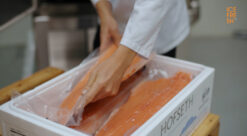
A small revolution is happening in the fishing industry. Freshly frozen fish can now be thawed in a new way, and that means you will have access to super-fresh food from the sea – even if you live thousands of miles away.
To gain more knowledge about how ultra-processed food affects us, we need new research methods, claim researchers. Now they are looking to better understand our intestinal flora.
Metformin makes it easier for women with the hormone disorder PCOS to get pregnant, and the mother often gets better throughout the pregnancy. Her children, however, have a markedly higher risk of eczema and allergies.
“That’s the dream,” says researcher Hanne Dalsvåg. If the researchers succeed, in the future you might be able to buy vegetables wrapped in packaging made from waste carrot or potato residues.
Researchers have developed a heat storage unit that takes up less space than a regular hot water tank. It charges when electricity is cheap and releases heat when needed.
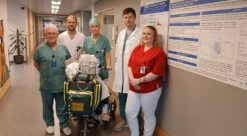
Giving adrenaline to hospital patients whose heart has stopped is very effective, and can increase the chance of bringing their heart rate back to normal by a factor of five.
How much does it matter where you are born, or whether you are heavy or light, if you are a house sparrow? Researcher Kenneth Aase calculates what the future looks like for these grey-brown feather balls – and hopefully other species, too.
Quick clay collapse can be both dangerous and costly. New research will help us understand more about why the clay is so unstable. And maybe what we can do about it.
Businesses along the Norwegian coastline are becoming increasingly vulnerable to storm surges and flooding. Researchers have now created digital maps that show who is most at risk.
All Norwegian women who have given birth will be offered a postnatal check-up by their GP or midwife six weeks after giving birth. Most of those who participate experience this as an important offer. Nevertheless, one in four women does not attend the postnatal check-up.
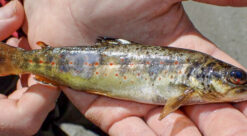
Hundreds of Norwegian hydropower plants threaten fish and bottom-dwelling animals by exposing them to water that is oversaturated with air. The danger increases with wilder, wetter weather and more flooding. The solution may be to use sound in a new way.
Some of the greatest natural treasures at NTNU University Museum are never put on display. Many of these objects were collected on famous expeditions or obtained in other ways. One such treasure is Charles Darwin’s coralline algae.
If you think something is off with added smoke flavouring in salmon, you’re not alone. Many consumers are skeptical of salmon that hasn’t been smoked in the traditional way.
Your work usually determines whether you manage to earn a better income compared to people around you. But your work earnings rarely determine when your income falls.
Early testing of schoolchildren has no impact on their educational attainment down the line. Nor do the tests have any effect on pupils’ mental health or how happy they are at school.
Ragnhild Langli (70) is the first person in Norway to receive personalized chemotherapy for bowel cancer. She is participating in a research study that is the first of its kind in the world.
A new, national centre will continue the quest to understand how Alzheimer’s and other dementias arise in the brain. The hope is to develop a treatment for dementia diseases.
Premature babies are particularly susceptible to strong sensory impressions and high sound levels from the incubator. Now researchers will look at what can be done to protect children’s hearing and development.
The Privacy Statement is about how this website collects and uses visitor information. The statement contains information that you are entitled to when collecting information from our website, and general information about how we treat personal data.The legal owner of the website is the processing officer for the processing of personal data. It is voluntary for those who visit the web sites to provide personal information regarding services such as receiving newsletters and using the sharing and tip services. The treatment basis is the consent of the individual, unless otherwise specified.
1. Web analytics and cookies (cookies)
As an important part of the effort to create a user-friendly website, we look at the user pattern of those who visit the site. To analyze the information, we use the Google Analytics analysis tool.Google Analytics uses cookies (small text files that the site stores on the user's computer), which registers the users' IP address and provides information about the individual user's online movements. Examples of what the statistics give us answers to are; how many people visit different pages, how long the visit lasts, what websites users come from and what browsers are used. None of the cookies allow us to link information about your use of the site to you as an individual.The information collected by Google Analytics is stored on Google servers in the U.S.. The information received is subject to the Google Privacy Policy.An IP address is defined as a personal information because it can be traced back to a particular hardware and thus to an individual. We use Google Analytics's tracking code to anonymize the IP address before the information is stored and processed by Google. Thus, the stored IP address can not be used to identify the individual user.
2. Search
If the webpage has search function, it stores information about what keywords users use in Google Analytics. The purpose of the storage is to improve our information service. The search usage pattern is stored in aggregate form. Only the keyword is saved and they can not be linked to other information about the users, such as the IP addresses.
3. Share / Tips service
The "Share with others" feature can be used to forward links to the site by email, or to share the content of social networking. Tips for tips are not logged with us, but only used to add the tips to the community. However, we can not guarantee that the online community does not log this information. All such services should therefore be used wisely. If you use the email feature, we only use the provided email addresses to resend the message without any form of storage.
4. Newsletter
The website can send out newsletters by email if you have registered to receive this. In order for us to be able to send e-mail, you must register an e-mail address. Mailchimp is the data processor for the newsletter. The e-mail address is stored in a separate database, not shared with others and deleted when you unsubscribe. The e-mail address will also be deleted if we receive feedback that it is not active.
5. Registration, form
The website may have a form for registration, contact form or other form. These forms are available to the public to perform the tasks they are supposed to do.Registration form is for visitors to sign up or register.Contact form is for visitors to easily send a message to the website's contact person.We ask for the name of the sender and contact information for this. Personal information we receive is not used for purposes other than responding to the inquiry.The form is sent as email via Mailgun as a third party solution. The entire submission will be stored at Mailgun for 24 hours. Between 24 hours and 30 days, only mailheader is stored before the submission is deleted after 30 days. The reason for this storage is to confirm whether emails are sent from the website and forwarded to the correct recipient.Once the email is received by the recipient, it is up to the recipient to determine the data processing needs of the email.
6. Page and service functionality
Cookies are used in the operation and presentation of data from websites. Such cookies may contain language code information for languages selected by the user. There may be cookies with information supporting the load balancing of the system, ensuring all users the best possible experience. For services that require login or search, cookies can be used to ensure that the service presents data to the right recipient.