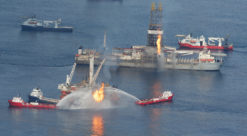
Ten years ago, the Deepwater Horizon accident in the Gulf of Mexico killed eleven men and resulted in the largest accidental oil spill in history. Years of investigations concluded that the drilling crew missed critical warning signals that would have stopped the problem. A new analysis suggests that wasn’t the case.
Once upon a time, lions were the world’s most widespread mammals. Now we know more about their genealogy – and that could make it easier to help the species survive.
Men and women choose partners according to different criteria. These are the same almost all over the world and have remained unchanged in the last 30 years, according to a new survey of 14 000 people.
CO2 emissions are generally recognized as something we need to avoid. Wouldn’t it be nice if we could just transform the CO2 into useful substances? Plasma technology has been proposed as a way to achieve this, and we have studied the feasibility of the concept from physical, chemical and economical points of view.
From 1 July, scientists from 14 institutions in six countries will be examining the opportunities and risks of ocean-based technologies for negative emissions.
“This is international recognition of her many years of efforts to promote smart and sustainable cities,” says Henrik Asheim, Norway’s Minister of Research and Higher Education.
How do we help the young, especially women, so they are better prepared for learning science, technology, engineering and mathematics (STEM) subjects? A multi-university consortium including NTNU has been awarded a four year, €4.12 million Horizon 2020 grant to help answer this question.
Research conducted as part of the project EvacSound demonstrates that auditory guidance using sound beacons is an effective aid during the evacuation of smoke-filled road tunnels. This is good news. It is a fact that vehicle drivers and passengers cannot normally expect to be rescued by the emergency services during such accidents.
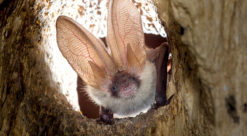
Bats have received a lot of negative attention, but the chances are slim that the virus that causes COVID-19 was transmitted from bats to humans. The world needs bats – in ecosystems, for pollination and for seed dispersal. On top of that, they keep harmful insects in check around our homes, on farms and in cities.
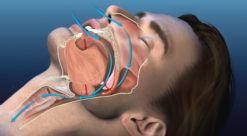
Every fifth Norwegian suffers from the widespread disease obstructive sleep apnea. Several treatment options exist, among them surgery, however results are unpredictable and of variable quality and differ from individual to individual. What determines if the treatment is successful or not? Our scientific research using mathematical airflow models may help the medical doctors to find the answer.
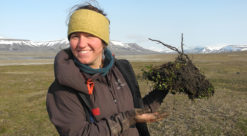
It’s not easy being a tiny willow on the wind-and snow-blasted islands of the Norwegian territory of Svalbard. It turns out that Salix polaris, the polar willow, handles these tough conditions by growing as best it can in response to July temperatures — a response that researchers recorded all over the archipelago.
In the aftermath of a crisis, it is always easy to see how the crisis could have been better handled, and then we put new measures into place. But do these measures set us up to solve the next crisis – the one we don’t yet know about?
Our language can be fun and colourful, but unusual phrases that aren’t literal can be difficult for some to interpret. Learning more about how we decipher these phrases can help us teach people in certain groups how to better understand them.
Published
01.06.20
Privacy Policy
The Privacy Statement is about how this website collects and uses visitor information. The statement contains information that you are entitled to when collecting information from our website, and general information about how we treat personal data.The legal owner of the website is the processing officer for the processing of personal data. It is voluntary for those who visit the web sites to provide personal information regarding services such as receiving newsletters and using the sharing and tip services. The treatment basis is the consent of the individual, unless otherwise specified.
1. Web analytics and cookies (cookies)
As an important part of the effort to create a user-friendly website, we look at the user pattern of those who visit the site. To analyze the information, we use the Google Analytics analysis tool.Google Analytics uses cookies (small text files that the site stores on the user's computer), which registers the users' IP address and provides information about the individual user's online movements. Examples of what the statistics give us answers to are; how many people visit different pages, how long the visit lasts, what websites users come from and what browsers are used. None of the cookies allow us to link information about your use of the site to you as an individual.The information collected by Google Analytics is stored on Google servers in the U.S.. The information received is subject to the Google Privacy Policy.An IP address is defined as a personal information because it can be traced back to a particular hardware and thus to an individual. We use Google Analytics's tracking code to anonymize the IP address before the information is stored and processed by Google. Thus, the stored IP address can not be used to identify the individual user.
2. Search
If the webpage has search function, it stores information about what keywords users use in Google Analytics. The purpose of the storage is to improve our information service. The search usage pattern is stored in aggregate form. Only the keyword is saved and they can not be linked to other information about the users, such as the IP addresses.
3. Share / Tips service
The "Share with others" feature can be used to forward links to the site by email, or to share the content of social networking. Tips for tips are not logged with us, but only used to add the tips to the community. However, we can not guarantee that the online community does not log this information. All such services should therefore be used wisely. If you use the email feature, we only use the provided email addresses to resend the message without any form of storage.
4. Newsletter
The website can send out newsletters by email if you have registered to receive this. In order for us to be able to send e-mail, you must register an e-mail address. Mailchimp is the data processor for the newsletter. The e-mail address is stored in a separate database, not shared with others and deleted when you unsubscribe. The e-mail address will also be deleted if we receive feedback that it is not active.
5. Registration, form
The website may have a form for registration, contact form or other form. These forms are available to the public to perform the tasks they are supposed to do.Registration form is for visitors to sign up or register.Contact form is for visitors to easily send a message to the website's contact person.We ask for the name of the sender and contact information for this. Personal information we receive is not used for purposes other than responding to the inquiry.The form is sent as email via Mailgun as a third party solution. The entire submission will be stored at Mailgun for 24 hours. Between 24 hours and 30 days, only mailheader is stored before the submission is deleted after 30 days. The reason for this storage is to confirm whether emails are sent from the website and forwarded to the correct recipient.Once the email is received by the recipient, it is up to the recipient to determine the data processing needs of the email.
6. Page and service functionality
Cookies are used in the operation and presentation of data from websites. Such cookies may contain language code information for languages selected by the user. There may be cookies with information supporting the load balancing of the system, ensuring all users the best possible experience. For services that require login or search, cookies can be used to ensure that the service presents data to the right recipient.