Are you more jealous of emotional or sexual infidelity? It may depend on your sexual orientation
It seemed so simple: men are more jealous of sexual infidelity, while women are more jealous if their partner falls in love with someone else. But it is not quite that simple.
Recent research shows that only the most heterosexual men are primarily jealous of sexual infidelity. Homosexual and bisexual men are more jealous of emotional infidelity, in the same way that women are.
NTNU professors Mons Bendixen and Leif Edvard Ottesen Kennair have spent many years researching infidelity and jealousy.
For a long time, the researchers believed that men are more often most jealous of sexual infidelity, while women are more jealous of emotional infidelity – and that was pretty much that.
However, it turns out it is not that simple after all; sexual orientation can also affect jealousy. Kennair and Bendixen collaborated with Professor David Schmitt from Kansas State University on an article recently published in the Archives of Sexual Behavior journal.
- You might also like: Women and men react differently to infidelity
Homosexual and bisexual men are jealous in the same way as women
“It is still the case that the most heterosexual men are most jealous of sexual infidelity. But this is not true for bisexual or homosexual men. They are most jealous of the feelings their partner might have for someone else,” said Kennair from NTNU’s Department of Psychology.

What makes you most jealous? That also depends a lot on your sexual orientation. Professors Mons Bendixen and Leif Edward Ottesen Kennair study jealousy. Photo: Steinar Brandslet, NTNU
It is more often the case that homosexual and bisexual men become jealous for reasons other than those of heterosexual men. When it comes to jealousy, they bear a closer resemblance to women.
“This exception to the general rule is not found in lesbian and bisexual women. Lesbian and bisexual women are most jealous of emotional infidelity, in the same way that heterosexual women are,” said Bendixen.
“It is important to point out here that our research did not primarily focus on categorical sexual orientation.
We investigated the degree to which individuals are attracted to men (androphilia) and to women (gynephilia) in both sexes,” emphasized Kennair.
- You might also like: Jealousy – we understand our own sex best
Biological explanation of jealousy
Perhaps there is more logic to this than might at first meet the eye. After all, there is a strong biological explanation behind jealousy. Jealousy is an emotional response to a threat against a valued relationship. (See the fact box.)
The biology behind the psychology
- Men invest in their presumed own offspring, and are among the few mammal species that do so. Our close relatives, the chimpanzees, don't do this.
- But men also have very low paternity certainty, summarized as "mummy's baby, daddy's maybe". The man can rarely be completely sure that he is the father of the child.
- Jealousy is one of the mechanisms that has developed to make the man aware of and avoid being deceived and raising another man's child. Raising another man's child will be strongly selected against evolutionarily.
- Women have historically been very dependent on their husbands contributing significantly to the upbringing of their children and protecting them. This was the case until a couple of generations ago. Women who were abandoned for a rival risked that their children's chances of growing up and having their own children would be greatly reduced.
Infidelity is an example of this type of threat, either in the form of a partner falling in love with or having sex with someone else. The way jealousy works is that you react emotionally to signs of infidelity in your partner.
This can in turn trigger a series of actions to protect the relationship. Examples include everything from confrontations, monitoring and restricting the partner’s social contact with other people, to ingratiation, flattery and increased sexual activity.
In homosexual relationships, regardless of gender, mutually hidden sexual infidelity is less relevant. Your partner is unlikely to have a secret child with someone else – a child you believe is yours and therefore invest time and resources in.
Thus, the fear of a partner leaving becomes much more important for homosexual individuals – the jealousy is more centred around the emotions involved.
Predicting sexuality based on questions
Nearly 4500 participants aged 16 to 80 participated in the study. They were recruited partly through Facebook and partly through the Gaysir website and other forums for queer individuals. The way in which the researchers recruited people ensured that sexual minorities were well represented.
“We also developed a method that could more or less predict the participants’ sexual orientation,” said Kennair. (See the fact box.)
The questions that reveal sexuality
Participants were asked a series of questions related to the following four areas:
-
Are you very compassionate or not? (How empathetic or systemizing are you?)
-
As a child, did you often play games typically associated with the opposite gender? (So-called “nonconforming” play)
-
What kind of profession could you imagine working in? (Regardless of your current job.)
-
How masculine or feminine do you feel, and how masculine or feminine do you think others perceive you?
The answers could predict participants’ sexual orientation with high accuracy, ranked according to how strongly they were attracted to men or women.
The questions covered personality, childhood interests, career preferences and how the participants experience their own gender role.
The answers could be used to predict the participants’ sexual preference with high certainty, ranked by how strongly they were attracted to men or to women.
- You might also like: When does the green-eyed monster of jealousy awaken in people?
Shades of grey
Of course, there are no clear-cut boundaries when it comes to sexual orientation. It is safe to say that some of us are more masculine or feminine than others, regardless of biological sex.
“Biological sex is fixed and strongly linked to the production of sex cells. However, with regards to sexual orientation and how we perceive our own gender and sexuality, there are no clear-cut boundaries,” said Kennair.

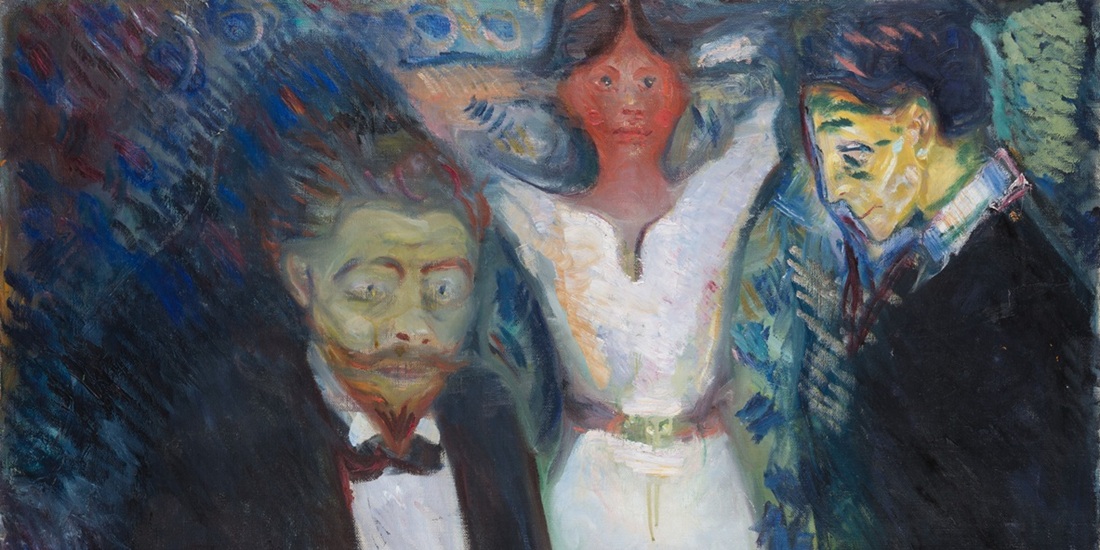
Only the most heterosexual men are the most jealous of sexual infidelity. Illustration: Edvard Munch, Wikimedia Commons
He likens it to different volume controls that are balanced in relation to each other. Some people are more attracted to one gender or the other, while others are less so.
“The degree of masculinity and femininity varies greatly from one person to the next and over time, regardless of biological sex.
This challenges the assumption that gender expression is static and inseparably linked to sex. Instead, the expressions are fluid, dependent on context, and shaped by social, cultural and personal factors.
This means that masculinity and femininity are not opposites on a linear scale, but can coexist side by side within an individual to varying degrees over time,” said Professor David Schmitt from Kansas State University. The extent to which this variation is related to sexual jealousy was one of the main focuses of this study
Testosterone levels play an important role, meaning jealousy also varies among individuals, even within the same sex. Therefore, jealousy can be seen as one of the possible evolutionary mechanisms.
“Most humans are chimeras; they are not strictly one thing or another. Everyone has parts that are masculine and parts that are feminine,” explained Kennair.
- You might also like: This kind of flirting works best
The mystery of bisexual men with female partners
Note that we constantly assume that jealousy actually serves a purpose. Jealousy is meant to help you keep your partner – or your partner’s resources – for yourself. In doing so, you maximize the chances of passing on your genes to the next generation.
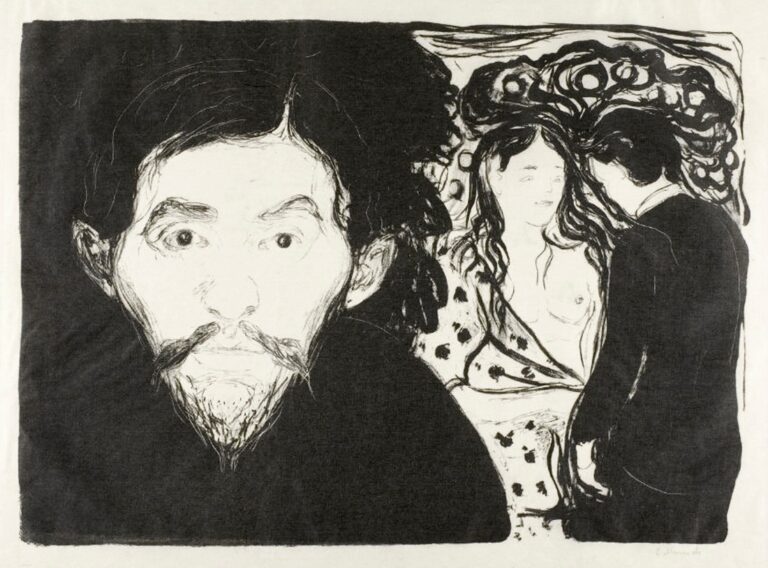
Bisexual men who live with women are, mysteriously, also the most jealous of emotional infidelity. Could that help explain why they are less common than bisexual women? Illustration: Edvard Munch, Shutterstock, NTB
But one great mystery still remains – bisexual men who are partners with women.
“Bisexual men with female partners are different from heterosexual men with female partners. These bisexual men are also more jealous of emotional infidelity and less jealous of sexual infidelity,” explained Bendixen.
This, however, does not fit the pattern. Bisexual men with female partners face the same risk as heterosexual men of investing resources in another man’s child if their partner is unfaithful. Therefore, the picture remains unclear.
“We still don’t know why this is. One possibility is that the jealousy response is easily feminized. As a result, only the most masculine men display typical masculine sexual jealousy,” said Kennair.
This may also help explain why bisexual men are far less common than bisexual women. In the United States, up to 6 per cent of women identify as bisexual, compared with only up to 2 per cent of men. If bisexual men are more often tricked into raising another man’s child, their genes are not passed on to the next generation to the same extent.
This, however, is just a theory, and not something the researchers know or have studied – and is an area that definitely requires more research.
Reference:
Kennair, L.E.O., Bendixen, M. & Schmitt, D.P. Male Sex, Masculinization, Sexual Orientation, and Gynephilia Synergistically Predict Increased Sexual Jealousy. Arch Sex Behav (2025). Published 22 August 2025 https://doi.org/10.1007/s10508-025-03225-z