Adrenaline restarts the heart after in-hospital cardiac arrest
Giving adrenaline to hospital patients whose heart has stopped is very effective, and can increase the chance of bringing their heart rate back to normal by a factor of five.
When a patient’s heart stops in a hospital, healthcare professionals need to act quickly.
“They immediately start cardiopulmonary resuscitation with breathing and chest compression, and connect to a defibrillator,” says Eirik Skogvoll, a senior consultant at the Department of Anaesthesia and Intensive Care Medicine at St. Olavs Hospital.
But this is not always enough.
“If this does not get the heart going, we give the patient adrenaline intravenously,” Skogvoll said. (See fact box.)
Adrenaline
- Adrenaline is a hormone that our bodies produce.
- It usually prepares the body to fight or flee in stressful situations by increasing heart rate and blood pressure, expanding the airways, and directing blood flow away from digestion and toward the muscles and heart.
- Adrenaline also releases the glucose to give us more energy, making you more alert, and can make you physically stronger for a short period.
Adrenaline in crisis
The fact that adrenaline also works to get the heart going in the event of cardiac arrest has long been a kind of accepted truth among health professionals. Many people are familiar with adrenaline from its use in treating anaphylactic shock, a severe allergic reaction that can be deadly. Adrenaline has been used in this context to resuscitate patients for more than 50 years.
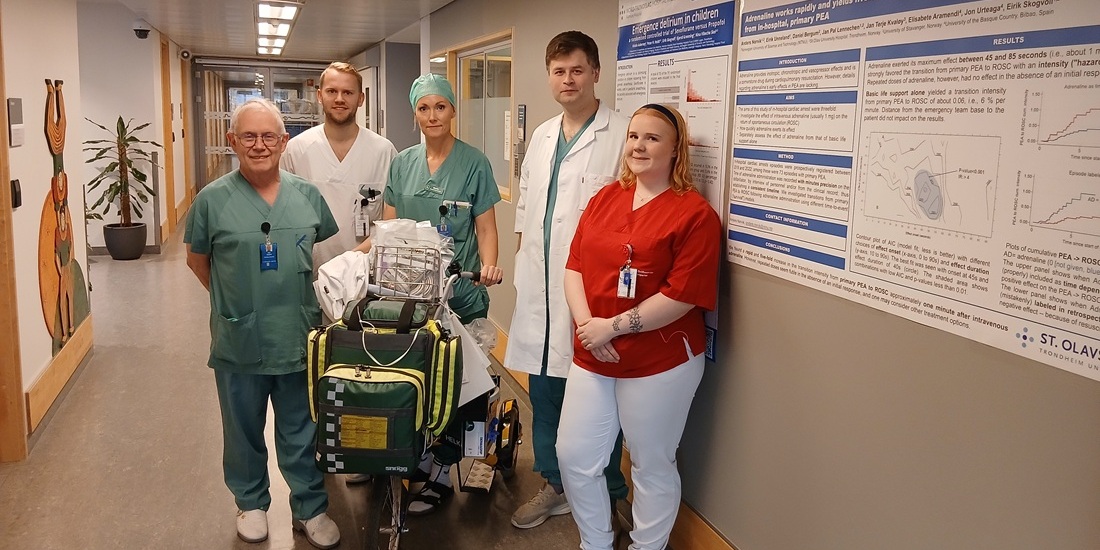
Extra adrenaline can save your life if you experience cardiac arrest. Photo: NTNU
Adrenaline is also well documented as used in an ambulance, outside hospitals. However, the extent to which adrenaline works in cardiac arrest in hospital has not been directly investigated – until now.
“The effect of adrenaline in this situation has so far not been unambiguously documented,”said Skogvoll, who is also a professor at the Department of Circulation and Medical Imaging at NTNU.
Now, in a study from St. Olavs Hospital and NTNU, anaesthesiologist Anders Norvik and the hospital’s emergency team have shown how effective adrenaline actually is, even with relatively few patients.
- You might also like: Breathing restored within 10 minutes for 80 per cent of overdose patients
Adrenaline acts almost immediately
“We found that adrenaline works within one minute. This increases the chance of the patient regaining their pulse fivefold,” Norvik said. This is the first step for the patient to survive.
In other words, these are very convincing results.
Skogvoll and Norvik’s research group can finally prove what many have believed because healthcare professionals accurately recorded the timing of the use of adrenaline during resuscitation attempts. Further statistical analysis could thus distinguish opinion from knowledge.
- You might also like: Centralizing Norwegian hospitals has reduced mortality at birth
The first dose is what counts
But there is also a limit to how useful adrenaline is.
“If the patient does not respond to the first dose, it’s not very useful to give more doses,” Norvik said. He added that this result is less certain.
However, the first dose of adrenaline is the one that works best.
NTNU and St. Olavs Hospital have studied resuscitation for many years, using modern statistical methods. Last year, the research group received the award for the best publication of the year (in Norwegian) at St. Olavs Hospital.
The group conducted the adrenaline study in collaboration with the Universities of Stavanger and the Basque Country (Bilbao). They recently presented the results at the conference of the European Council for Resuscitation (Revival) (ERC). The study has also recently been published in the professional journal Resuscitation Plus.
Reference:
A. Norvik, E. Unneland, D. Bergum, JP. Loennechen, JT. Kvaløy, E. Aramendi, J. Urtega, E. Skogvoll, Adrenaline and return of spontaneous circulation during in-hospital cardiac arrest, Resuscitation Plus, 2025, 101140, ISSN 2666-5204. https://doi.org/10.1016/j.resplu.2025.101140