A smart patch that can measure your pulse without electronics
The patch is the first of its kind in the world and can assess a patient’s heart condition when combined with an ordinary smartphone.
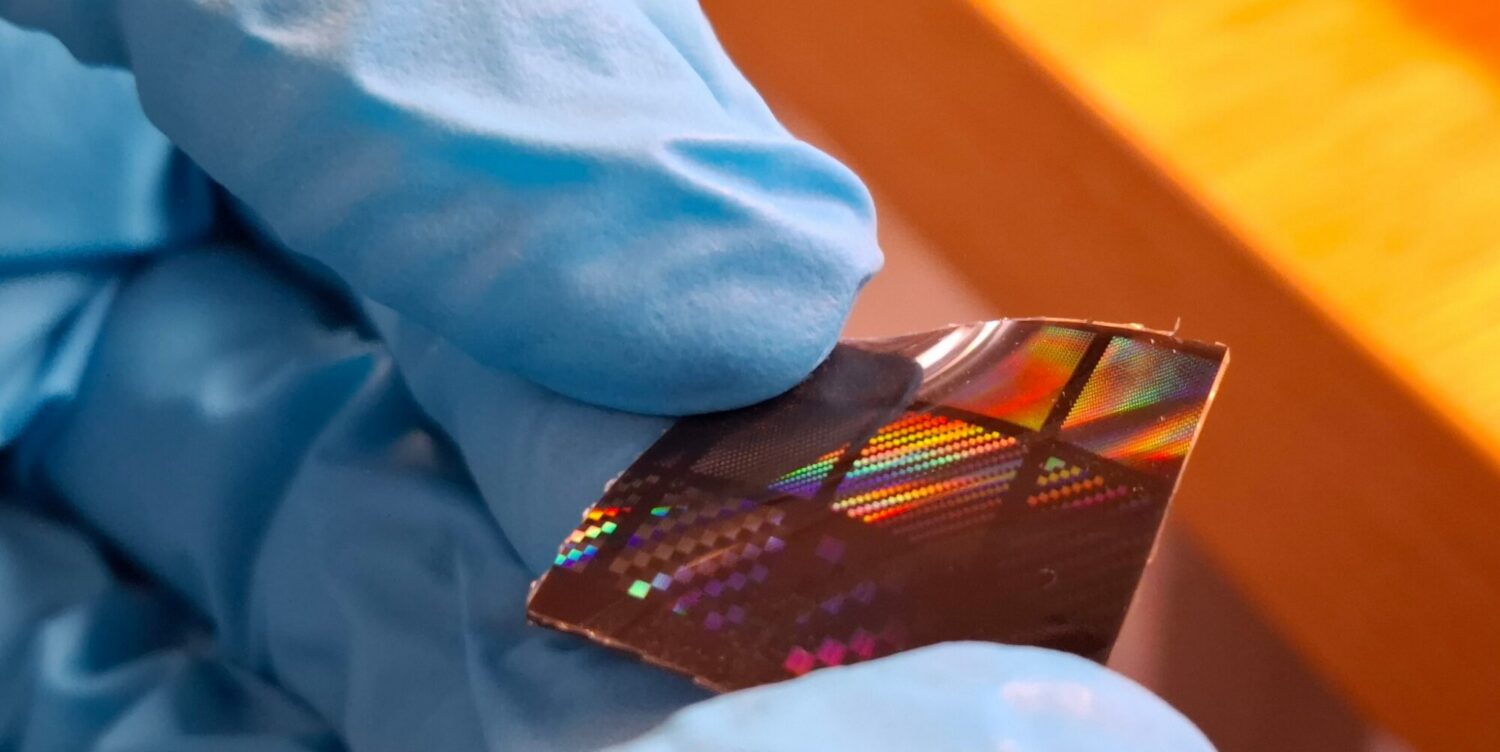
It looks like a small, transparent patch with a rainbow on its surface – or for those old enough to remember, the back of a CD.
The patch is the first of its kind in the world and, when combined with an ordinary smartphone camera, can measure two things: pulse and blood vessel stiffness.
This is all that is required to reveal important findings regarding heart condition and cardiovascular system functioning.
The patch is made of silicone rubber. No electronics or cables are required.
Like an octopus’s suction cups
“We wanted to develop a flexible, low-cost device. What makes it unique is that we can clearly see the signal from the heart on the patch with our own eyes,” says Angelos Xomalis, an associate professor of electronic systems at NTNU.
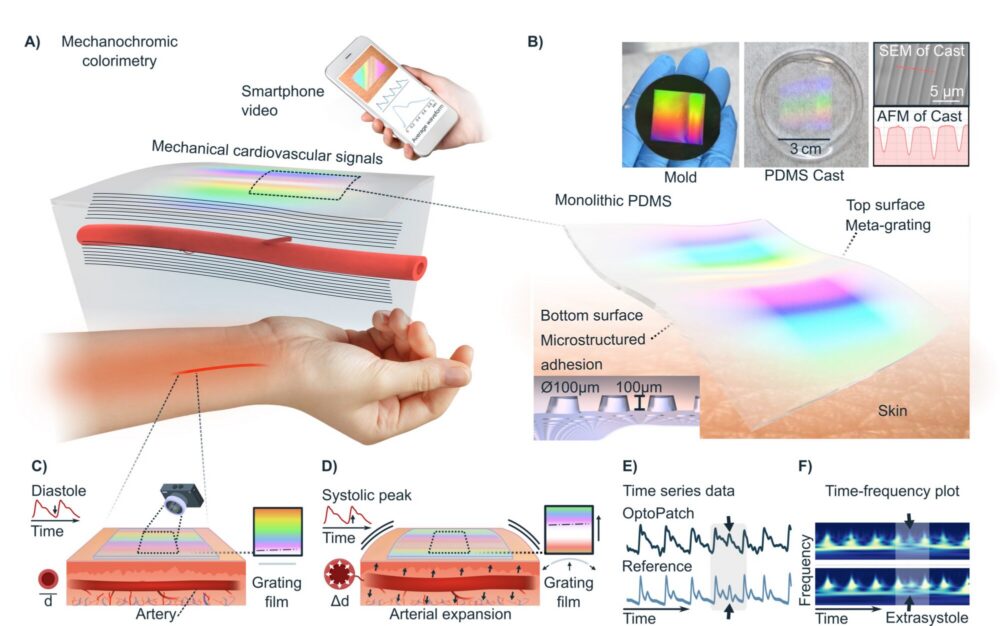
One side of the patch has a nanoscale pattern that changes colour when the material stretches. On the other side, researchers created a three-dimensional adhesive structure.
This structure is inspired by nature – specifically the suction cups of an octopus – allowing the patch to adhere firmly to the skin.
When pulse waves from the blood vessels cause the skin to move, the patch stretches. This leads to small but measurable changes in the colour of the nanostructured surface.
The colour changes can be detected directly using any camera (including a standard mobile phone camera) without the need for a spectrometer, laser, or other specialized equipment.
Not like a smartwatch
The device may look a bit like a smartwatch that measures heart rate, but the technology used is different. If you glance at the back of a smartwatch, you see green LED lights. These sensors are pressed onto the skin to detect changes in blood volume over time.
This is called optical monitoring.
“One drawback of smartwatch measurements is that they are strongly influenced by the amount of pigment in the skin,” says Xomalis.
Optical monitoring, as is found in smartwatches, simply performs less effectively on dark skin.
“Optical measurements are not equally accurate for all skin types. Naturally, this is a significant issue when it comes to equitable healthcare services,” says Xomalis.
The patch, however, relies on mechanical movements of the skin surface rather than how light is absorbed by the skin. In addition to measuring heart rate, the patch can also measure blood vessel stiffness.
The electronics and physics behind the project
“We know that blood vessels generally become stiffer with age. However, if you exercise a lot and have a really healthy lifestyle, you can maintain a relatively youthful vascular system. However, if you’re a heavy smoker, your blood vessels may appear biologically older,” says Torjus Lines Steffensen, a postdoctoral fellow in medical imaging at NTNU.
Stiff blood vessels can contribute to various types of cardiovascular disease. This type of information is difficult to obtain from the optical sensors used in devices like smartwatches.
“In short, we can extract more information using the patch,” says Steffensen.
Can replace advanced equipment
Measuring blood vessel stiffness, for example, currently requires advanced equipment involving electrodes attached to the skin of the chest, arms, and legs. These are connected by wires to an ECG machine. Many patients have likely also experienced having a glowing clip attached to their fingertip to measure pulse and oxygen saturation.
This is advanced equipment found in emergency rooms, ambulances, GP clinics, or hospitals.
“In Norway, this works fine. However, the challenge arises if you are in a remote location in Africa, or other parts of the world where specialized medical personnel and advanced equipment may be far away,” says Xomalis.
With the patch, healthcare workers essentially only need access to a smartphone, something a vast number of people around the world already own.
“What we are essentially doing is taking a lot of the complexity involved in these measurement systems and shifting it to the smartphone,” says Steffensen.
The researchers believe this technology could mark the beginning of a new generation of wearable health sensors that are inexpensive, require no external power source, and are easy to use. The patch is an innovation from NTNU and was designed, manufactured, and tested entirely at NTNU.
Here is how the patch is made:
The technology is based on a thin film of the elastic material PDMS (silicone rubber) featuring two specially designed surfaces. The researchers used large-scale nano-imprinting to produce the patch and investigated how the optical response changed under mechanical stress. The results showed that stretching the film by just two percent produced a nine percent change in colour intensity. This response remained stable over at least 1000 stress cycles. Furthermore, the biomimetic adhesive structure improved adhesion to the skin by 65 percent compared to a flat PDMS surface.
In trials involving thirteen volunteers, handheld mobile phones successfully recorded detailed pulse waveforms that matched clinical reference measurements very closely. In the study, the patch outperformed several established techniques, including traditional photoplethysmography, image-based PPG, and piezoelectric pulse sensors.
Source:
Steffensen TL, Stubberud V, Hennisen ES, Winogrocki ET, Lövgren J, Torvund AGS, Vestad H, Skjærvold NK, Steinert M, Xomalis A. Circuit-Free Cardiovascular Monitoring via Smartphone-Readable Skin-Interfaced Nanophotonic Films. Adv Mater. 2026 Aug 6:e74512. doi: 10.1002/adma.74512. Epub ahead of print. PMID: 42559738.