The turn of the 20th century has been referred to as the homosexual breakthrough in Europe. A recent study has analyzed literary texts in which Norwegian nature plays an important role in conveying this perspective.
Edvard Munch used materials that make his paintings vulnerable to the ravages of time. A new digital tool now shows how much The Scream may change over the next 300 years.
World-famous treasures crafted from walrus ivory are on their way to Norway, including chess pieces from the Isle of Lewis in Scotland. Were they originally from Norway? And why did the walrus trade disappear?
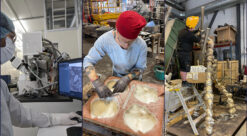
Trondheim’s Nidaros Cathedral is full of secrets, messages from the past written in stone. One researcher is now decoding these missives, half hidden in a very special spot in and around the most sacred place in the church.
A playful artist duo invited scientists to take part in a collaboration, and they were more than willing to oblige. This is how an intestinal bacterium from Bergen and a 1200-year-old wooden splinter became public art.
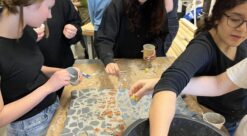
Recycling is the guiding principle behind the new Voldsløkka school and Culture Centre. Pupils are taking part in an art project as their contribution to the research project called ARV.
Are you getting fat from playing way too many computer games? If so, we have good news for you. The game of BitPet requires you to move around in order to do well.
As you walk around the city, nature “pops up” in unexpected places. Like a “lung tree” – a tree that breathes. The Nature in Your Face research project wants to use art to create engagement.
Can art that literally takes your breath away make you more climate friendly? You can find out yourself if you happen to be in Madrid, at the UN Climate Change Conference, COP 25.
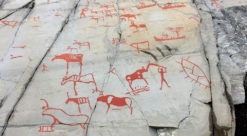
Regular protective treatment of rock carvings and paintings has done a good job protecting this important part of Norway’s cultural heritage. But according to the current schedule, the unique programme will end next year.
Church art from the Middle Ages reflects the dramatic societal changes that were underway during this period. Artists changed the way they depicted Christ from a regal figure with a crown of gold to a suffering Christ with a crown of thorns.
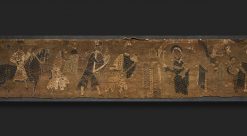
Norwegian churches in the Middle Ages were decorated with embroidered tapestries that told Bible stories almost like a comic series. The Høylandet tapestry is the only one of its kind that has survived the march of time.
A Madonna figure from Grong municipality is one of the best preserved and special church sculptures in Norway from the Middle Ages. She looks like a sweet, friendly girl who’s been asked to model for the sculpture.
One of Scandinavia’s finest collections of church art from the Middle Ages lay hidden and forgotten in Norwegian churches for centuries. Indeed, this long forgetting is precisely what preserved the unique church art.
Some people may have heard about the magical phenomenon of gand. When life seems to be against you or you’re plagued by one misfortune after another, you might jokingly say that you’ve been ‘ganda’ if you’re Norwegian. But what did gand really look like and why do we associate it with the Sami people?
The secrets of St Olav’s shrine and Nidaros Cathedral have drawn pilgrims for nearly a thousand years. Curious researchers have also made the journey, eager to solve the mysteries locked up in the cathedral’s stones.
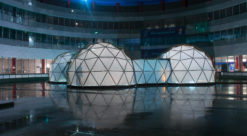
Imagine breathing polluted New Delhi air. It’s a scorching 40 degrees and the humidity is high. But you’re not in New Delhi – you’re in an art installation, during the Starmus festival in Trondheim in June.
2014 NOBEL PRIZE: Edvard and May-Britt Moser finished their Nobel lecture with a music video where NTNU music professors improvised over a Norwegian folk tune. The video was filmed in a dense fog where viewers see the faces of the musicians as they play.
Published
07.12.14
Privacy Policy
The Privacy Statement is about how this website collects and uses visitor information. The statement contains information that you are entitled to when collecting information from our website, and general information about how we treat personal data.The legal owner of the website is the processing officer for the processing of personal data. It is voluntary for those who visit the web sites to provide personal information regarding services such as receiving newsletters and using the sharing and tip services. The treatment basis is the consent of the individual, unless otherwise specified.
1. Web analytics and cookies (cookies)
As an important part of the effort to create a user-friendly website, we look at the user pattern of those who visit the site. To analyze the information, we use the Google Analytics analysis tool.Google Analytics uses cookies (small text files that the site stores on the user's computer), which registers the users' IP address and provides information about the individual user's online movements. Examples of what the statistics give us answers to are; how many people visit different pages, how long the visit lasts, what websites users come from and what browsers are used. None of the cookies allow us to link information about your use of the site to you as an individual.The information collected by Google Analytics is stored on Google servers in the U.S.. The information received is subject to the Google Privacy Policy.An IP address is defined as a personal information because it can be traced back to a particular hardware and thus to an individual. We use Google Analytics's tracking code to anonymize the IP address before the information is stored and processed by Google. Thus, the stored IP address can not be used to identify the individual user.
2. Search
If the webpage has search function, it stores information about what keywords users use in Google Analytics. The purpose of the storage is to improve our information service. The search usage pattern is stored in aggregate form. Only the keyword is saved and they can not be linked to other information about the users, such as the IP addresses.
3. Share / Tips service
The "Share with others" feature can be used to forward links to the site by email, or to share the content of social networking. Tips for tips are not logged with us, but only used to add the tips to the community. However, we can not guarantee that the online community does not log this information. All such services should therefore be used wisely. If you use the email feature, we only use the provided email addresses to resend the message without any form of storage.
4. Newsletter
The website can send out newsletters by email if you have registered to receive this. In order for us to be able to send e-mail, you must register an e-mail address. Mailchimp is the data processor for the newsletter. The e-mail address is stored in a separate database, not shared with others and deleted when you unsubscribe. The e-mail address will also be deleted if we receive feedback that it is not active.
5. Registration, form
The website may have a form for registration, contact form or other form. These forms are available to the public to perform the tasks they are supposed to do.Registration form is for visitors to sign up or register.Contact form is for visitors to easily send a message to the website's contact person.We ask for the name of the sender and contact information for this. Personal information we receive is not used for purposes other than responding to the inquiry.The form is sent as email via Mailgun as a third party solution. The entire submission will be stored at Mailgun for 24 hours. Between 24 hours and 30 days, only mailheader is stored before the submission is deleted after 30 days. The reason for this storage is to confirm whether emails are sent from the website and forwarded to the correct recipient.Once the email is received by the recipient, it is up to the recipient to determine the data processing needs of the email.
6. Page and service functionality
Cookies are used in the operation and presentation of data from websites. Such cookies may contain language code information for languages selected by the user. There may be cookies with information supporting the load balancing of the system, ensuring all users the best possible experience. For services that require login or search, cookies can be used to ensure that the service presents data to the right recipient.