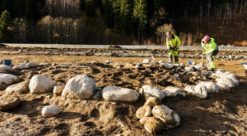
The secrets of St Olav’s shrine and Nidaros Cathedral have drawn pilgrims for nearly a thousand years. Curious researchers have also made the journey, eager to solve the mysteries locked up in the cathedral’s stones.
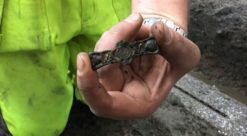
What was supposed to be a simple excavation to allow for the expansion of a church cemetery turned into a treasure trove of historic artefacts, including a decorative fitting from a book “imported” by Vikings from Ireland.
Computer games designed to make us more environmentally conscious need to be both entertaining and educational. Few game designers are good at both. NTNU researchers are creating a model that can bridge the gap between the two.
Hydrogen fuel cells can store and supply electricity, but are still developing as a technology. NTNU researchers are helping advance this approach to making the transition to environmentally friendly energy.
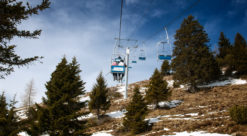
Trondheim: Norwegian researchers believe that it will be possible to make environmentally-friendly snow at above-zero temperatures. Now they have the backing of Europe and the skiing industry in their bid to save the sport from climate change.
They live side by side with the Maasai people and maintain a culture where rituals and music play an important role. The Sonjo people’s harvest ceremony is their most central ritual.
Children who experience social exclusion in preschool are at greater risk of becoming so-called “school losers”. Researchers at NTNU Social Research are studying what happens to children who are marginalized.
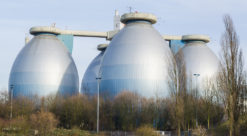
Plastic trash is a rapidly growing environmental problem. But a biodegradable and natural material could replace plastic packaging and eliminate this problem.
“Customer journeys” have become a popular method to increase customer focus and improve service quality in many branches of industry. But research shows that the method doesn’t always work as expected – and confusion surrounds the meaning of the concept itself.
The 1969 discovery of oil at the Ekofisk field in the North Sea transformed Norway into an internationally important energy nation. But long before black gold was being pumped from the Norwegian Continental Shelf, Norway’s economy was fuelled by a different kind of energy: hydropower.
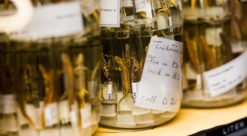
DNA analysis allows new species to be described all the time. Researcher Xiaolong Lin has recently published a description of eight new non-biting midge species, but has found many more.
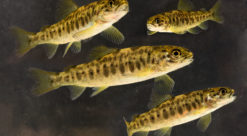
The condition of the water in salmon hatcheries can tell us a great deal about when and why outbreaks of disease occur. Now, SINTEF researchers are about to expose the water’s secrets, both to prevent suffering in fish and to save the aquaculture industry a great deal of money.
A Norwegian-Swiss research team has succeeded in growing cartilage tissue cells using algae. Moreover, the new cells can reduce joint inflammation. This news gives hope for people suffering from arthrosis, also known as osteoarthritis.
Most people who have been unfaithful do not believe it when their partner says they forgive them. And the fact that men often don’t realize that emotional infidelity is a problem just feeds the conflict.
The Privacy Statement is about how this website collects and uses visitor information. The statement contains information that you are entitled to when collecting information from our website, and general information about how we treat personal data.The legal owner of the website is the processing officer for the processing of personal data. It is voluntary for those who visit the web sites to provide personal information regarding services such as receiving newsletters and using the sharing and tip services. The treatment basis is the consent of the individual, unless otherwise specified.
1. Web analytics and cookies (cookies)
As an important part of the effort to create a user-friendly website, we look at the user pattern of those who visit the site. To analyze the information, we use the Google Analytics analysis tool.Google Analytics uses cookies (small text files that the site stores on the user's computer), which registers the users' IP address and provides information about the individual user's online movements. Examples of what the statistics give us answers to are; how many people visit different pages, how long the visit lasts, what websites users come from and what browsers are used. None of the cookies allow us to link information about your use of the site to you as an individual.The information collected by Google Analytics is stored on Google servers in the U.S.. The information received is subject to the Google Privacy Policy.An IP address is defined as a personal information because it can be traced back to a particular hardware and thus to an individual. We use Google Analytics's tracking code to anonymize the IP address before the information is stored and processed by Google. Thus, the stored IP address can not be used to identify the individual user.
2. Search
If the webpage has search function, it stores information about what keywords users use in Google Analytics. The purpose of the storage is to improve our information service. The search usage pattern is stored in aggregate form. Only the keyword is saved and they can not be linked to other information about the users, such as the IP addresses.
3. Share / Tips service
The "Share with others" feature can be used to forward links to the site by email, or to share the content of social networking. Tips for tips are not logged with us, but only used to add the tips to the community. However, we can not guarantee that the online community does not log this information. All such services should therefore be used wisely. If you use the email feature, we only use the provided email addresses to resend the message without any form of storage.
4. Newsletter
The website can send out newsletters by email if you have registered to receive this. In order for us to be able to send e-mail, you must register an e-mail address. Mailchimp is the data processor for the newsletter. The e-mail address is stored in a separate database, not shared with others and deleted when you unsubscribe. The e-mail address will also be deleted if we receive feedback that it is not active.
5. Registration, form
The website may have a form for registration, contact form or other form. These forms are available to the public to perform the tasks they are supposed to do.Registration form is for visitors to sign up or register.Contact form is for visitors to easily send a message to the website's contact person.We ask for the name of the sender and contact information for this. Personal information we receive is not used for purposes other than responding to the inquiry.The form is sent as email via Mailgun as a third party solution. The entire submission will be stored at Mailgun for 24 hours. Between 24 hours and 30 days, only mailheader is stored before the submission is deleted after 30 days. The reason for this storage is to confirm whether emails are sent from the website and forwarded to the correct recipient.Once the email is received by the recipient, it is up to the recipient to determine the data processing needs of the email.
6. Page and service functionality
Cookies are used in the operation and presentation of data from websites. Such cookies may contain language code information for languages selected by the user. There may be cookies with information supporting the load balancing of the system, ensuring all users the best possible experience. For services that require login or search, cookies can be used to ensure that the service presents data to the right recipient.