Sustainability and animal welfare concern young people the most
What are people’s attitudes towards food, sustainability, new foods and food additives? Researchers have found some answers.


What are people’s attitudes towards food, sustainability, new foods and food additives? Researchers have found some answers.

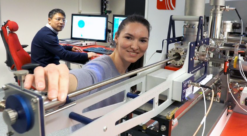
New research on semiconductors using microscopes that provide 3-D models at an atomic level could one day have an impact on your electronic gadgets.
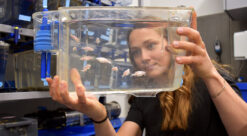
Which organisms survive and which succumb when the climate changes? A small larval fish is providing surprising insight into how the brain reacts when the temperature rises.

The interplay between mercury and manganese in Arctic seawater may explain a surprising drop researchers found in mercury levels in the Barents Sea during the winter.

Combining ultrasound and bubbles helps medicines pass through the protective blood-brain barrier and is giving hope for improved treatment of several diseases.

The prevailing belief by researchers has been that mothers of twins are more fertile than other women. But a new study shows that isn’t the case.

NTNU biology and cybernetics researchers have built a robot that allows them to sample everything from microplastic to salmon lice densities.
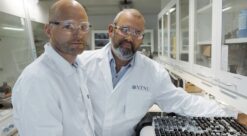
Researchers are creating molecules that can slow down the development of osteoporosis, cancer and inflammation. Foreign investors are interested.
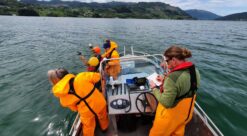
Researchers at NINA, the Norwegian Institute for Nature Research, and NTNU have developed a new method for monitoring salmon lice larvae along the coast. The lice trap is now being tested in the Hardangerfjord.
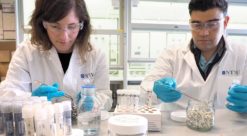
Chemists behave like detectives as they examine sludge from sewage systems. They hope to contribute to better sludge recycling by identifying the contaminants and toxic substances it contains.

NTNU researchers from AMOS, the Centre for Autonomous Marine Operations and Systems, used small satellites and subsea robots — and everything in between — to study marine life in Svalbard’s Kongsfjorden in a first-ever experiment in May.
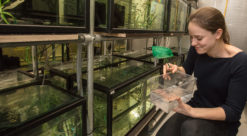
An animal’s ability to adapt to its environment is clearly key to its survival, but does that ability come at a physiological cost? A clever experiment with laboratory zebrafish and their wild relatives suggests it does.

Light and molecules behave in very special ways in optical cavities. Don’t think this is important to you? It may be soon.
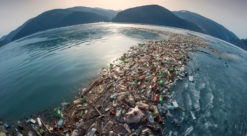
Capping production of new plastics will help cut their release to the environment — and brings other benefits, from boosting the value of plastics to helping tackle climate change.
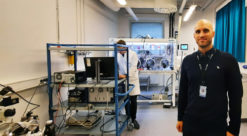
Driving range is often a deciding factor when consumers choose an electric car. Lithium-ion batteries are reaching their ability to store energy, which has researchers exploring new alternatives — including solid-state batteries.
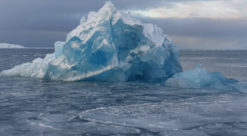
What researchers are learning about the fate of chemicals in the Arctic, and how what they’re learning is changing international law and providing life-saving advice.

How the unlikely combination of WWII Germany, a modest English engineer who created a worker’s paradise, an ambitious industrialist prosecuted as a traitor and a hardworking PhD helped build modern Norway, one aluminium ingot at a time.
Norwegian industry is shifting towards a greener future. But what does the transition to a greener economy really mean for industry and for consumers?
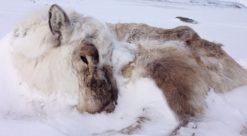
Hunting or other wildlife regulations can make a population more viable – if done correctly.
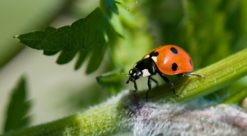
Ladybird beetles are probably among the most popular insects we have. Did you know that Norway has some 50 different species – plus some unwelcome guests?
Covering glass microscope slides in tiny, nano-sized pillars can mimic a cell’s natural environment – and could help biologists understand how cells act inside the human body.

Little research has been done on how nano- and microplastics affect children. Researchers are surveying what we actually know and offer some useful tips to parents.
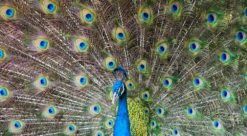
Dye pigments are often toxic, so researchers around the world have long been looking for effective ways to make non-toxic, recyclable and sustainable colours instead. The answer lies in nanotechnology and nature’s own methods.
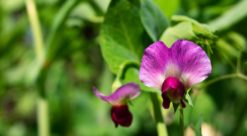
When temperatures rise, it affects the plants that agriculture and we depend on. Now we know more about how plants resist drought.