The Norwegian research organisation SINTEF will investigate whether rare earth element minerals contribute to pollution in costal areas. Research scientists from Norway, Denmark and Germany are taking part in the project.
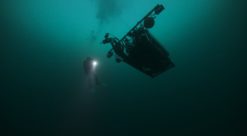
The launch of a new research centre for robotics will provide increased knowledge about the sea with the help of underwater drones and robots. This could impact Norway’s international role as a major power at sea, says centre director.
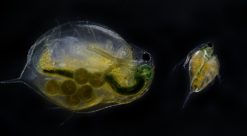
Dopamine can trigger feelings of happiness in humans. Water fleas that are exposed to dopamine-regulating substances apparently gain several advantages.
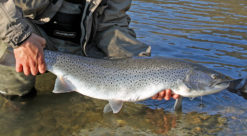
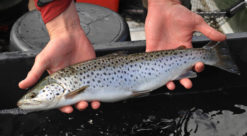
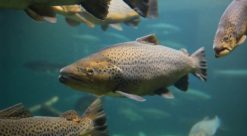
Sea trout numbers are declining in Norway and scientists don’t know why. They have studied the trout in two rivers in northern Norway’s Nordland county. Soon, sea trout along the entire Norwegian coast will be investigated.
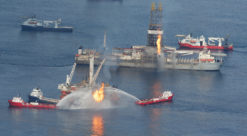
Ten years ago, the Deepwater Horizon accident in the Gulf of Mexico killed eleven men and resulted in the largest accidental oil spill in history. Years of investigations concluded that the drilling crew missed critical warning signals that would have stopped the problem. A new analysis suggests that wasn’t the case.
Low oil prices have fueled the debate about which industries Norway should develop and live on in the future. In the government’s revised national budget, the extraction of seabed minerals emerges as a clear investment area.
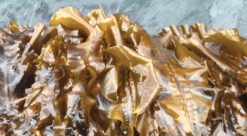
A unanimous group of research scientists are convinced that kelp may share many of the applications of soya and oil, and that they can also be used to capture CO2. Seaweeds can contribute towards climate-friendly solutions in all sorts of contexts. New know-how about seaweed farming is currently accelerating industrialisation of the sector.
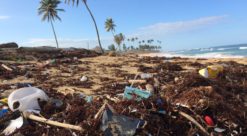
Researchers believe that plastic refuse can be used as fuel in cement factories in Asia. If this works, it may provide a solution to two of the planet’s biggest environmental problems – plastic in the oceans and high levels of coal consumption.
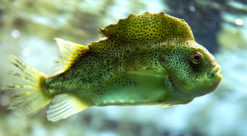
Research shows that even fish farmers have doubts as to whether using cleaner fish is an effective delousing method. “Fish farmers tell us that they want a ban on the use of certain species. They’re also very critical of wild-caught cleaner fish being transported,” says researcher Kristine Størkersen. She is one of the scientists who have been helping the Norwegian Food Safety Authority gain an overview of the situation.
The coastline of Norway is peppered with more than a thousand oil wells, most of which will be plugged once they’re no longer profitable. They have to be monitored in case they leak — but keeping an eye on them isn’t easy. A new company offers a different approach that could help.
Sea trout populations have declined sharply. Researchers have studied the life of sea trout by means of acoustic telemetry tags and listening stations. Now they know more about what we need to do to protect the sea trout population.
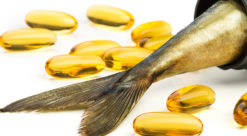
Omega-3 fatty acids are essential components of healthy diets for both humans and fish. The dramatic increase in fish farming worldwide has boosted the demand for omega-3 fatty acids so much that today’s supply can’t meet demand. Reducing waste and finding new sources can help.
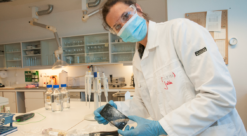
Every time you wash clothes, you are releasing microplastics into the sea, but we know little about the amount and distribution of such material from different types of textile. Research scientists are now working on measuring and capturing microplastics in our laundry.
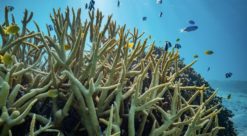
Several high-profile studies report that ocean acidification will affect coral reef fish behaviour enough to jeopardize their survival. One research team looked more deeply at this assertion — and found it is simply not true.
By now it’s well established that microplastics are a problem in the environment, even in the remotest parts of the planet. But where do different microplastics come from and how they get there, especially in the Arctic?
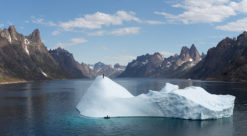
The Arctic’s once impenetrable ice cap is melting away, with profound consequences for everything from ocean circulation patterns to fish numbers and diversity. The Nansen Legacy Project, including NTNU biologists, chemists and engineers, is working to better understand what these changes mean for the Barents Sea and the Arctic Basin
NTNU researchers are delving deep to investigate the seabed and opportunities for deep sea mining to extract precious metals that lie several thousand metres deep.
The Privacy Statement is about how this website collects and uses visitor information. The statement contains information that you are entitled to when collecting information from our website, and general information about how we treat personal data.The legal owner of the website is the processing officer for the processing of personal data. It is voluntary for those who visit the web sites to provide personal information regarding services such as receiving newsletters and using the sharing and tip services. The treatment basis is the consent of the individual, unless otherwise specified.
1. Web analytics and cookies (cookies)
As an important part of the effort to create a user-friendly website, we look at the user pattern of those who visit the site. To analyze the information, we use the Google Analytics analysis tool.Google Analytics uses cookies (small text files that the site stores on the user's computer), which registers the users' IP address and provides information about the individual user's online movements. Examples of what the statistics give us answers to are; how many people visit different pages, how long the visit lasts, what websites users come from and what browsers are used. None of the cookies allow us to link information about your use of the site to you as an individual.The information collected by Google Analytics is stored on Google servers in the U.S.. The information received is subject to the Google Privacy Policy.An IP address is defined as a personal information because it can be traced back to a particular hardware and thus to an individual. We use Google Analytics's tracking code to anonymize the IP address before the information is stored and processed by Google. Thus, the stored IP address can not be used to identify the individual user.
2. Search
If the webpage has search function, it stores information about what keywords users use in Google Analytics. The purpose of the storage is to improve our information service. The search usage pattern is stored in aggregate form. Only the keyword is saved and they can not be linked to other information about the users, such as the IP addresses.
3. Share / Tips service
The "Share with others" feature can be used to forward links to the site by email, or to share the content of social networking. Tips for tips are not logged with us, but only used to add the tips to the community. However, we can not guarantee that the online community does not log this information. All such services should therefore be used wisely. If you use the email feature, we only use the provided email addresses to resend the message without any form of storage.
4. Newsletter
The website can send out newsletters by email if you have registered to receive this. In order for us to be able to send e-mail, you must register an e-mail address. Mailchimp is the data processor for the newsletter. The e-mail address is stored in a separate database, not shared with others and deleted when you unsubscribe. The e-mail address will also be deleted if we receive feedback that it is not active.
5. Registration, form
The website may have a form for registration, contact form or other form. These forms are available to the public to perform the tasks they are supposed to do.Registration form is for visitors to sign up or register.Contact form is for visitors to easily send a message to the website's contact person.We ask for the name of the sender and contact information for this. Personal information we receive is not used for purposes other than responding to the inquiry.The form is sent as email via Mailgun as a third party solution. The entire submission will be stored at Mailgun for 24 hours. Between 24 hours and 30 days, only mailheader is stored before the submission is deleted after 30 days. The reason for this storage is to confirm whether emails are sent from the website and forwarded to the correct recipient.Once the email is received by the recipient, it is up to the recipient to determine the data processing needs of the email.
6. Page and service functionality
Cookies are used in the operation and presentation of data from websites. Such cookies may contain language code information for languages selected by the user. There may be cookies with information supporting the load balancing of the system, ensuring all users the best possible experience. For services that require login or search, cookies can be used to ensure that the service presents data to the right recipient.